Spencer Airship

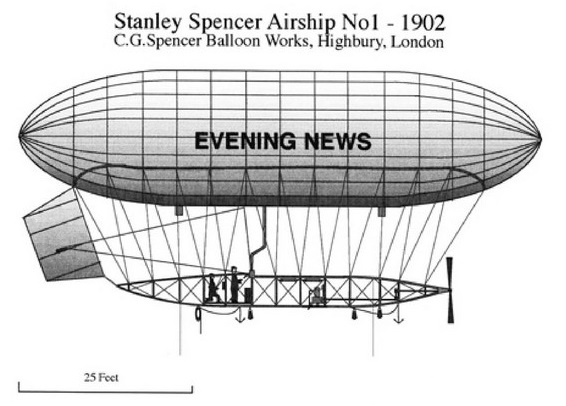
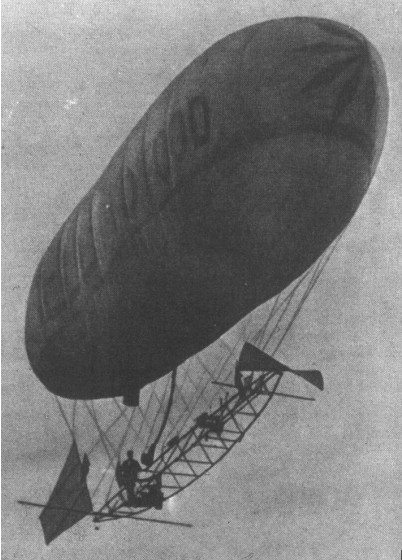
Stanley Spencer, with his brothers, ran a balloon factory at Highbury in North London. In 1902 they built a small 20,000 cu.ft capacity airship constructed along the lines of the Santos-Dumont craft.

The first successful navigable flight in Great Britain of a manned, powered aircraft took place on 22 September 1902, when Stanley Spencer piloting his airship No.1 flew from Crystal Palace via St Pauls to Eastcote Middlesex, a distance of 28 miles, in 94 minutes. It was intended to fly from Crystal Palace, round to St Paul’s and return to the starting point but contrary winds caused the airship to be driven to the north-west.

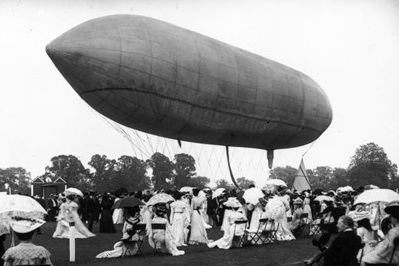
A Spencer Airship ascending at Ranelagh, watched by a fashionable crowd, 1903

Spencer Airship No.1 1902
Capacity: 20,000 cu.ft
Gross lift: 0.580 ton
Disposable lift: 600 lb
Engine: 1 x JAP water cooled single cylinder, 3 hp
Speed: 20 mph
Crew: 1-2

Spencer, Stanley

Stanley Spencer, with his brothers, ran a balloon factory at Highbury in North London. In 1902 they built a small 20,000 cu.ft capacity airship constructed along the lines of the Santos-Dumont craft.

The first successful navigable flight in Great Britain of a manned, powered aircraft took place on 22 September 1902, when Stanley Spencer piloting his airship No.1 flew from Crystal Palace via St Pauls to Eastcote Middlesex, a distance of 28 miles, in 94 minutes.

Spencer built a series of airships, but more powerful, similar to the No.1, up to the outbreak of the war. Finance was in part by the use of advertising slogans on the envelopes: Boveril being one of the companies that utilised this advertising medium.

Stanley Spencer died from malaria in 1904.

Spainhour 1912 monoplane

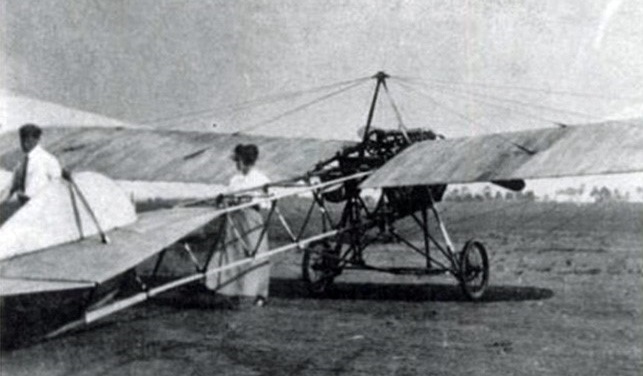
The monoplane of James S. Spainhour, of Pittsburgh, PA, had an unusual device for securing lateral control. The wings did not warp, or only very slightly. They were fixed to the fuselage by a floating bridge, and the angle of incidence of the whole of each wing could be altered by the movement of a pedal, one for each plane. When the angle of incidence of both the wings is increased the machine pitched up. The machine weighed 497 pounds, had a triangular fuselage and a span of 34 feet 5 inches. It was powered by a 40 hp four-cylinder Kowalsky engine, which had a self-starting crank. Spainhour made several short flights near Pittsburgh on a six-acre field, and moved to Mineola, Long Island, to get more room.

It apparently reached 1000′ high at speed of 50 mph

SPAD / Societe Provisoire des Aeroplanes Deperdussin

Societe Provisoire des Aeroplanes Deperdussin
Societe Parisienne des Avions Deperdussin
Societe des Productions Armand Deperdussin
Societe Pour Aviation et ses Derivees

Silk merchant Armand Deperdussin (1867-1924) was associated from 1910 with a series of notable monoplanes. Built precursor in 1909 for show in a Paris store.

By 1914 monoplanes bearing Deperdussin name were used not only privately but by several military authorities. Designed by Louis Bechereau, these aircraft were especially noted for speed performances in 1912-1913, and in some instances for monocoque construction. Deperdussin, a great promoter, became involved in financial difficulties and in 1915 the company was declared bankrupt.

In 1913 Deperdussin was arrested for embezzlement and the company was taken over by Louis Bleriot and renamed Societe Pour I’Aviation et ses Derives in 1915, thus retaining these initials. Chief technician was at first Bechereau, later Andre Herbemont.

The Deperdussin name had links with several companies, including the British Deperdussin Company with which John Porte was connected. Initials SPAD were also ascribed to Societe Provisoire des Aeroplanes Deperdussin and Societe Parisienne des Avions Deperdussin, as well as Societe des Productions Armand Deperdussin.

Company became world famous for SPAD single-seat fighters and fast reconnaissance adaptations. More than 2,000 fighters built at Suresnes factory alone; great numbers under license in France and elsewhere. Classic tractor single-seat biplane flown late 1915 as SPAD V; developed into SPAD VII of 1916, thus establishing company’s name in aviation history. Characteristic design feature was two-bay wing cellule with special form of bracing. Combination with Hispano-Suiza 8-cylinder vee engine was major factor in success. SPAD XII had a 37 mm engine-mounted gun. From May 1917 improved two machine-gun type XIII replaced VII. Large numbers ordered by U.S. SPAD XX of late 1918 was two-seat fighter to Herbemont design and precursor of new Bleriot-SPAD line of single-strut monocoque-fuselage biplane fighters, built after Bleriot took over SPAD company in 1921 SPAD became Bleriot-SPAD.
Šoštarko Monoplane

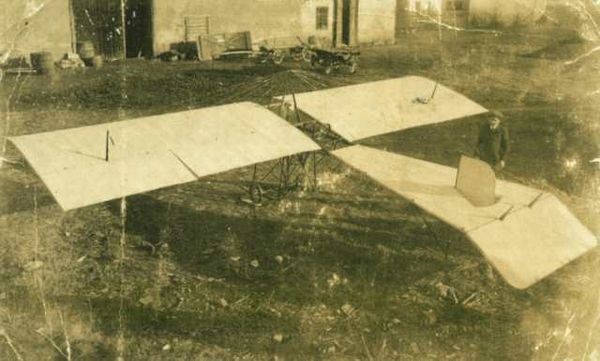
1911-12 monoplane of Austro-Hungarian/Croatian origin built by Slavoljub Šoštarko in Zagreb (Agram), Croatia – then part of the Austro-Hungarian Empire. Šoštarko was probably an automobile racer who crossed over to airplane design and flying, but when his monoplane was exhibited in Zagreb in 1912, it was destroyed during his very first attempt at flight. There is no evidence that Šoštarko flew after this. As one of a few others who were experimenting right next to the sheds of Mihajlo Mercep at the gates of Zagreb, to be expected, the Šoštarko monoplane shows some resemblance to the Mercep Rusjan-Novak monoplanes; i.e. wing-posts, tail assembly with rudder running through the stabilizer, etc.

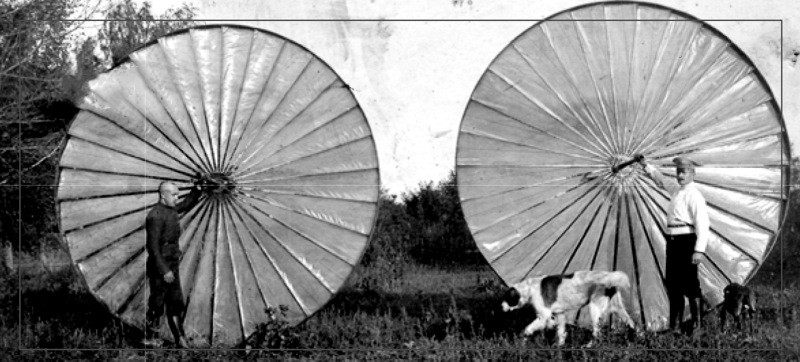
Sorikin 1909-1914 helicopter

Most writers state that Sorikin failed to build a working (or complete) machine in St. Petersburg, mainly because of a low power engine. On the eve of WW1 Sorokin completed his (modified) helicopter design in his home place at Novgorod-Seversky (Ukraine) [Новгород–Северски] after a long development during 1911-1914. It is stated that the machine was tested and actually flew. The construction was based on the two rotors and a tractor propeller. There were rudders to steer the machine.

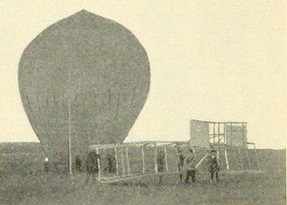
Sorenson 1909 Glider

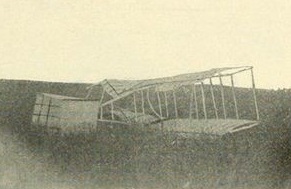
A hot-air balloon-launched glider built and flown by U. Sorenson of Berwyn, Nebraska, specially constructed with warping wings for balance. Its first and only flight was less than successful as the left wing broke and the machine came spinning down at 100 rpm. Sorenson was not killed.

After the accident

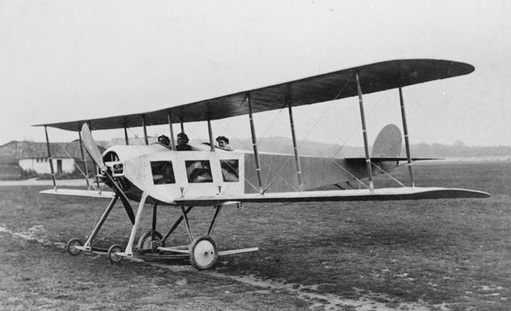
Sopwith Three-Seater / D1

A three-seat general purpose biplane, the Three-Seater / D1 set a number of British altitude records in June and July 1913, in the hands of the by then Sopwith Chief Test Pilot, “Harry” Hawker. Of these the highest reached was 12,900 feet with one passenger. The Three-Seater could carry a 450 lb payload at 70 mph.

At least seven of these machines were known to have been operated by the naval wing of the RFC.

Type D

Engine: Gnome, 80 hp
Span: 40′
Length: 29’6″
Weight: 1060/1810 lb
Speed range: 40-75 mph