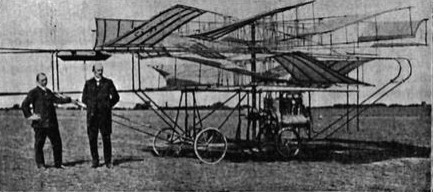
A complicated helicopter with two contrarotating fabric-covered rotors of eight and six blades, built by F. Sternemann and Dr.ing. W. Siebert of Hamburg, Germany, in 1910 and tested at the Wandsbecker Exerzierplatz.
A complicated helicopter with two contrarotating fabric-covered rotors of eight and six blades, built by F. Sternemann and Dr.ing. W. Siebert of Hamburg, Germany, in 1910 and tested at the Wandsbecker Exerzierplatz.
USA
William Starling Burgess was yacht and boat builder. Made an aeroplane 1909/10. Built Wright biplanes under license as Burgess-Wright. Also developed twin-engined type, tractor type and flying-boat. From 1913 under license from Britain’s J. W. Dunne, made Burgess-Dunne tailless floatplanes, Burgess developing the single main float. Two such seaplanes bought by U.S. Navy 1916, and one used for gunnery trials. Navy also bought tractor floatplanes and U.K. bought 36 landplanes developed by the Burgess company.
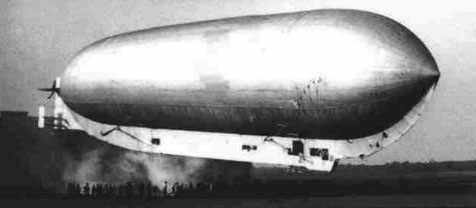
A rigid airship designed by Albert Paul Veeh, who was from Düsseldorf, Germany. It was built by the “Luftschiffbau Veeh GmbH”, a company that Veeh had set up in 1910, and which changed it’s name to “Deutsche Luftschiffwerft GmbH” in 1911. Veeh had patented his ideas for a semi-rigid airship, which featured a solid keel hull structure running the full length of the airship, and which incorporated the passengers, the motors, and fuel. His design allowed easy dis-assembly of the entire airship. Although several test runs were quite promising in nature, later tests proved problematic and Veeh eventually lost interest and financial support for his venture. The first proper test flight took place on 11 July 1912, “Flight” reports further flights during 1913 and 1914. Veeh himself died in 1914, apparently broken by the project.
The Stadlman Exhibition Biplane was designed by Chance Vought and built circa 1913. A single-place, open cockpit biplane, it was destroyed in a crash in Lake Michigan in 1914.
Engine: 90hp Curtiss OX
Max speed: 80 mph
Stall: 35 mpg
Seats: 1
Anthony Stadlman & J E Roth
Chicago IL.
USA
Built an Exhibition Biplane circa 1913.
Little is known of a 1910 Triplane built in the USA by Stadtler. Three wings were forward, three wings aft, the span for all being 25’0″. The length was 40’0″. Twin chain-driven pusher props had “variable pitch.”
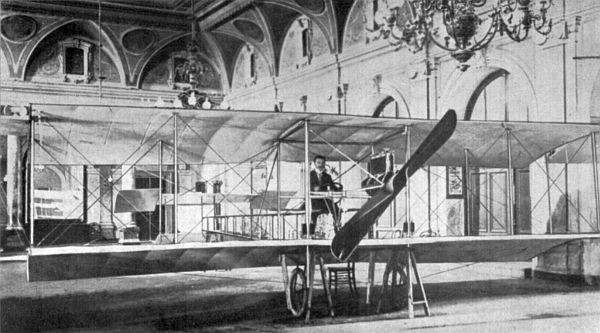
The first design of brothers Franz and Josef Spiller in Graz, Austria. It was exhibited in Graz in June 1910 before tests on the Graz flying field Thalerhof. The engine was a 50 hp Austro-Daimler automobile motor similar with that which Etrich also had no joy in Spring 1910 (before Ferdinand Porsche designed an aero engine of it). The Spillers later that year changed to a Puch aero engine, also built in Graz. Details of their achievements are almost undocumented, but they were experimenting at Thalerhof at least until 1912, with more or less success.
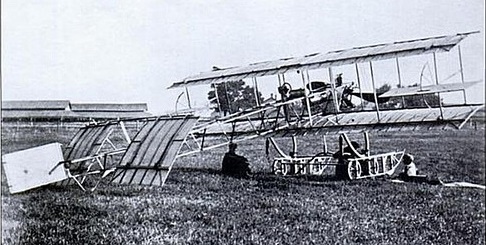
Lawrence Sperry first became interested in aviation after seeing Henri Farman make a short flight in Brooklyn in 1908. In the summer of 1910, at age 17, he built an aircraft from an original design on the second floor of his parents’ house in Flatbush.
First flown as a glider, a 60 hp Anzani engine was then procured and the aircraft was successfully flown at the Sheepshead Bay racetrack. Certainly one of the first tractor biplanes constructed in the United States, it was equipped with an unusual multi-wheeled lattice skid undercarriage meant to help the aircraft operate from rough terrain.
Percival Hopkins “Spence” Spencer convinced his father to invest in the wreckage of a Curtiss F. At age 17 he rebuilt and modified it as flying boat.
On 12 April 1911 he not only took his creation on its first flight but on his own solo flight. Unskilled in turning the plane, he flew for five miles, landed on a river, and pushed it around for the return flight.
Spencer was still actively flying in 1987 at age 90.
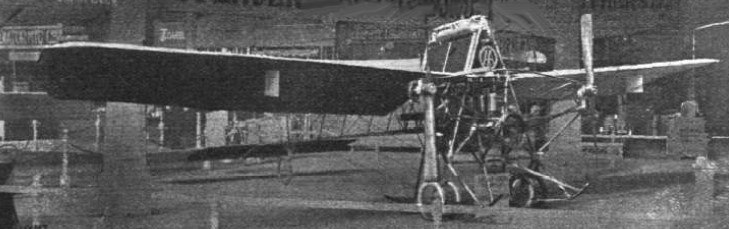
A tractor monoplane built by C. G. Spencer and Sons and displayed at the 1910 Aero Show at Olympia. It was designed by Herbert Spencer and W. Stirling, powered by a four-cylinder 40 hp British Aeroplane Syndicate R.H. engine, which drove by chains two propellers of 6 ft. 6 ins. diameter mounted on the leading-edges of the wings. A reverse gear was incorporated in one propeller bracket for opposite rotation. The fuselage was of the “A”-frame type. The machine was tested at Brooklands, but it was not successful and it was soon abandoned.
 All Aero