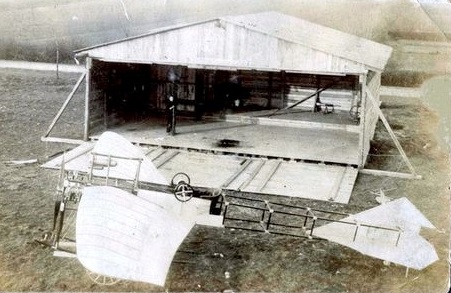
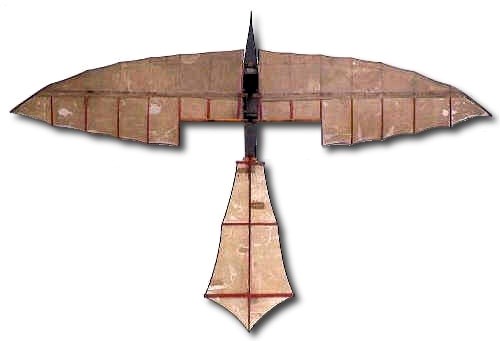
Joseph Suwelack built this airplane after he had managed to acquire a motor in Dresden. On 12 March 1910, Josef Suwelack continued his flight tests in Dornau with the new flying machine, a monoplane, with 8.8 m span and a length of 8.9 m. This machine was powered by a 36 HP engine and had weight with pilot 300 kg. Before departure, the machine was placed on a 18 m long rail track, and by a rope with a 600 kg weight in the 8 m high tower was connected. Because of the falling weight of the apparatus was moved over the rails and obtained by the gravity of the weight of the necessary airspeed.
Inspired by the experiments of Graf von Zeppelin, Heinrich Suter of Arbon, Switzerland, built an airship of 40 metres length. The Paris-made, cigar-shaped, 5-chamber envelope had a reported volume of 1000 m³. The movements of the LTA/HTA craft were carried out by propellers, while the balloon was used only to lift the machine and aeronaut. On a wooden pole under the balloon hung by a ball joint, was the actual flying machine, which enabled a free, independent movement of the two parts. Suter’s connection of a balloon with a flying machine was based on the principles of Ingenieur Kreß of Vienna. In Gustav Adolf Saurer, the founder of the “Ersten Schweizerischen Velociped-Fabrik Arbon”, Suter found the perfect construction partner. Inside the metal structure that connected to the ball joint, he built a velo-drive. Pedals drove outside of the “cage”, mounted and by hand, a pivotable double propeller. In this way, Suter believed to be able to control the occurrence of different air currents, while the position of the steering sail could also be altered manually. On April 19, 1901, from the purpose-built shed at the Hotel “du Lac” the inflated airship was pulled to the shore of Lake Constance. Many curious onlookers as well as journalists were in attendance to witness the spectacular event. At first everything went according to plan – Suter increased the pressure on the pedals and circled the steerable airship over Steinacherbucht bay. Suddenly the wind shifted, and at low altitude drove it into the branches of a tree on the Steinach shore, ending the maiden voyage. As for Suter, he lacked the funds to conduct further tests and the project was terminated shortly thereafter.
Noel Pemberton-Billing, a wealthy yacht-broker, gun-runner and aircraft manufacturer (he established the Supermarine company, described as ‘tall, slick, monocled and iron-jawed’ by contemporary society columnists, learned to fly in 24 hours to win a £500 wager with Frederick Handley Page and subsequently served with the Royal Naval Air Service, from which his ‘tem¬pestuous temperament’ earned him an early retirement, though not before he had helped to organize the first aerial attack on the Zeppelin sheds on Lake Constance.
Noel Pemberton Billing began aeronautical experiments in 1908 with a primitive monoplane. Acquiring a factory at Woolston, Southampton, in 1913, he began to design and build marine aircraft, his P.B.1 biplane flying-boat being exhibited at the 1914 Olympia Show, but not flown.
Pemberton-Billing Ltd registered June 1914.
At outbreak of First World War in 1914 designed, built and flew P.B.9 single-seat scout biplane in nine days. The P.B.29E night patrol quadruplane of 1915, built in seven weeks from beginning of design, paved the way for the improved version, the 1915 P.B.31E Nighthawk anti-airship fighter with many ingenious features, including searchlight and recoilless gun. By the time this had flown the company had been renamed Supermarine Aviation Works.
Other designs were a twin-float seaplane and Baby single-seat fighter flying-boat, the latter flying in February 1918. Company’s postwar Schneider Trophy Sea Lion racing flying-boats were developed from Baby, but advanced S.4 racer of 1925 was a twin-float seaplane, though still of wooden construction. The S.5 and S.6 seaplanes, which followed, were renowned for racewinning and record-breaking, but especially as forerunners of Second World War Spitfire, designed by Reginald Mitchell (1895-1937), who had joined company in 1916. Well-known maritime aircraft included the Admiralty (AD) type built by Supermarine (and Pemberton-Billing) in First World War, and Seal/Seagull/Scarab/Sheldrake series developed during 1920s and 1930s. When the company was absorbed by Vickers in 1928 it was already famous for large multi-engined flying-boats, particularly Southampton, distinguished in RAF service from 1925, especially for long cruises.
Supermarine became Vicker-Supermarine in 1929.
Successors were much-refined Scapa of 1932 and Stranraer of 1935, and the Walrus and Sea Otter earned their place in FAA history during Second World War. The Supermarine Spitfire first flew March5, 1936. Well over 20,000 were built by various makers. Basic change came when the Rolls-Royce was replaced by the Griffon engine. Seafire was naval development (over 2,500 built). Spiteful and Seafang were late piston-engined types with new wing, from which the jet-propelled Attacker was developed to enter service in 1951. Swept-wing Swift was unsuccessful as fighter, and twin-jet Scimitar of 1958 concluded fighter line.
Maximillian Stupar was born on Sept. 23, 1885 in Metlika, Slovenia, where he learned the delights of flying kites. Even after his parents uprooted Max from the empire of the Hapsburgs to South Chicago, that joy never left him. He followd the exploits of Octave Chanute, another transplanted European (from France) who had found a home in Chicago and had developed an interest in kites.
Max was inspired by Chanute’s building on the landmark glider experiments of Otto Lilienthal, a German, to write Progress in Flying Machies (1894). This book was the bible of aeronautics. Max’s book, some glider experiments he attempted in the dunes of Indiana, Miller Beach, during 1896, and in Dune park during 1897, provided the design for the Wright brothers’ first airplane.
But while Chanute and the Wright brothers were becoming aeronautical icons, Max managed to elude celebrity. In 1902, as the Wright brothers also experimented with gliders, Max began his own experiments. Instead of taking off from the dunes of Kitty Hawk, Max leaped from the tops of houses, barns, low hills, and slopes of South Chicago.
Max Stupar, atop of a Baltimore Avenue building, prepares to launch himself in one of the gliders he built circa 1908.
His gliders sometimes reached the awe-inspiring altitude of 300 feet. Some neighbors demanded the kid be given a saliva test. Then, like Octave Chanute, Max moved his experiments to the sands of Dune park, which led in 1908, to his construction of his first airplane. The plane cracked up before Max could test it properly.
Undeterred, Max patterned a plane after the one Louis Bleriot had used to fly the English Channel. He made a test flight to Milwaukee, lifting the hydroplane from the waters of Sandy Beach at 95th and the Big Lake the following year. That plane also had a short life, ignominiously plowing into Chicago’s first airfield, Cicero Field at 22nd and Cicero.
In 1910, he opened the Stupar Aero Works in South Chicago, then sold it in 1912 to the Chicago Aero Works for a one-third ownership, and a position as chief engineer. Between 1912 and 1916, Chicago Aero built 30 airplanes and introduced the Stupar Tractor Biplane, the first biplane to use an enclosed fuselage and tractor propellor.
With a glowing resume that proclaimed Max an aviation pioneer, he left South Chicago, in 1916, to join the Standard Airport Corporation in New Jersey.
With America’s entry into World War I Max returned to Chicago as a member of the inspection service for the new U.S. Air Service, and then went to Buffalo, and finally Washington, D.C., as assistant chief of wood inspection for airplane construction.
Throughout the war, and until 1922, airplanes were made almost exclusively of wood, the so-called “stick and wire” construction. Max knew more about that than just about anybody, having worked closely with several South Chicago lumber firms. He also authored a book entitled “Wood Technology,” as he drifted farther away from the cockpit.
After the war, Max became an engineer with the G. Elias and Brothers Lumber Co., which was just getting into aircraft design. In 1927 joined Curtiss Airplane. He stayed with Curtiss until 1939, as chief of the estimations department, in which post he originated the definitive advanced system of airplane cost estimating.
When war started again in Europe during 1939, not only did Max help develop the modern method of assembly-line airplane construction, he became liason between the government and the aircraft industry, flying all over the country in the process.
On Nov. 27, 1941, near the Dayton field named of the Wright Brothers, Max fell to the earth for the last time.
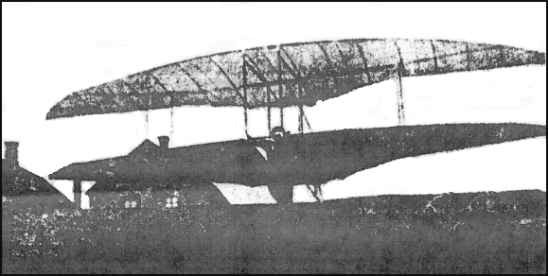
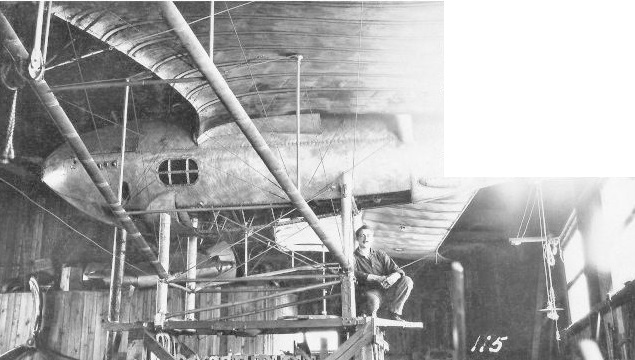
Designed by Carl Strom, a Dane, this was an all-steel passenger-carrying monoplane. Dimensions were 49 feet span, 24 feet height and the wings had a chord of 11 feet. Construction started late in 1911, with Strom building his machine with Oscar Olesen in Mineola, New York, USA.
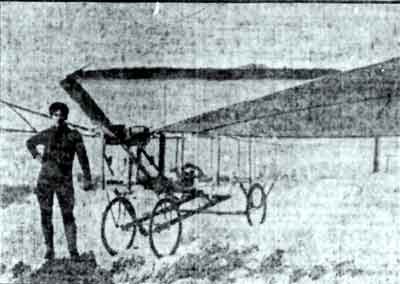
Constructed by George Strohbach, a skilled mechanic in Company E of the Fifteenth Infantry at Fort Douglas near Salt Lake City, Utah. In April of 1910 however, prior to finishing the project, Strohbach deserted the Army and disappeared. A fifty dollar reward for his apprehension was offered, but the Army also had another problem. Still in its box at Fort Douglas was the motor for the flying machine, ordered from St. Louis, yet no one knew how to handle either the motor or the monoplane, and neither was anyone willing to pay the C.O.D. charges on the crated engine – thus leaving the Army’s aeroplane-building attempt forever grounded.
George Strohbach, a skilled mechanic in Company E of the Fifteenth Infantry at Fort Douglas near Salt Lake City, Utah, constructed a monoplane. In April of 1910 however, prior to finishing the project, Strohbach deserted the Army and disappeared.
The Stringfellow Flying Machine of 1848 was built by John Stringfellow using a Henson steam engine modified by himself. The model was demonstrated attached to a cable inside a lace production shed at Chard, Somerset, England and at Cremorne Gardens in 1848 flying a distance of 40 m before crashing into a wall. Having a wingspan of 10.5 feet and a wing surface area of 12 square feet, it used a six and three-quarter pound engine. This was the first successful flight by a heavier-than-air machine to fly under its own power.
W.P.A. Straith of Norwood (outside Winnipeg, Canada), is said to have dismantled his 1911 Wright Model B, and built a new aircraft from it in 1912. Examining photos in; Canadian Aircraft Since 1909 (pp 437-438), it is clear that this aircraft was either a Williams Model 2, or was built along the lines of the Model 2. A different four-wheel Wright-type undercarriage is fitted (possibly taken from the Model B), as is a different engine, but the airframe is distinctly quite similar to the Model 2, including the radiator type, which was fitted to one Model 2. The engine bearers have been lengthened, apparently due to the use of a smaller (but heavy), 100 hp six-cylinder, two-stroke inline Emerson engine. Straith, used the aircraft until 1915, when it was destroyed in a crash. While it is dubious that the dimensions of the Straith were the same as those of the Williams Model 2, the span is given as 42′, the length is listed as 22′, and the height was 9′ (the figures may have been rounded-off, according to the aforementioned book).


 All Aero