Tatarinov Aeromobile

Tatarinov started building his “Aeromobile” at Petrograd in 1909 with a grant provided by the Russian Ministry of War. The project was never completed, since Sukhomlinov, Russian Minister of War at the time, thought the work was progressing too slowly and consequently, the continuation of funding was denied. In despair, Tatarinov set fire to his rotorcraft and the hangar which housed it. The “Aeromobile” had four rotors, each turning at the end of an X-form of beams. Beneath it the chassis contained an EDTT 25 hp water-cooled engine which was to drive the rotors as well as a five-bladed “centrifugal propeller”. The pilot’s seat and controls were placed behind the engine. The total weight of the machine was 1300 kg.

Taris No.2 monoplane / Monoplan de course Paul de Lesseps

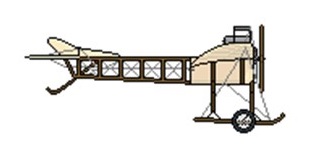
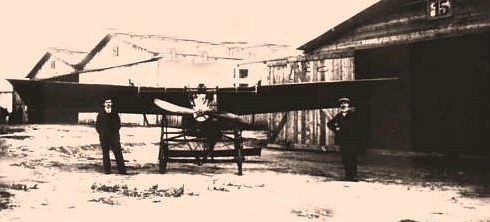
This peculiar monoplane, also known as the “Monoplan de course Paul de Lesseps”, was designed and built in 1910 by Taris, a Polytechnique graduate that taught aerodynamics at the Ligue Nationale Aérienne. A characteristic feature was its intricate triangular fuselage, uncovered and the front and covered at the rear and with a triangular cockpit floor breaking the lines. It was powered by a 50 hp Gnôme driving a ground-adjustable four-bladed propeller. It crashed in 1911.

Tański Łątka / Dragonfly

In 1909 Czesław Tański started design works on an aircraft with longitudinal axis steering done by change of the angle-of-attack of the whole wing. Construction lasted until 1911 and in autumn of that year, the airplane, named Łątka (Dragonfly) underwent trials at Warsaw’s Mokotów airfield. Unfortunately, Tański, witnessing numerous undercarriage failures on other aircraft, designed very heavy one for his aircraft, which resulted in aircraft – powered by relatively weak Anzani engine – never managed to take off the ground.

Span: 36’1″
Length: 23’8″

Taddéoli La Mouette

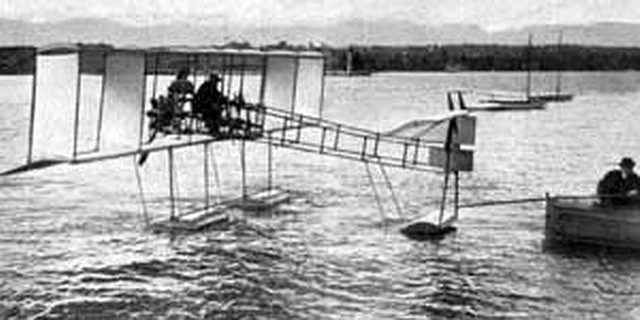
La Mouette seaplane of Emile Taddéoli on Lake Geneva in March 1912

Émile Taddéoli’s Gnôme-engined, Voisin-inspired canard float biplane “Mouette” was designed by his mechanic Prampolini and built at the Perrot & Cie workshop. It flew 80 meters during the first test flight on Lac Léman in March 1912, but sunk when landing, as the main floats got submerged instead of skimming the surface. After that, the project was abandoned.

Taddéoli, Emile

Emile Taddéoli (March 8, 1879 in Geneva – May 24, 1920 in Romanshorn) was a Swiss aviation pioneer. He was active as a pilot, instructor, test pilot, and also the probably most prominent pioneer using seaplanes in Switzerland. Taddéoli received the pilot’s brevet number 2 issued in Switzerland on October 10, 1910.

Székely IV

The Székely IV Parasol of 1913 was designed and built by the Hungarian Mihály Székely (Hungary then part of the K.u.k – Austro-Hungary). A typical parasol wing machine with the pilot and passenger sitting in a nacelle beneath the wing-tractor configuration, with the engine high before the wing and petrol tanks above.

1913 Szekely IV 2-seater “parasol” monoplane received 2nd altitude prize achieving 610 meters.

Span: 36’1″
Length: 28’11”
Weight empty: 521 lbs
Speed: 44 mph