Motorboat builder Alphonse Tellier (one of his craft towed Voisin’s float glider in 1905) built his first aircraft, for Emile Dubonnet, in 1909-1910, but went into liquidation in 1911.
Pioneers
Tellier
Motorboat builder Alphonse Tellier (one of his craft towed Voisin’s float glider in 1905) built his first aircraft, for Emile Dubonnet, in 1909-1910, but went into liquidation in 1911. Re-formed upon outbreak of First World War, Tellier’s company built floats and hulls for other marine aircraft before flying prototype of T2 flying-boat in June 1916. This soon crashed, but with new funds from Dubonnet Tellier evolved the T3 two-seat bomber flying-boat of 1917 and its cannon-armed derivative, the TC6. Most were built by Nieuport and other manufacturers. Final products were the unsuccessful twin-engined T5 flying-boat and tri-motor T7. In August 1918 the company was absorbed by Nieuport, with Tellier as its marine aircraft designer.
Telfer 1909 Multiplane
A Multiplane built in 1909. No specs or data in 1909 Jane’s, only that “the top plane is used as a horizontal rudder”.
Telfer
Richmond VA.
USA
Circa 1909 built a Multiplane
Teichfuss Aerocicloplano
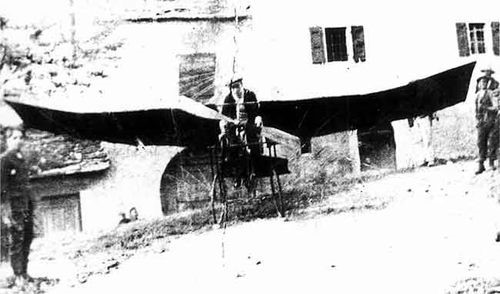
Designed and built by cycling champion Luigi Teichfuss in 1907. Span was 10 m, empty weight 90 kg. It was unsuccessful.
Teasdale-Bucknell 1913
Built circa 1913 as a twin-prop “direct-lift canard”. According to an article, this did fly, and at 70mph with help from two rotorlike contraptions behind the propeller blades, the idea of which was supposed to eliminate the danger of side wind effects and to increase lift.
Engine: 30hp
Wingspan: 14’0″
Length: 18’0″.
Taylor No.1
A Thomas Taylor in the USA in 1910 built a biplane aircraft type with a 90hp LeBlon (N19985 c/n 1).
Taylor 1909 Glider / Aerial League 1909 Glider

In 1909 Mr. George Taylor, secretary of the Aerial League, took a biplane,18ft long, with 4ft planes, and box-kite tail balance, to Narrabeen, NSW, Australian-built glider. The trials at gliding were held, Mr. Taylor himself acting as demonstrator. The scene of the flights was at Narrabeen Heads, in the presence of about one hundred visitors, the wide stretch of sand rendering any possible fall a matter of some safety. At the beginning of the experiments the wind came from the south-east at 10 miles an hour. The machine was carried to a sand knoll, and brought face on to the wind. Messrs. Schultz, Le Clerc, and Gibbons, of Narrabeen, required all their strength to hold it down. For the preliminary flights the corners were held by guide ropes 15ft in length to prevent the machine from getting out of control before the experimentor was properly tuned to automatic balancing.
At the commencement of the latest flights the wind came from the north-east at a pace of only three knots, hardly sufficient to give the necessary lift to the machine. A few attempts were made, but they wore too short and too close to the ground. The wind, however, increased in volume, and at 6 o’clock a 15-knot breeze was coming from the north-east. As the machine was wheeled face on, it shot up with Mr. Taylor to a height of 25ft, and soared the full length of the course. The demonstrator, by means of the-elevating plane, brought the machine rather sharply to the ground at the water’s edge. Tho second flight was even more successful, the machine during its course actually poising for about 10 seconds, owing to its being tilted at an angle that for a short time allowed the wind to counterbalance the soaring tendency.
At the signal to let go the machine was well lifted by the wind, and by careful manipulation on the part of Mr. Taylor it shot towards the ocean 98 yards away in a series of curves from 3ft to 15ft above the ground, dragging its guides, who, however, pulled it to the ground at the water’s edge. Twenty-nine successful flights were made by Mr. Taylor and Mr. Hallstrom, an enthusiastic member of the Aerial League. As the afternoon wore on the flights improved on account of the wind freshening to 15 miles an hour, and coming directly from the east so much so that the last flight of the day was notable.
At “let go” the wind immediately lifted the machine to the full length of the guide ropes, and dragged the operators so fast to the ocean that two let go; the machine now soared to-wards the ocean, and at the water’s edge the remaining guide ropes were loosened, the machine making a leap upwards. Mr. Taylor by careful manoeuvring, kept the machine well under control, and dived it in the sea some little distance from the heads. The machine will be fitted with steering gear and other improvements for further flights. Mr. Taylor’s monoplane is now having its powerful engine fitted to it at Gibson and Son’s motor works at Balmain, and he hopes to have it in the air during Christmas week. If the flights are as successful as anticipated the machine will be placed at the disposal of the military authorities during the Kitchener camp and review.
Tatin-Mallet 1907 Monoplane
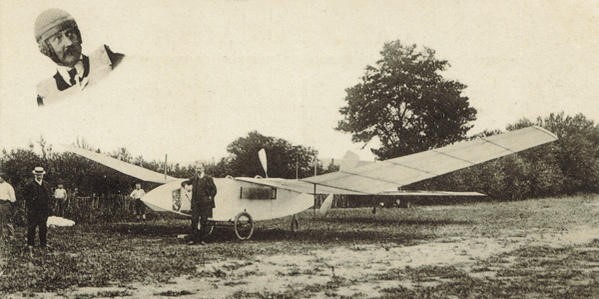
The Tatin-Mallet Monoplane of 1907 was funded and piloted by Comte Henry de la Vaulx at St. Cyr.
Tatin, Victor

Friend of Pénaud, Victor Tatin presents in 1874 to the French Society of Air Navigation, a mechanical bird of very small size with a wingspan of 24cm and a weight of less than 6 g which could walk about twenty meters without impulse of departure.
After numerous tests with wing-wing appliances, some of which were steam-powered, Victor Tatin built a small airplane powered by compressed air, which made its circular flight tests at Chalais-Meudon in 1879.
Victor Tatin (1843-1913) built a model in 1879 with a fuselage that acted as a tank for the compressed air that drove a small engine linked to two tractor propellers.

A series of experiments, tried by an able mechanician, which almost demonstrate that artificial flight is accessible to man, with motors that have been developed within two years. These experiments were carried on by M. V. Tatin, who was then Professor Marey’s mechanical assistant.
Continuing his work with Professor Charles Richet, Victor Tatin presents in 1890 a large steam airplane, monoplane 33 kg, a span of 6.6 m, powered by two propellers in tandem. The steam engine weighed 11 kg and gave 1 hp.
This device, which can be seen at the Museum of Air and Space, has a wingspan of one meter ninety and weighs 1.8 kg (with its full tank of air). The tapered tank is formed of a spirally wound steel ribbon fixed by 1300 rivets, it contains the compressed air which feeds an oscillating cylinder actuating by translation two four-blade propellers.

 All Aero