Tokyo Imperial University Aeronautical Research Institute

Professor Tanakadate, who started out as a researcher of geomagnetism and earthquakes, became interested in aviation after witnessing the flight of an airship in France in August 1907, while attending a Paris meeting of the General Conference on Weights and Measures. That experience, along with the findings he gleaned from an aerodynamics book he obtained from a British researcher, stimulated his interest in aviation science and set him on course to become one of Japan’s earliest and most important pioneers in the field.
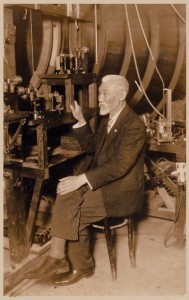
Prof Tanakadate Aikitsu

On returning home, Tanakadate built a wind tunnel, the first such device in Japan. His apparatus, created from a nagamochi, a wooden drawer used for storing kimonos, was fed air from one side and had a small glass window in the side through which to observe how a scale-model airplane, hung from the ceiling inside the tunnel, would react to the air flow. He may have used the wind tunnel to test scale models of the first glider to fly in Japan.

Tanakadate frequently emphasized that it was vitally important to fully understand the basics of all related phenomena when it came to aeronautical research. His advocacy for comprehensive learning resulted in the opening in 1918 of Aeronautical Research Institute attached to the University and the commencement of an aeronautical course in the Department of Shipbuilding. This course expanded to become the Department of Aeronautics in 1920.
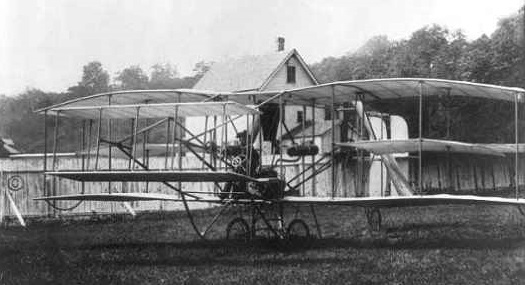
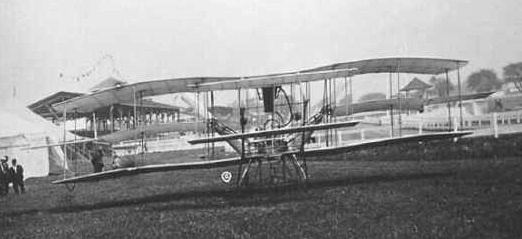
Todd 1909 Biplane

Miss [E.L.] Todd in her aeroplane, Sept 23, 1909

After years of effort, Miss E. Lillian Todd, of No. 131 West Twenty-third street, realized her ambition on Nov 7, 1910, when she had the pleasure of seeing a biplane, the work of her hands and brain, fly across the Garden City aviation field.

Designed and built by E. Lillian Todd and first flown by Didier Masson over the Garden City aviation field in Long Island during November of 1910.

Miss Todd was well known at the time, and her 1910 Biplane, powered by an eight cylinder 60 hp Rinek engine, was the first successful aeroplane built by an American woman. She then tried to get an engine, but met with repeated defeat, as the engines which she tried were not suitable. Finally a modified Rinek motor was declared satisfactory. Todd is told to have designed and built three full-size aircraft; her first – an engineless machine – in 1906.

A good sized crowd was on hand to witness the first attempt to fly the biplane. Mr. Didier Masson was the aviator. He ran the machine across the ground, then went to the air for twenty feet and made a turn at the far end, returning to the starting place, where he was enthusiastically received by Miss Todd and the crowd.

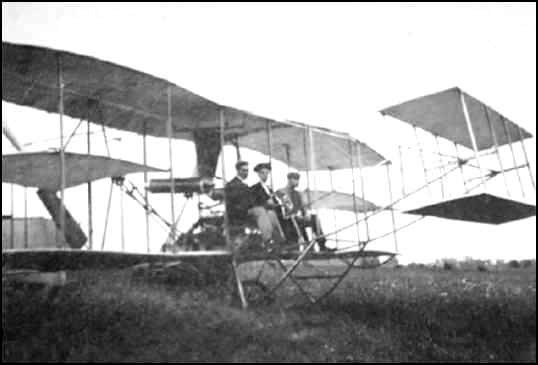
Todd in her plane with Didier Masson

Miss Elizabeth L. Todd has entered the lists as a competitor in several long-distance flights and she has her mechanicians at work in her aerodrome at Hempstead Plains on three machines she designed. She has made several flights and has learned to manipulate her planes and her engines in masterly style.

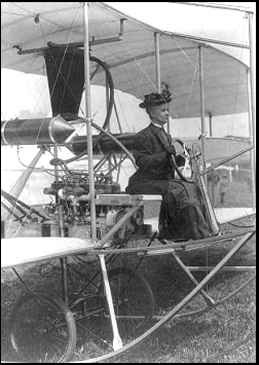
E. L. Todd at the Controls
Probably Sept., 1909

Tissandier Airship

The contemporary engraving shows the Tissandier electric dirigible scale model – similar in appearance to the Giffard airship of 1852 – at the Conservatoire des Arts et Metiers in Paris. Seen at the Exposition d’électricité in 1881, the aérostat électrique was a demonstrative model of the later constructed full-scale Siemens electromotor-driven Tissandier airship. The model’s all important electromotor was designed and built by French inventor Gustave Trouvé.

In 1882 the Tissander brothers built a 92 ft long airship. At 37,000 cu.ft capacity, it was powered by a Siemens electric motor of 1.5 hp driving a primitive two-bladed airscrew, which drew its power from twenty-four bichromate of potash cells weighing 500 lb, contained in the car suspended by netting below the fuselage.

The first trial took place on 8 October 1883 when, despite a fair breeze, a measure of control was achieved with the aid of the sail rudder. A second trial on 26 September produced better results although due to the low power of the engine the craft was unable to make any headway in a wind of any magnitude and the brothers ended their works.

Tips 1908 Biplane

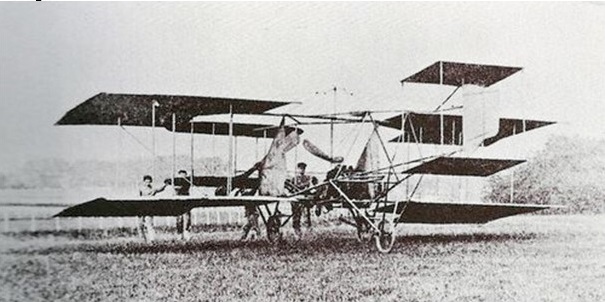
Tips Biplane (second version)

Belgian brothers Maurice and Ernest Tips designed in 1908 a machine that would rise and land vertically while transitioning to and from horizontal flight. Their solution to this challenge opted for a canard type biplane, driven by three-bladed propellers which could be rotated, thus given the need for space, the middle section of the wing was almost completely open. The engine to power this complex design was Belgian-made by the firm Pipe, and construction was done in Etterbeeke (now part of Brussels). The machine was not successful however, and the brothers persevered onward and re-designed their machine – using as many parts as already available – whereas they dropped the idea of starting and landing vertically. The second version of the Tips machine was a biplane which resembled the original quite closely, but fitted with two “fixed” two-bladed propellers. Almost everything else was the same, save the engine of Pipe which was at a later time changed to a 50 hp Gnôme rotary. The machine flew during 1909 and 1910 earning the distinction (with the Pipe engine that is) of being the first Belgian plane of construction (inclusive the engine) to do so.

Timm Aircraft Corp

Several experimental planes were produced during 1911-20, but data are lacking. Company logo proclaims 1911 as starting year.

Formed at Van Nuys, California, USA, circa 1922 as the O W (Otto William) Timm Aircraft Corp,
901 N San Fernando Rd, Glendale CA.

c.: 1928: Timm Airplane Co.

Was inactive in aircraft manufacture for several years, but in late 1930s produced prototype T-840 twin-engined six-seat transport.

1935: Timm Aircraft Co.

1937: Acquired Kinner Aircraft

1939: Metropolitan Airport, Van Nuys CA.

It developed a plastic-bonded plywood Aeromold, applying this first to the S-160-K two-seat primary trainer of 1940, which was built in Second World War as N2T-1 trainer for U.S. Navy.

Timm also built 434 Waco CG-4A cargo gliders, and did wartime subcontract work for Harlow, Lockheed, Vultee and other companies.

1941: Sold to Aetna Aircraft Corp, Los Angeles.

Charles Lindbergh’s first airplane ride was with barnstormer Timm.

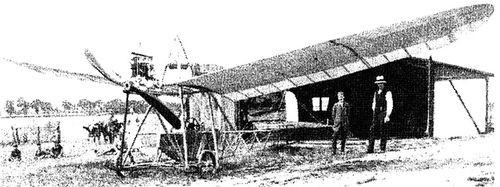
Timm Eindecker 1

Heinrich Timm, owner of a sawmill in Kummer near Ludwigslust, built two monoplanes. The first in 1912, and an improved model in 1913. Both of them flew. An earlier doppeldecker was not completed. The latter eindecker, something of a Taube-Blériot hybrid, was flown regularly until WWI, although Timm did not have a flying licence until, after joining the German flying corps, passed his “Feldpilotenprüfung” in 1915. Timm, born in 1885, died in the winter of 1917, having succumbed from severe burns suffered in a crash landing.

AB Enoch Thulins Aeroplanfabrik (AETA)

1922 logo

Title from 1914 of the former AVIS (Aeroplanvarvet i Skane) company formed 1913 by Dr Enoch Thulin and Oskar Ask. Licence built Le Rhone engines.

Enoch Thulin Article

Models A, B, C and D were respectively Swedish versions of the Bleriot monoplane, Morane-Saulnier monoplane, Albatros B.II and Morane-Saulnier parasol. Thulin designs included the Type E, FA, G, GA, H, K, L, LA, N and NA. Total factory output was 99 aircraft, of which 32 produced in 1918. By the end of 1918 had produced nearly 100 aircraft of 11 different types, 7 their own design.

Dr Thulin died in flying accident in 1919 and the company closed its doors lacking the leadership of the early pioneer. ABThulinverken, a company which was formed a year later, is not connected with aviation.