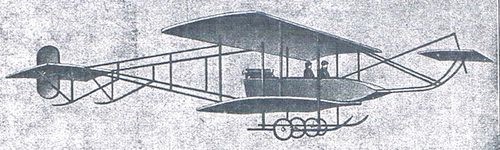
A Farman-copy built by Otto Trinks & Co Luftfahrt-material (Gitschinerstrasse 91, Berlin) during 1910/11 and fitted with a 44 hp eight-cylinder engine.
A Farman-copy built by Otto Trinks & Co Luftfahrt-material (Gitschinerstrasse 91, Berlin) during 1910/11 and fitted with a 44 hp eight-cylinder engine.

The Otto Trinks Doppelrumpfeindescker was presented at Johnnisthal in 1911 as the first bi-fuselage aircraft; its pusher prop between the two tail booms driven by a 50 hp Argus.
Otto Trinks & Co Luftfahrt-material
Gitschinerstrasse 91
Berlin
An airplane builder circa 1910/11
An open cockpit biplane built in 1909, Jane’s noted that “Messers. Luttgen & Beckert are connected with the design of this machine.”
Intl School of Aeronautics
Airplane builder circa 1909.
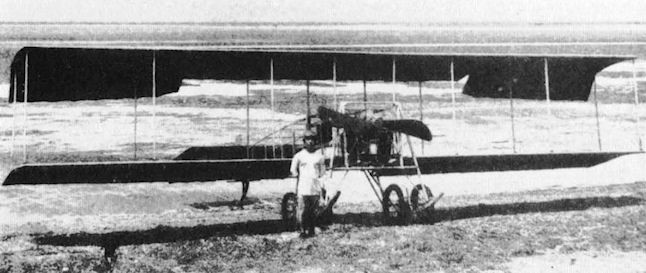
Shigesaburo Torigai with a new-found interest in aviation as a hobby, organized the Nihon Hiko Kenkyukai (Japan Flight Research Association). His ambition was to have an aeroplane of his own. To achieve this, he asked Toyokichi Daiguchi, who was associated with Narahara, for technical assistance in the building of his own aeroplane.
In 1913, to open the project, Torigai purchased a used 45hp Gregoire Gyp engine from Shinzo Morita of Osaka after his flying accident. Torigai completed his aeroplane in April 1913 and called it the Hayabusa-go (Falcon). It was an equal-span three-bay biplane with uncovered fuselage, tractor engine, ailerons on the upper wing and undercarriage comprising two sets of twin wheels and two skids. Otijiro Itoh assisted Shigesaburo Torigai, another Japanese pioneer, in the construction of the Torigai ”Hyabusa-go”.
He flew it for the first time on 3 May, 1913, at Inage, Chiba Prefecture, but at a height of about 20m the aeroplane stalled and crashed. Torigai survived, but the aeroplane was severely damaged.
After repairs by Daiguchi, Torigai took the aeroplane to Hokkaido. While preparing for a flying exhibition at the Tsukisappu Military Drill Grounds on 7 September, 1913, Torigai took off and, on the outskirts of Sapporo, soon crashed once again. Speculation about the cause of this and the earlier accident is that Torigai did not know how to fIy, for there was no record of him having been given formal flying lessons. Torigai escaped serious injury but the aeroplane was badly damaged. The wreckage was saved and eventually transferred to Otojiro Itoh, to help start his flying school at Inage the next year. Itoh made the necessary repairs along with his own modifications and made the aeroplane flyable.
Itoh eventually purchased the Gregoire Gyp engine from Torigai in August 1915 so that it could be installed in his first-built aircraft, the Emi 1 Aeroplane. This is the aeroplane that made the first flight to Tokyo from Inage on 8 January, 1916.
Shigesaburo Torigai was a manager of an imported automobile sales and repair business in Yuraku-cho, Tokyo. Because of his new-found interest in aviation as a hobby, he organized the Nihon Hiko Kenkyukai (Japan Flight Research Association). Under this name, and to satisfy his own interest in aviation, he voluntarily managed and promoted exhibition programmes for Einosuke Shirato who flew the Narahara No.4 Ohtori-go Aeroplane on tours throughout Japan, and his ambition was to have an aeroplane of his own. To achieve this, he asked Toyokichi Daiguchi, who was associated with Narahara, for technical assistance in the building of his own aeroplane.
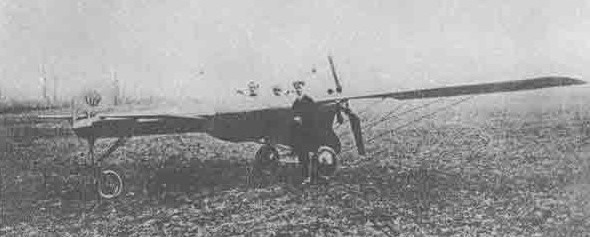
An earlier canard monoplane, the more streamlined Italia-1, was designed for the Italian 1913 trials but became badly damaged by Alessandro Tonini during a landing.
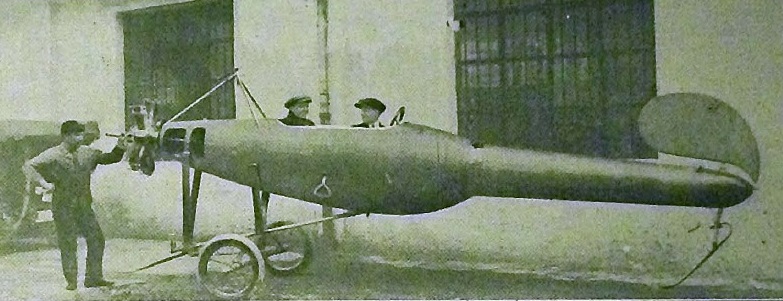
Due to a lack of funds and an underpowered airframe, Tonini shifted to a more “rough” and lighter configuration as a replacement: the Italia-2. According to Tonini’s son, the aircraft never flew.
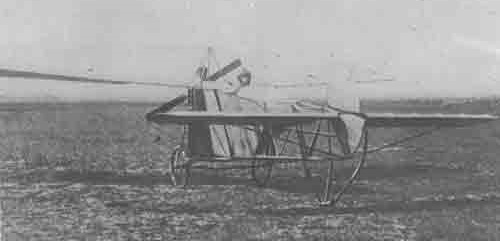
The Tonini-Bergonzi-Negri “Italia II” was a lighter airplane with a smaller engine, and also a canard. This did not take off – the partners experienced serious financial problems because Negri lost the money in cards, and their team broke up.

Italia-2
Engine: 35 hp
Span: 6m
Weight: 340 kg

Tonini Monorebus monoplane of 1911 was designed by Alessandro Tonini, and powered by a REBUS engine. The name of the machine was a contraction of both, becoming Monorebus. Tonini had initiated the firm Officine Mechaniche REBUS in Milan, which specialized in “Aeroplani, Motori per Aeroplani, Costruzioni Aeronautiche and Construzioni Mecchaniche”. After the Monorebus was successfully flown in June 1911, Tonini started designing revolutionary canard machines and later became chief constructor with Nieuport-Macchi.
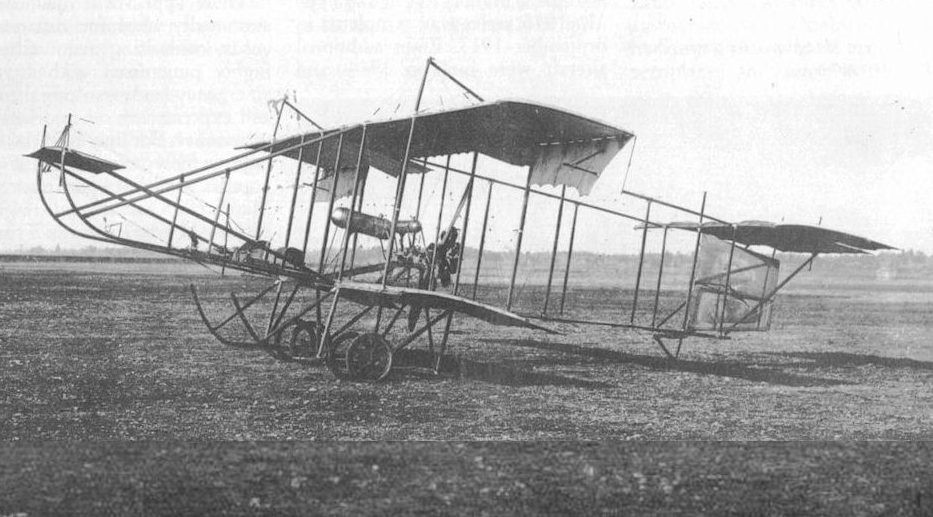
Japan’s very first Japanese-designed and manufactured aeroplane was the Kaishiki No. 1 (kaishiichigouki, 会式一号機), pusher aeroplane (propeller is behind the pilot, pushing the craft, as opposed to the puller type we commonly have nowadays that leads the aircraft) which was designed and flown by Captain Tokugawa Yoshitoshi (surname first), on October 13, 1911 at Tokorozawa in Saitama-ken (Saitama Prefecture).
The motor and propeller came from France, but everything else came from or was built in Japan. The aircraft’s frame was mostly made from hinoki (Japanese cypress), and was covered by two layers of silk glued together with sounds like liquid rubber.
All attachment fittings, bracing wires and turn buckles were purchased from iron works companies or bought from local hardware shops.
Differences from the Farman III design included a reduced wing area, which gave it more speed. The aerofoil had a larger front curve which was thought to provide better lift. Other differences between the Kaishiki No. 1 and the Farman III include the fact that ailerons were on the upper wing only, and the tail was simplified by having a single horizontal tail surface.
As well, the engine and propeller were mounted higher than in the original design, and therefore the undercarriage could be shortened. A windshield was added for the pilot.
When the aeroplane was constructed, it was called the Tokugawa Type, but was later officially identified as Kaishiki No.1 Aeroplane.
The aeroplane was moved to the Army facility and flying field at Tokorozawa where it made its first flight on October 13, 1911, piloted by Captain Tokugawa.

A later test flight on October 25, 1911 achieved an altitude of 50 meters (164 feet), reaching a top speed of 72 kilometers per hour (45 miles per hour).
Further testing had it reach 85 meters (278 feet) in altitude and flying a grand distance of 1,600 meters (1 mile).
Continued testing convinced the flight crew that the propeller ground clearance wasn’t high enough, as the blades would hit the grass below, slowing it down, causing the Kaishiki No. 1 to lose power.

Actually, it was only after the providing greater clearance that the aircraft was given the Kaishiki No.1 moniker.
More changes ensued, including changeable landing skids in case one broke; twin rudders replaced by a single and larger rudder which was part of the advantage of the gained from the propeller slipstream meaning improved directional control.
Longer interplane struts on the aircraft were added to provide more spacing between the two wings.
One other alteration from the Kaishiki‘s original design was the removal of the pilot windshield, while it did provide protection from bug’s flying in the pilot’s mouth while screaming for joy as he flies through the air, the team felt that pilot needed to feel the air so as to get a better sense of the aeroplane’s speed.
Kaishiki No.1
Engine: 1 × Gnome Omega 7-cylinder, 50 horsepower
Propeller: 2-bladed wooden Chauvière
Length: 11.5 m (37 ft 9 in)
Upper wingspan: 10.5 m (34 ft 5 in)
Lower wingspan: 8.0 m (26 ft 3 in)
Height: 3.90 m (12 ft 10 in)
Wing area: 41.0 sq.m (441 sq.ft)
Empty weight: 450 kg (992 lb)
Gross weight: 550 kg (1,213 lb)
Maximum speed: 72 kph (45 mph)
Endurance: 3 hr
Crew: 2
 All Aero