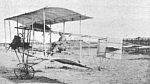
The 1909 Ueda Hiryu-go biplane was designed and built by Shoraro Ueda in Japan.
The 1909 Ueda Hiryu-go biplane was designed and built by Shoraro Ueda in Japan.
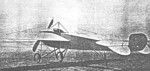
The 1913 Tsuzuku monoplane No. 3 was designed and built by Tetsaburo Tzusuku in Japan for the Revolutionary Government of China.
Span: 37’5″
Length: 24’7″
Gross weight: 1213 lb
Speed: 56 mph
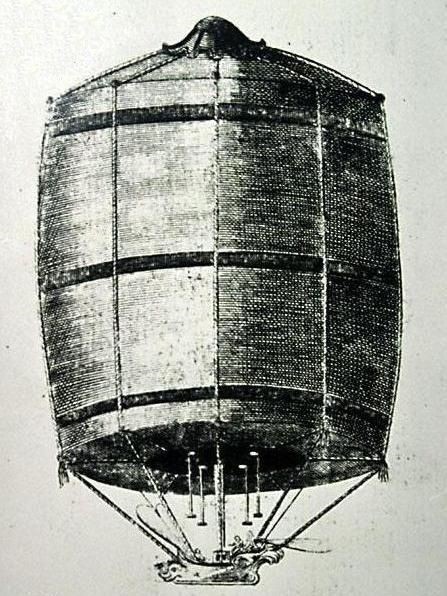
A barrel-shaped balloon constructed by James “Balloon” Tyler of Edinburgh, Scotland, in 1784.
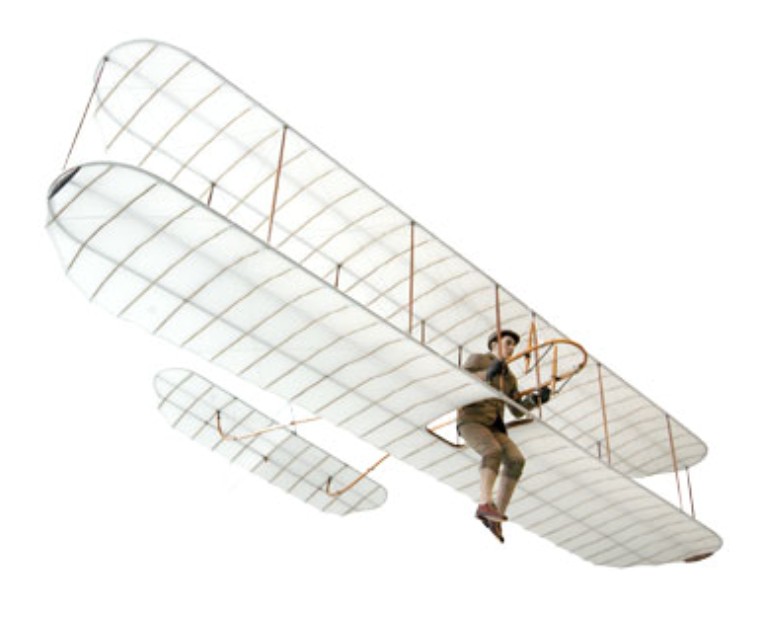
In 1910 TWK Clarke and Co., a Kingston-on-Thames manufacturer of aircraft, accessories and flying models, produced a range of four biplane gliders. This machine, based on a configuration evolved by the American pioneer Octave Chanute, was the third largest of the range and resembled the Wright brothers’ aircraft in general construction. It could be bought as a kit for 10 guineas (£10.50) or completely assembled and covered for £34.
The machine was flown as a hang-glider with the pilot resting his armpits on the padded cushions, while the two control levers, connected in unison, operated the rudder when moved from side to side and the one-piece elevator when moved backwards or forwards. Banking in turns was achieved by the pilot swinging his body and legs towards the inside of the anticipated turn.
Gliding and hang-gliding are now popular leisure pastimes, but at the time T.W.K. Clarke built this glider, powered and controlled flight had yet take place. Gliders were used by many pioneers to perfect their skill at flying and also the machines they were building.
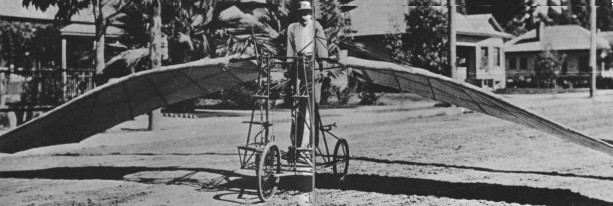
American Harry LaVerne Twining built himself a man powered ornithopter, likely with the assistance of Warren Samuel Eaton. Completed around the summer of 1909 and first appearing in the October 1909 issue of Aeronautics it was tested late in 1909.
It consisted of a tricycle to which articulated 8.2 m (27 ft) wings, operated by foot stirrups, were attached. The Los Angeles Daily Times dubbed it ‘Twining’s Flip Flop’ and assured worried readers that Twining did not intend to rise far from the ground at first, which was just as well because the flip flop was a complete flop, flapping furiously along a Los Angeles street but barely rising an inch.
As President of the Aero Club of California, Twining entered his second ornithopter into the 1910 Los Angeles International Air Meet at Dominguez Field.

The origins of aircraft construction in Turkey can be traced back to the first maintenance unit of the Turkish Air Force officially established on 1 June 1911, set up at the airport in Yesilköy / Istanbul. During the First World War maintenance facilities were established in Baghdad, Damascus, Izmir and Konya. They were under the umbrella of the 9th Department of Aviation Affairs (9 Hava Isleri Subesi), which was established on 15 Febuary 1915. The main task of this maintenance facilities was the maintenance of the aircraft of the German Air Force but due to the war situation could not always be guaranteed the supply of spare parts. The technicians at the front often no choice but to produce the items urgently needed themselves. In 1917 the Baghdad facility built a “new airplane”, the Baghdad first, which was built from parts of Albatros C III and from captured aircraft parts “redesigned”. During the Liberation War, which began immediately after the end of the First World War, the need for a separate aircraft production became increasingly clear.
The first steps for national aircraft production were initiated. Firstly reconstructions were performed on available aircraft types on the Gaziemir / Izmir Air Force Base. In 1922 two captured Airco DH 9 were retrofitted with dual controls. In 1924, the unreliable original engines were replaced on four B.1 Aviatik SAML training aircraft with older, but proven, Mercedes engines.
Turkish aircraft in the true sense began only after the founding of the Republic in 1923. A small delegation was dispatched to Europe to procure aircraft for the new Turkish Air Force. After evaluation it was decided to obtain 16 Bréguet XIV A-2, 39 Caudron C-27 and 32 Caudron C-59 aircraft. These aircraft were dismantled in 1924 and shipped to the Gaziemir / Izmir Air Force Base under French supervision. After the first requirements of the Turkish Air Force, the armed force withdrew from the assembly of planes however, this plan did not last long. When in the course of technical development, the maintenance became more complicated and more complex, the maintenance facilities of these forces were again entrusted with the manufacture of spare parts or installation or modernization of aircraft. So the 1st Air Supply and Maintenance Center emerged (1 Ikmal Hava ve Bakim Merkezi, 1.HIBM) in Eskisehir (1926), the 901 Home Depot and production plant for aircraft (the 901.Hava Araci Ana Depo ve Fabrika Komutanligi, nine hundred and first HAADFK) in Polatlı (1948, 1962 in Ankara) and the 2nd Air Supply and Maintenance Center (2nd Hava Ikmal ve Bakim Merkezi, 2.HIBM) in Kayseri (1950).
The 1909 Tucek Type I 1-seater monoplane was designed and built by Tucek in Czechia (Austro-Hungarian Empire).
Span: 29’10”
Length: 24’7″
Weight: 772 lb
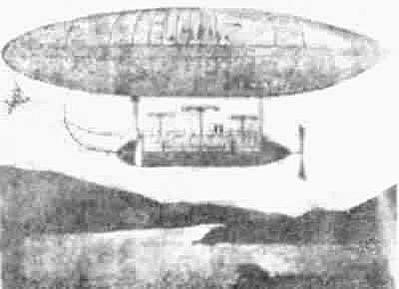
LTA/HTA dirigible designed by Australian-born and raised Chinese revolutionary Tse Tsan-tai – sometimes identified as being the first person of Chinese descent to fly an airship, although it is not clear as to whether the actual craft was ever completed. Even so, had it been, it almost certainly would not have been able to fly. An extract from the July 1907 issue of “Aeronautics” describes the invention thus: “A syndicate is being formed in Hong-kong to build an airship designed in 1894 by a Chinaman, Tse Tsan Tai. It is to be built of aluminum, and will be enclosed in an aluminum shell to protect it from the enemy’s projectiles. The envelope is to be cigar-shaped. Tse Tsan Tai’s principle is that airships should depend upon their fan-propellers for advancing, receding, ascending and descending. The gas-envelope is to be used only as a buoy. For the vertical movement, therefore, there are to be horizontal propellers on the deck regulated by clockwork. The steering will not be by exposed planes and rudders, but by concealed steel wings, which can be thrown out at the stern on the pressure of an electric button.”
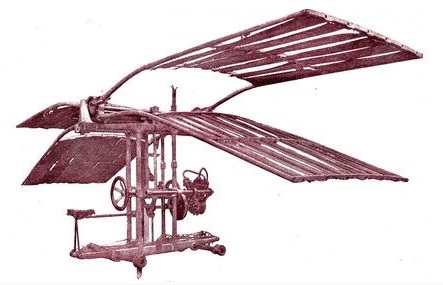
The 1908 Orthoptère of Spiridon Tsapenko [Спиридон Цапенко] and Joseph Michel Ambroise Farcot. The two photos taken by Branger on July 21, 1908 show a small scale version built as a pre-study for a full-size higher powered machine. This trial version had a 12 hp Farcot engine of 20 kg in weight, bringing the total weight of the machine to 150 kg.
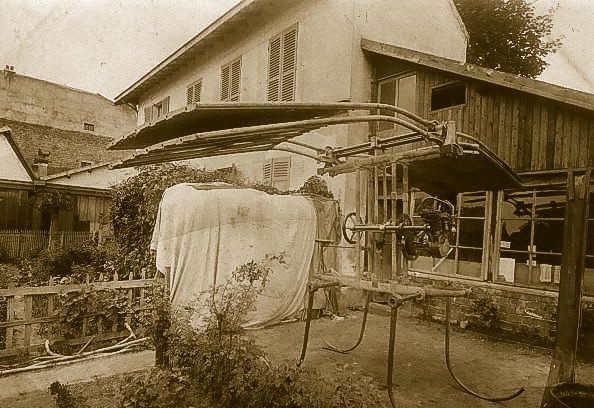
(H D) Truman Aeroplane Co of San Francisco CA., USA built an airplane circa 1912.
 All Aero