In 1909 Engineer Oscar Ursinus of Frankfurt formed a team to promote the application of motorless flight. This team, mostly technical high school teenagers, studied early Otto Lilienthal theory and his bold experiments. After fabricating a glider of their own design they transported it to Rhön for trials. Oscar Ursinus became the first person to successfully fly a glider from the cliffs of Wasserkuppe.
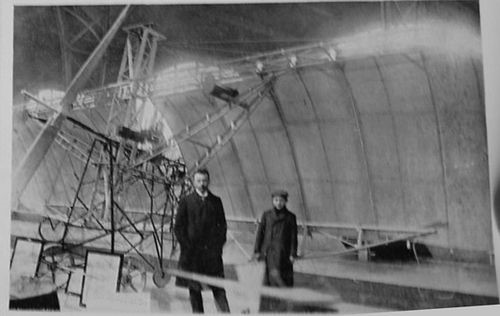
The second design of Vilém Urbánek (sometimes identified as Urbánek II) which was exhibited at the Prague Automobile Salon of 1910 in an unfinished form. The aim of Urbánek was to design an “automatic” device for lateral control.
In the available photographs of the machine can be seen a long construction of lattice fitted before the wing used in such a way that when one wing half dropped (or rose) the other wing half would automatically compensate in the opposite direction. The machine was never finished, so it was never determined whether the automatic stability system devised by Urbánek would work in actual flight.
The Union Pfeil-Doppeldecker was designed by Josef Sablatnig and/or Walter Höhndorf, and/or Karl Bomhard, characterized by the swept-back wings with unusual upturned lower wing tips, and built in Berlin-Teltow. It won four prizes at the Wiener International Flag-Meeting 1913, fitted with a 120 hp Austro-Daimler engine. Previous and later versions with other engines were successful in several meetings and set altitude records.
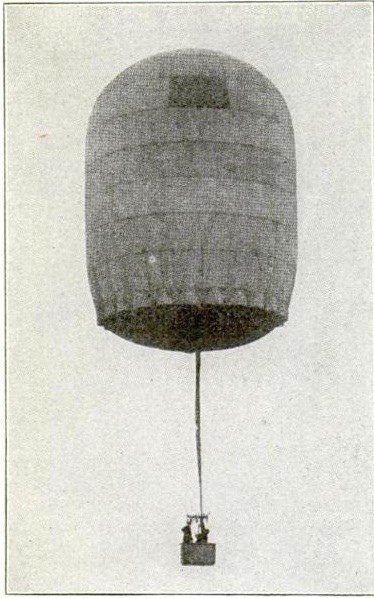
A 1902 design by Captain Eric Unge, patented in the UK. The body of the balloon consisted of plane, cylindrical and conical surfaces, made by long and wide pieces of cloth, so that the lengths of the joints and the corresponding leakage was reduced about 75 per cent. The other inventive features included an outer envelope that would reduce the heating of the gas by the sun. The balloon’s envelope, in an emergency, could also function as a parachute. And indeed it did, when the gas exploded during its second flight (the first being a 24-hour flight from Sweden far into Russia) and Unge and his passenger were unhurt in the following crash.
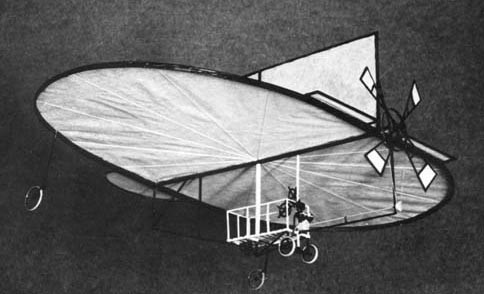
Elmer, George and John Underwood of Stettler, Alberta set to work inventing a flying of their own. The result was a craft with elliptically shaped wings. The Flying Wing was composed of long strips of fir and wire that were covered with cloth. Above the wing was a large fin, with a rudder at the back and an elevator attached to the tail. Under the large wing was a platform where the pilot sat. Motorcycle wheels were placed under the platform and bicycle wheels placed on each wing to hold it steady for take-offs and landings.
The platform also contained a place to house the motorcycle motor once they were able to afford one. In the meantime, the Underwoods displayed their creation at Stettler’s exhibition in July 1907, and tested the machine on their farm.
Tying the aircraft to a fencepost, the brothers placed sacks of wheat on the platform to replicate the weight of a pilot, and launched the plane like a kite. The test went well, and for the next trial, John took the place of the wheat to “fly” the machine for 15 minutes. Their enterprise was then put away until the next year, when the Underwoods finally obtained their motorcycle engine.
Attached to the front of the wing was a large bamboo and canvas propeller, powered by the motorcycle motor. Unfortunately, the brothers found that the engine was too small to get the craft airborne, so they hitched the plane to the fence post once again, using it like a kite, until the Flying Wing was destroyed one day by high winds. Their effort was eventually abandoned, since they lacked the resources to continue.
The first aeroplane with a circular wing, the Spheroplan, was built in Russia by A.G.Ufimtsev in 1909-10. Ufimtsev practised controlling the Spheroplan in numerous runs on the ground, but the tests were never completed because of the damage done to the apparatus by a sudden storm.
It was not until 1912 that the first Hungarian aircraft factory was born in Budapest, at the corner of Hungária körút and Váci út, with the cooperation of Ganz-Danubius, the Weiss Manfréd factory, the Hitelbank and the financial wizard Camilio Castiglioni, who had also helped BMW to prosper. The company was given the creative name of First Hungarian Airship and Aircraft Factory and, lacking its own types, started to produce biplane Lohner aircraft.
The company’s first manager was the twenty-four-year-old Viktor Wittmann, who in 1910, with a degree in mechanical engineering, set off for Reims, France, to study European aircraft manufacturing. The following year, he was already testing aircraft for the Monarchy’s air force at Aspern airbase in Austria. In May 1915, during a demonstration flight of one of the factory’s military aircraft, he lost control of the plane and crashed from an altitude of 30 to 40 metres.
However, the first and earliest site of the factory did not have an airport, so most of the aircraft parts had to be transported to Rákosmező, where the airplanes were assembled and tested.
In the light of this, and the increasing demand for aircraft, the company grew rapidly, outgrowing its available space. They found a new site in Albertfalva, on the outer section of Fehérvári út, where there was enough space not only for halls but also for an airport (which was actually just a flat field, as the runways were not paved at the time).
Hansa-Brandenburgische Flugzeug Werke then joined the company’s ownership, and from then the company began to produce aircraft under the names MARE (Magyar Repülőgépgyár Rt.) and UFAG (Ungarische Flugzeugfabrik Aktien Gesellschaft), including an increasing number of German-designed Hansa-Brandenburg C.I. aircraft, which accounted for a quarter of the Austro-Hungarian Empire’s First World War fleet, 1,258 of them.
These were still canvas-covered, wood-frame and plywood machines and were powered by 160, 200 and 230 hp Hiero engines manufactured by UFAG. They were armed with one or two Schwarzlose machine guns, redesigned for aircraft, with greatly increased rate of fire.





 All Aero