Vaniman Akron

5 November 1911

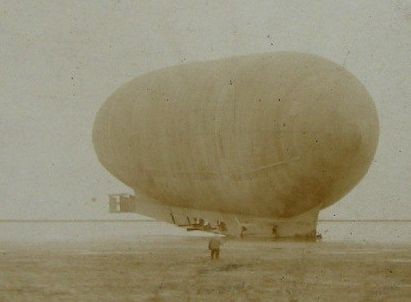
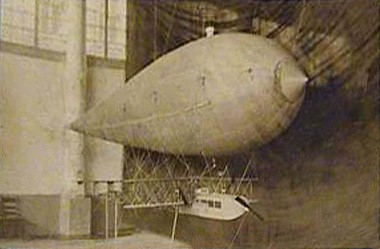
The original Akron was specifically built for the Sieberling-Vaniman trans-Atlantic expedition, undergoing trials at Atlantic City, New Jersey on November 5, 1911. Identified by its semi-rigid keel design, box-tail rudder and placement of the four, 2-bladed propellers.

After making changes and repairs to the airship, it was once again tried on June 1, 1912 with results less than satisfactory due to an accident with the drag rope in which Calvin Vaniman, the younger brother of expedition leader and commander Melvin Vaniman, had to climb out on the propeller struts to save the airship from wrecking.

The final test of the Akron on July 2nd ended in an explosion of the over-pressurized hull 500 feet above Absecon Bay, resulting in the deaths of all five crewmen aboard, including Melvin Vaniman and his brother Calvin.
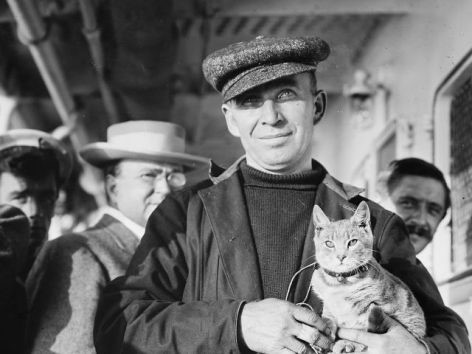
Vaniman, Melvin

Born in Virden, Illinois to parents George and Luisa, Vaniman was the oldest of four sons. The short fiery red-head and his siblings were raised within a Christian sect called the Dunkards (via the German Baptist church)… a sect that disagreed with the concepts of modernization and even sad no to instrumental music in the agricultural community they lived in.

They lived on a farm and Vaniman was the kid who learned how to fix all kinds of machinery – even engines on the farm.

Like many kids, Melvin Vaniman wanted to escape the small town and seek his fortune elsewhere… turning his back on farming to study music, initially at Mt. Morris College run by the German Baptist Bretheren, before gaining further study at Valparaiso University in Indiana and later at Dexter College in Iowa, where he stayed on to become a music teacher – guitar and singing – before joining a touring opera company in Louisiana in 1887.

Vaniman built his own aeroplane in 1906… a triplane, in fact… the first ever triplane.

Calvin Vaniman completed a scaled miniature trans-Atlantic passenger airship, “Atlantic No.1”, on June 23, 1912.

Atlantic No.1

It was made for the American inventor-aeronaut-adventurer Melvin Vaniman, who died alongside his younger brother Calvin and three other crew members in the airship “Akron” trial-flight disaster on July 2, 1912 near Atlantic City, New Jersey.

Vanden Plas Médiaplan

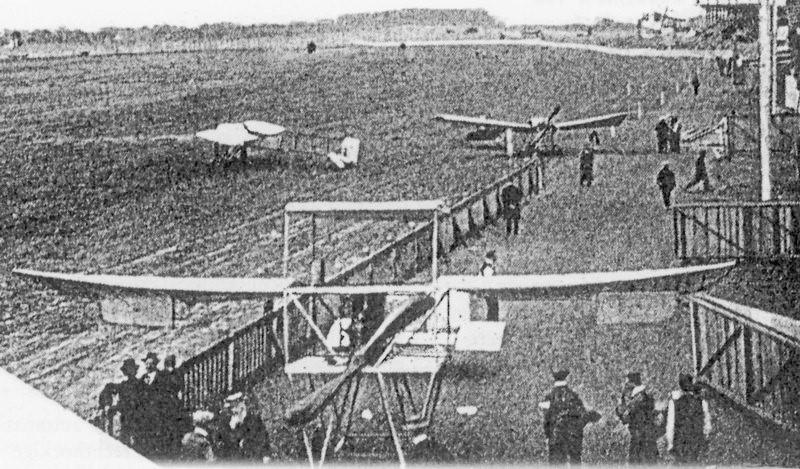
The second try at flying by Vanden Plas was the “Médiaplan”, subject of Belgian Patent 237.925 of 22 July 1911. It was built by the Laurent firm at Leuven, which built propellers and other aviation parts. It was shown at Ans on 15 June 1911, flown successfully by Westerlain, although it is reported it ran out of fuel and had to land in field. It was displayed at the XI Salon in Brussels in January 1912 and it was reported that flying would resume in Kiewit, but nothing was heard of it. It was powered by a Vivinus engine, later by a 50 hp Gnôme.

Vanden Plas

The coach building firm Vanden Plas was founded in 1870 in Belgium and employed a total workforce of 750 before the Great War. Albert Victor Vanden Plas tried his hands in designing aeroplanes, first resulting in a Belgian patent for a “Héli-Orthoptère-Planeur”, which was not proceeded with.

The second try was the “Médiaplan”, subject of Belgian Patent 237.925 of 22 July 1911.

van der Fleet & Boklevskogo Dove

Designed by Professor van der Fleet and Boklevskogo, also an engineer, VF Naydenov with Captain BV Golubova, the Dove was built in 1910 in Russia on Izhorskij, located in Kolpino near Petrograd.

During the First World War, this airship carried out a number of reconnaissance flights over enemy lines. In October 1914 it was evacuated to Lida, where the blimp was dismantled. Unpacked in the summer 1916 in the open, during a storm it was damaged.

Length: 50 m
Width: 8 m
Envelope volume: 2270 cu.m
Max speed: 50 km / h

VAMP Bat

Frank Van Dersarl was born August 13, 1895 in Denver. He flew a Bleriot airplane on August 10, 1911 at Sable Airstrip located in Aurora at the junction of Sable Blvd. and the Union Pacific railroad tracks. It was a favored location for early flyers and auto racers. This aircraft was assembled by Frank and his brothers, John and Jules, using plans purchased in France from Bleriot. They were 10 and 12 years old at the time. He also flew a glider, which was built at the age of 12 from a booklet ordered from a London company. It crashed on its first flight.

Pioneer aviator Harry Combs (1913-2003), with only 30 hours of flying under his belt, at the age of 16, decided to build his own aeroplane. With the help of Frank Van Dersarl they completed the construction of a sport bi-plane called the VAMP Bat in 1929. The VAMP Bat had a short life, after flying to Pueblo, Combs lost control of the aircraft on the runway, there were no brakes and only a tailskid, caught in high winds the aircraft flipped on its back. Combs said ‘I was hanging upside down inches from the ground. It busted up. I should have known that when you don’t have brakes you have to stay on the grass’.

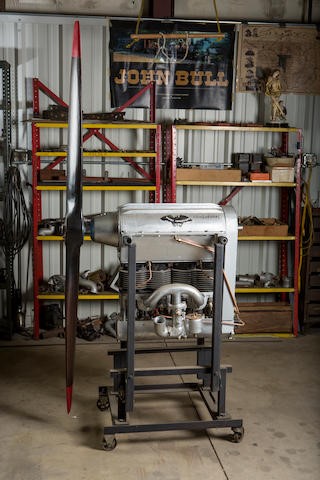
VAMP Bat engine

Usuelli U.1

A 3970 cu.m non-rigid airship designed by Celestino Usuelli, 51 meters long with a maximum diameter of 9.8 meters. Construction of the U.1 was started in 1909 although it probably didn’t make its first flight until 1910 at Turin. Powered by one SPA of 100 hp driving two propellers.