In 1910 Raoul Vendome built a monoplane weighing 100 lb. The folding aeroplane incorporated several features. It could be assembled or dismantled by two people in four minutes. When folded it could be stored in a space of 7 x 10 x 17 feet.
Vendome tried to perfect a simple, cheap aeroplane that anyone could build at home.
Designed or built several novel prototypes between 1906-1914, and after outbreak of First World War produced small number of single-seat monoplanes for artillery spotting for French Army. Last known design was 1916 experimental military biplane with two Gnome engines mounted laterally.
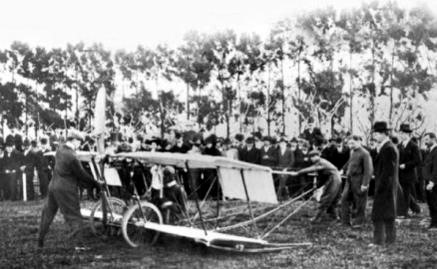
The machine was designed and built by the four (!) brothers Escofet and Enrique Martinez Velazco together with the Frenchman Henri de Rosiers. It was built as a glider then fitted with an Anzani engine but flight could not be achieved. Parts of the Escofet I were used in the second model. The Escofet II was momentous as it was the first machine in Uruguay to have actually flown on August 26, 1910. This first flight was also the last for the machine as on landing after about 200 meter it crashed severely, wounding the pilot.
Parts of the Escofet I were used in the second model.
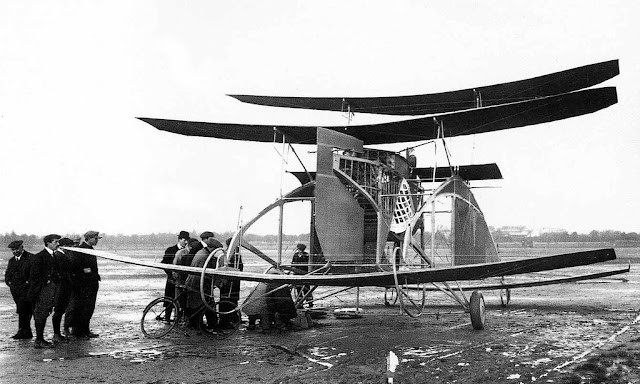
A monstrous multiplane, created by Edouard Vedovelli. Debuted at Issy-les-Moulineux, Paris, in 1910. Continuously tested and modified until it was abandoned in 1912. Press referred to it as “L’Appareil Fantôme d’Issy-les-Moulineaux” or “The Phantom Machine of Issy-les-Moulineux”.
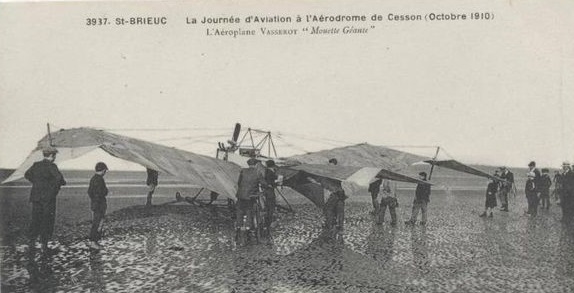
Built in 1910 by Jean-Marie Vasserot with the assistance of a carpenter named Louis Houard, who also designed the engine. There is apparently no evidence that it flew successfully, although it is reported by Opdycke to have flown 100 meters at the beach at Cesson on November 13, 1909 as the Vasserot-Delassor Monoplane. Opdycke was most likely mistaken; confusing it with Vasserot’s glider model which made several flights in 1909 from the cliffs at Cesson. M. Delassor is unknown at this time.
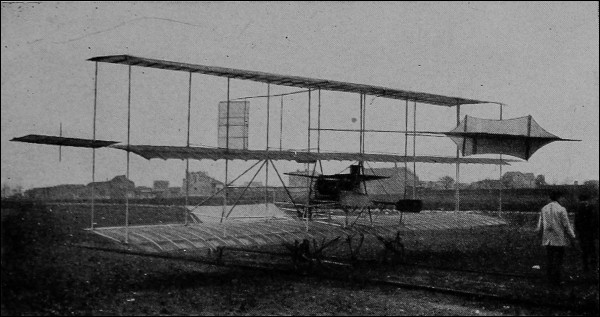
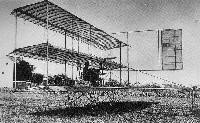
In 1910 John Van Pomer built a single-seat copy of Curtiss A, one of the undocumented first attempts by early home-builders. Based on the then-popular Wright design, power was a 35hp Kemp engine.
A colleague, who as a teenager helped with the construction, said that he once had ridden on the wing in one of its short flights, which were always downhill and never involved turns.
The aircraft was located in a barn and recently restored to display condition at Empire State Aerospace Museum, Schenectady County airport NY.
Melvin Vaniman built his own aeroplane in 1906… a triplane, in fact… the first ever triplane. Made of three arched planes, supported by a frame of steel tubes, each measuring 11 meters (36-feet) in length and 2 meters 20 cm (7.2-feet) in breadth. Total surface area: 72 (square) meters (775-square-feet). 70/80 HP Antoinette engine with 8 cylinders driving a propeller with two arms placed to the rear. The length is six meters (19.7 feet). In front, two elevators (or rudders): one horizontal and placed in the lower part, serves to control the altitude; the second, vertical, placed about 2/3 of the height of the machine, controls the direction and the turning, whether one tilts to the right or the left. The function of warping the wings is made by means of an arrangement placed on the shoulders of the aviator, and the direction to the right or the left by means of two pedals. Total weight: 500 kilograms (1,102.3-pounds).
There seems to be some discrepancy over whether or not his triplane actually flew. In 1907 Vaniman appears to have given up on aeroplanes saying: “I once had great faith in aeroplanes… I am firmly set in my belief that the aeroplane will never be a cargo carrier.”
Vaniman did not participate in the 1909 Reims air show… because he was already heavily at work on his dirigible, and therefore, there is no way anyone anywhere saw him fly at Reims some 150 meters (492 feet).
The 1911-series of 75 Aviation cards from Wills’s shows the Vaniman triplane in flight… and despite the date, it actually shows the earlier machine… perhaps more for what they hoped it actually represented… a triplane…
The two machines are basically the same: a triplane, with twin-boom outriggers, a high rectangular vertical surface, a single pusher propeller. But the two Vaniman triplanes are otherwise quite different.







 All Aero