In 1912 Vickers produced Type 18 Destroyer for Admiralty; pusher-engined gun-carrying fighter from which evolved, via successive E.F.B. (Experimental Fighting Biplane) prototypes, the F.B.5 and F.B.9 “Gunbus” fighters of First World War.
Pioneers
Vickers No.VIII monoplane
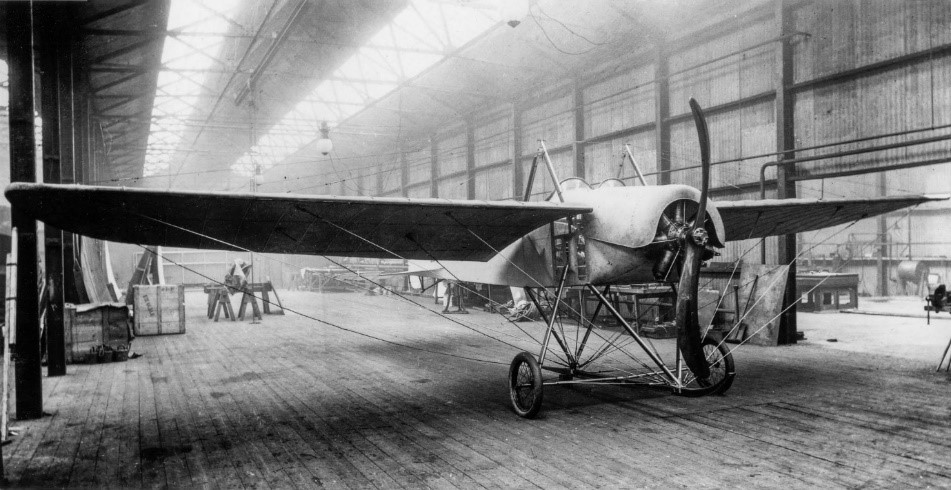
The Vickers No.8 Monoplane was built at Erith and displayed at the Fourth International Aero Show at Olympia, in February 1913. This aircraft resembled the No.6 Monoplane and seated its two occupants side-by-side and had a twin wheel undercarriage with a single central skid.
The elevators were aerodynamically balanced and the triangular fin and rudder resembled that used on the No.7 Monoplane. The 70 hp Gnome engine, with front and rear plate mountings, drove a two-blade propeller and was cowled over the upper part of the engine.
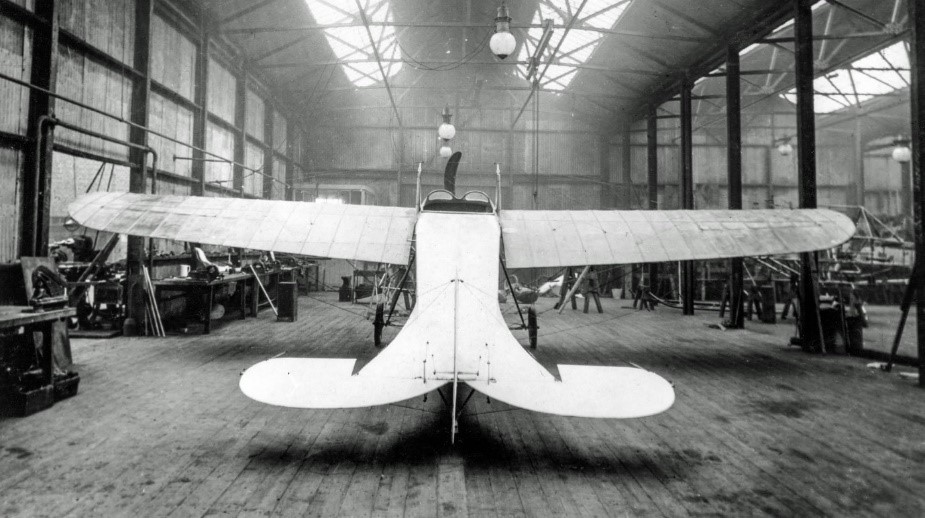
Performance figures were also quoted with an 80 hp Gnome fitted. As with the other Vickers monoplanes, the fuselage structure was of steel tube construction. Transparent ‘Cellon’ panels were provided in the lower cockpit sides and floor to improve the crew’s view of the ground. The cockpits were also provided with small transparent windshields.
The tailplane was formed by splaying out the rear longerons. The machine was designed to fold, allowing it to be transported by road mounted on a wooden trailer.

Only one was built.
Powerplant: One 70 hp Gnome rotary
Span: 34’6″
Empty weight: 700 lb
Speed: 45-69 mph
Endurance: 3 hours 30 min
Capacity: Pilot and passenger
Price: £1300
Vickers No.VII monoplane
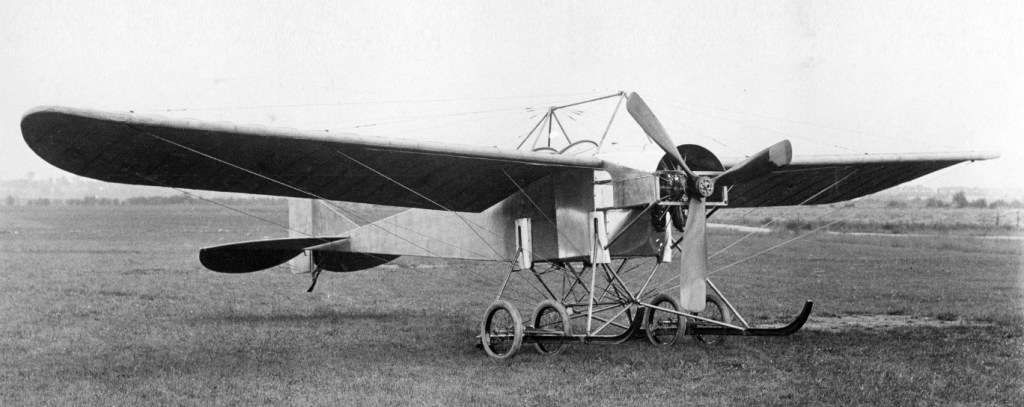
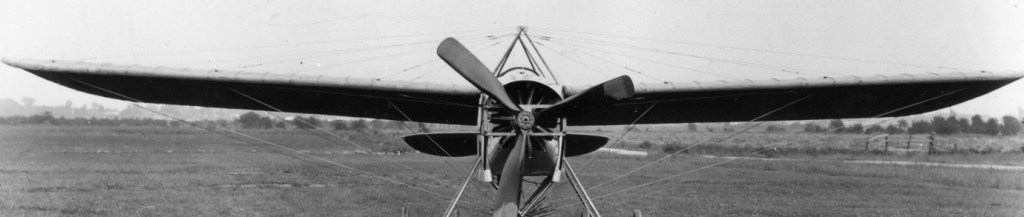
The Vickers No.7 Monoplane returned to the same configuration as the No.5 Monoplane. It accommodated the two occupants, seated in tandem and featured two-skids and a four-wheel undercarriage as used on the earlier machines. Power was provided by a 100 hp Rolls-Royce Gnome rotary engine driving a three-blade propeller.
The tail surfaces were again modified, with a fixed fin ahead of a re-shaped, unbalanced rudder. The Gnome engine was supported by a front mounting, with the upper part of the engine being cowled, presumably to prevent hot oil being thrown into the face of the front seat occupant.
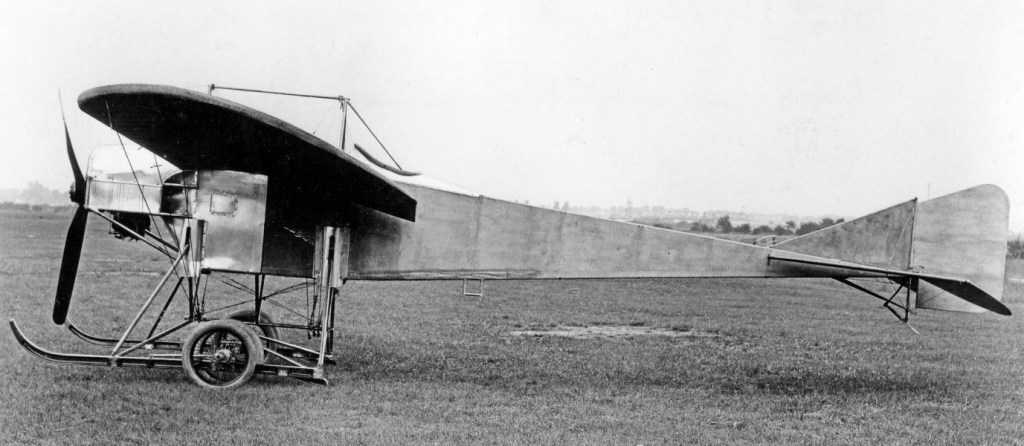
The Vickers No.7 Monoplane was flown for the first time by Robert Barnwell at Brooklands on 1st January 1913. However, this aircraft was later reported to have been turned over by a student pilot on 4th October 1913, after which nothing more is heard of it. It is assumed that the company decided not to repair it for further use.
Engine: 100 hp Gnome
Span: 34’6″
Length: 25′
Weight all-up: 1200 lb
Speed: 70 mph
Range: 350 miles
Seats: 2
Vickers No.1

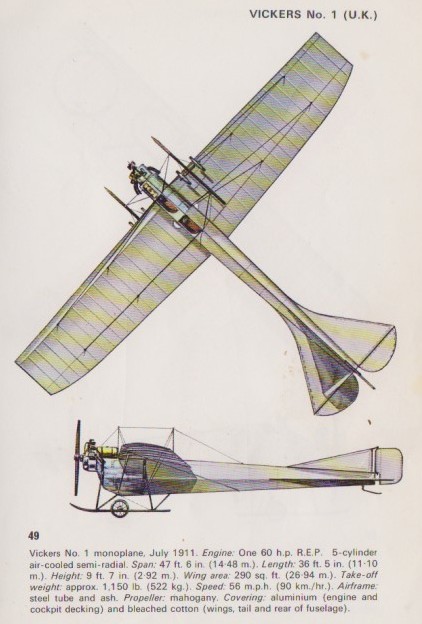
The 1911 Vickers No. 1 monoplane was designed and built by Vickers Aircraft in the UK
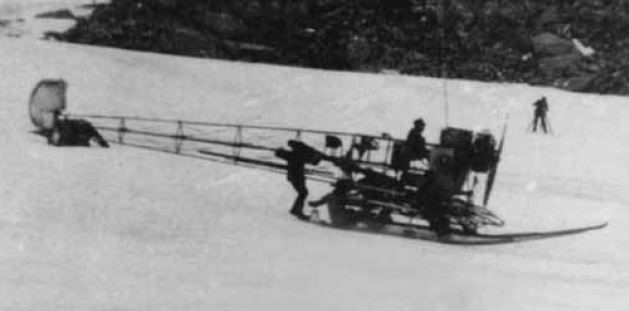
The Vickers No 1 was based on a REP design, but used originally designed wings. It was powered by a 5-cylinder, air cooled REP engine developing 60 h.p. The second airframe was sold to Douglas Mawson for possible use in an Antarctic expedition, but was badly damaged in a crash landing at Adelaide in October 1911. The remains (the fuselage and engine) were used by the expedition as a motorized sledge or “air tractor”, but engine problems made it more or less useless. The remains are buried in the ice at Cape Denison, where efforts have been made to retrieve it.
Span: 47’6″
Weight: 1000 lb
Speed: 56 mph
Vickers (Aviation) Ltd / Vickers-Armstrong
Vickers was formed in Sheffield as a steel foundry by the miller Edward Vickers and his father-in-law George Naylor in 1828. Naylor was a partner in the foundry Naylor & Sanderson and Vickers’ brother William owned a steel rolling operation. Edward’s investments in the railway industry allowed him to gain control of the company, based at Millsands and known as Naylor Vickers and Company. It began life making steel castings and quickly became famous for casting church bells. In 1854 Vickers’ sons Thomas (a militia officer known familiarly as ‘Colonel Tom’) and Albert joined the business and their talents – Tom Vickers as a metallurgist and Albert as a team-builder and salesman – were key to its subsequent rapid development. “Its great architects,” the historian Clive Trebilcock writes, “Colonel T.E. (1833-1915) and Albert (1838-1919) Vickers… provided both inspired technical leadership… and equally astute commercial direction. Both men were autocrats by temperament, but neither shunned advice or avoided delegation; each, but particularly Albert, had a marked gift for the selection of talented subordinates.”
Vickers (Aviation) Ltd / Vickers-Armstrong Article
In 1863 the company moved to a new site in Sheffield on the River Don in Brightside.
The company went public in 1867 as Vickers, Sons & Company and gradually acquired more businesses, branching out into various sectors. In 1868 Vickers began to manufacture marine shafts, in 1872 they began casting marine propellers and in 1882 they set up a forging press. Vickers produced their first armour plate in 1888 and their first artillery piece in 1890.
Vickers bought out the Barrow-in-Furness shipbuilder The Barrow Shipbuilding Company in 1897, acquiring its subsidiary the Maxim Nordenfelt Guns and Ammunition Company. at the same time, to become Vickers, Sons & Maxim.
Ordnance and ammunition made during this period, including World War I, was stamped V.S.M.
The yard at Barrow became the “Naval Construction Yard”. With these acquisitions, Vickers could now produce a complete selection of products, from ships and marine fittings to armour plate and a whole suite of ordnance. In 1901 the Royal Navy’s first submarine, Holland 1, was launched at the Naval Construction Yard. In 1902 Vickers took a half share in the famous Clyde shipyard John Brown and Company.
Further diversification occurred in 1901 with the acquisition of a proposed business which was incorporated as The Wolseley Tool and Motor Car Company and in 1905 the goodwill and patent rights of the Siddeley car. In 1911 a controlling interest was acquired in Whitehead and Company, the torpedo manufacturers.
In 1911 the company name was changed to Vickers Ltd and expanded its operations into aircraft manufacture by the formation of Vickers Ltd (Aviation Department) on March 28, 1911, under Capt. H. F. Wood, and a Vickers School of Flying was opened at Brooklands, Surrey on 20 January 1912. Production rights for Esnault-Pelterie REP tractor monoplane obtained in 1911; several variants built before First World War.
In 1912 Vickers produced Type 18 Destroyer for Admiralty; pusher-engined gun-carrying fighter from which evolved, via successive E.F.B. (Experimental Fighting Biplane) prototypes, the F.B.5 and F.B.9 “Gunbus” fighters of First World War. Later front-gunned tractor-engined F.19 was less successful. During war also built RAF B.E.2 series, B.E.8, F.E.8, and S.E.5a and Sopwith 1 1/2-Strutters under license. Vickers Vimy of 1917 remained standard RAF bomber throughout 1920s: one used by Alcock and Brown for first non-stop Atlantic crossing by airplane on June 14/15 1919. Vimy Commercial was 11 -passenger airliner with enlarged fuselage; Vernon troop transport developed from this.
In 1919, the British Westinghouse electrical company was taken over as the Metropolitan Vickers Electrical Company; Metrovick. At the same time they came into Metropolitan’s railway interests.
Vimy and Vernon succeeded respectively by Virginia and Victoria in mid-1920s, followed by Pegasus engined development, the Valentia.
By the end of 1924 Armstrong’s was virtually bankrupt. The bank of England discreetly moved in, and eventually brought pressure to force a merger with Vickers, using the Sun Insurance Company as their front to guarantee the new company, now called Vickers Armstrong. It was a condition of the rescue that the new company would restrict themselves to ship building, heavy engineering, and predominantly armaments.
A reorganisation during 1926 led to the retention of the rolling stock group: Metropolitan Carriage wagon and Finance Company and The Metropolitan -Vickers Company and the disposal of: Vickers-Petters Limited, British Lighting and Ignition Company, the Plywood department at Crayford Creek, Canadian Vickers, William Beardmore and Co, and Wolseley Motors.
In 1927, Vickers merged with the Tyneside based engineering company Armstrong Whitworth, founded by W. G. Armstrong, to become Vickers-Armstrongs, Ltd. Armstrong Whitworth had developed along similar lines to Vickers, expanding into various military sectors and was notable for their artillery manufacture at Elswick and shipbuilding at a yard at High Walker on the River Tyne. Armstrongs shipbuilding interests became the “Naval Yard”, those of Vickers on the west coast the “Naval Construction Yard”. Armstrong Whitworth Aircraft was not absorbed by the new company.
In 1928 the Aviation Department became Vickers (Aviation) Ltd and four months later acquired Supermarine, which became the “Supermarine Aviation Works (Vickers) Ltd”. In 1938, both companies were re-organised as Vickers-Armstrongs (Aircraft) Ltd, although the former Supermarine and Vickers works continued to brand their products under their former names. Supermarine became Vicker-Supermarine in 1929. 1929 saw the merger of the acquired railway business with those of Cammell Laird to form Metropolitan Cammell Carriage and Wagon (MCCW); Metro Cammell.
Vickers’ own products continued in early 1930s with Vildebeest torpedo- bomber and Vincent general-purpose biplane. June 1935 saw first flight of Pegasus engined long-range Wellesley bomber, first RAF aircraft to use system of geodetic construction devised by Dr. B. N. (later Sir Barnes) Wallis, who remained head of research until early 1970s. Subcontract production included Armstrong Whitworth Siskin IIIAs (1929-1930), Hawker Harts (1932-1934) and Hart Trainers (1936). In March 1936 the prototype was flown of R. J. Mitchell’s supreme design, the Supermarine Spitfire; and in June 1936 prototype of Vickers Wellington twin-engined bomber.
Vickers’ main concern up to and during Second World War was production of Wellington bomber and Avro Lancaster; Wellington replaced at end of war and early postwar by its non-geodetic successor, the Warwick. In August 1946 came first flight of VC1 Viking, first postwar British transport to enter airline service. Subsequent products included four-jet Valiant (first British V-bomber); world’s first turboprop airliner to enter production/service, the Viscount; and in 1959 the four-turboprop Vanguard airliner.
In 1960 the aircraft interests were merged with those of the Bristol, English Electric Company and Hunting Aircraft to form the British Aircraft Corporation. This was owned by Vickers, English Electric and Bristol (holding 40%, 40% and 20% respectively). BAC in turn owned 70% of Hunting. The Supermarine operation was closed in 1963 and the Vickers name for aircraft was dropped in 1965. Under the terms of the Aircraft and Shipbuilding Industries Act BAC was officially nationalised in 1977 to become part of the British Aerospace group, which exists today in the guise of BAE Systems.
The Aircraft and Shipbuilding Industries Act also led to the nationalisation of Vickers’ shipbuilding division as part of British Shipbuilders. These had been renamed Vickers Armstrong Shipbuilders in 1955, changing again to Vickers Limited Shipbuilding Group in 1968. This division was privatised as Vickers Shipbuilding and Engineering Ltd (VSEL) in 1986, later part of GEC’s Marconi Marine. It remains in operation to this day as BAE Systems Submarine Solutions.
With their steelworking operations also nationalised into British Steel the remnants of Vickers became Vickers plc. In 1986, Vickers acquired the armaments manufacturer Royal Ordnance Factory, Leeds, which became Vickers Defence Systems. Other acquisitions included automotive engineers Cosworth in 1990, waterjet manufacturer Kamewa in 1986 and Norwegian marine propulsion and engineering company Ulstein in 1998. 1998 also saw the sale of Rolls-Royce Motors and Cosworth to Volkswagen Group for £430 million, beating out BMW’s offer of £340 million.
Vickers remained independent until 1999 when the then Vickers plc was acquired by Rolls-Royce plc who sold the defence arm to Alvis plc, which became Alvis Vickers. Vickers plc and the subsidiaries retained by Rolls-Royce were renamed Vinters in March 2003. This Vickers name lived on in Alvis Vickers, until the latter was acquired by BAE Systems in 2004 to form BAE Systems Land Systems.
BAE Systems announced on 31 May 2012 that the ex Vickers Defence Systems factory on Scotswood Road, Newcastle would close at the end of 2013.
Vert Poisson Volante / Flying Fish

The “Flying Fish” of 1858, designed by Camille Vert shown here during the presentation of the machine in 1859 at the Palais de l’Industrie in Paris.
A description of the airship was “Two propellers are placed under the balloon, at the extremity of a horizontal axis and the vertical plane passing through the length of the device, that is to say one at the front, the other at the back, and united by a steam engine at the center of the nacelle, are used to direct the Flying Fish. Tractive effort is directed onto the frame solidly fixed around the aerostat.”
Demonstrated in the presence of the French emperor Napoleon III, the airship, which had an ingenious parachute system for the safety of its passengers, functioned satisfactory as it turned at will in all directions when in the air. The inventor, after being praised by His Majesty, was authorized to make a public exhibition in the Palace of Industry.

Vernander Swallow / Самолет АПВ

Designed by a collective [Аэроплан АПВ (Коллективный)] in 1909 under Alexander Petrovich Vernander (Александр Петрович ВЕРНАНДЕР – 1844-1918), professor of the Military Academy of Engineering, then second chief of the engineering bureau in Gatchina. Among the seven aircraft constructed in Gatchina one was christened „ласточку“ – swallow – a triplane that followed the Wright design but with curved wings, its propulsion consisting of a 25 hp REP engine, that drove two inward slanted propellers via bevel gear, to centre the air stream onto the rudder’s sides. Construction began in St. Petersburg in 1909, but the machine was not completed when construction ended in 1910.
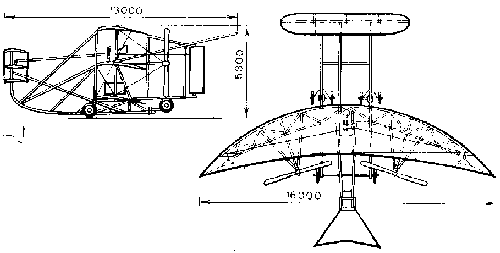
Verdaguer 1909 multiplane

This Spanish “Multiplano”, with seven wings and four horizontal control surfaces, was designed by Francisco Verdaguer and built in 1909 at the “A.L.A.” (Association de Locomocion Aeria) of Barcelona.
Vendome La Moustique
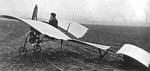
The 1909 Vendome “La Moustique” (Mosquito) monoplane was designed and built by Raoul Vendome in France.
Vendome No.3

The 1909 Vendome No. 3 monoplane was designed and built by Raoul Vendome in France.
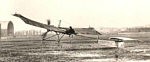
Vendome No. 3
Span: 37’9″
Length: 31’2″
 All Aero