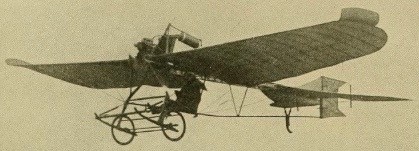
Gaston Vinet was a well-known French car manufacturer and coachwork builder in the 1900s, who became interested in airplanes around 1904. He started with the construction of gliders, then built a series of monoplanes between 1910 and 1913. The first Vinet monoplane (the 1910 type A) was designed after extensive research on the curvature of the wings, resulting in the characteristic upturned tips, and it was extensively tested with different centres of gravity to achieve maximum stability. The pilot was seated in a gondola under the wings. This arrangement lowered the center of gravity and provided good longitudinal and transverse stability.
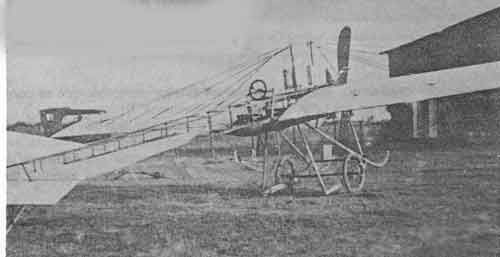
Claimed to be the first powered aeroplane built in Mexico (a claim sometimes made for all of Latin America), by Juan Guillermo Villasana, Santiago Poveregsky and Carlos Leon in 1912.
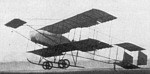
Suggested not to be a direct copy of a Deperdussin, but except for the uncovered fuselage, they may be indistinguishable.
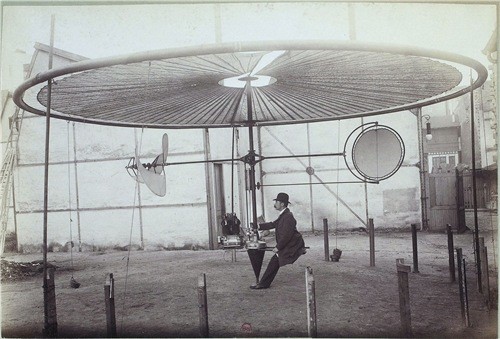
Early in 1914 Villard built a second model with a frame made of steel tubes. An Anzani 100hp radial engine was mounted on top of a central tripod structure to which the rotor blades were attached. Movements of the pilot’s seat enabled the aircraft’s centre of gravity to be shifted. There was also a small tail rotor 60 centimetres in diameter. Villard ‘s tests were brought to a swift end by the German invasion of Belgium.
Félix Henri Villard was born on August 14, 1869 in France, in the village of Torteron. He trained to be an engineer, and on April 22, 1901, he submitted his first patent application, and by July he built his helicopter in metal.
On September 26, 1916, Felix Henri Villard died from wounds received on the fronts of the First World War at his mother’s house in Cahors.
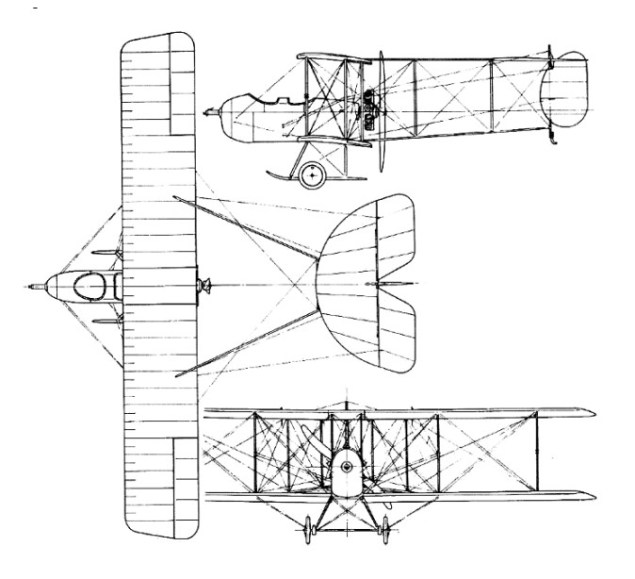
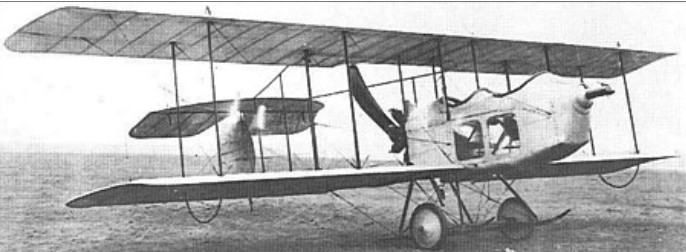
In December 1913, a third Vickers Experimental Fighting Biplane, the E.F.B.3, made its debut. The slight overhang of the top wing was eliminated to result in an equi-span biplane, the fuselage nacelle underwent further redesign, the celluloid windows being eliminated, and, most important, ailerons on both upper and lower wings supplanted the wing-warping control of its predecessors. The 100hp Gnome Monosoupape rotary was retained as was also the 7.7mm Vickers gun. Displayed at the Aero Show held at Olympia in 1914, the E.F.B.3. was the subject of an order from the Admiralty for six aircraft placed in December 1913. This contract was subsequently taken over by the War Office, the six aircraft embodying a number of modifications – at least one was fitted with an eight-cylinder Vee-type 80hp Wolseley engine – and being referred to as the Vickers No (or Type) 30. These were to lead in turn to the E.F.B.5 and F.B.5 Gunbus.
Engine: 100hp Gnome Monosoupape Max take-off weight: 762 kg / 1680 lb Empty weight: 476 kg / 1049 lb Wingspan: 11.38 m / 37 ft 4 in Length: 8.38 m / 28 ft 6 in Height: 2.97 m / 10 ft 9 in Wing area: 35.77 sq.m / 385.02 sq ft Max. speed: 97 km/h / 60 mph Range: 483 km / 300 miles
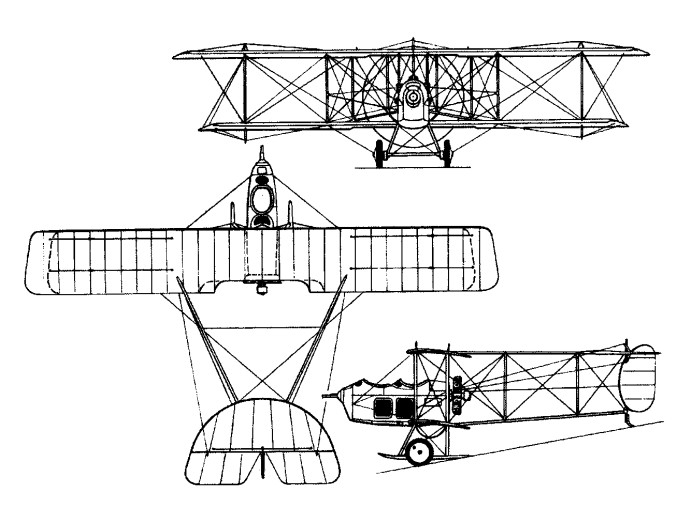
Following the loss of the E.F.B.1, Vickers undertook major redesign of its gun carrier while retaining the basic configuration to result in the E.F.B.2, again against an Admiralty contract. The E.F.B.2 eliminated the wing stagger of the previous aircraft and increased the span of the lower wing while retaining warping for lateral control. The fuselage nacelle was redesigned and large celluloid windows were inserted in its sides; the angular horizontal tail surfaces gave place to surfaces of elliptical form and a 100hp Gnome Monosoupape nine-cylinder rotary engine was fitted. The 7.7mm machine gun on a ball-and-socket mounting in the forward cockpit was retained, and the E.F.B.2 entered flight test at Bognor in the autumn of 1913, but crashed there during the course of October.
Max take-off weight: 798 kg / 1759 lb Empty weight: 476 kg / 1049 lb Wingspan: 11.76 m / 39 ft 7 in Length: 8.89 m / 29 ft 2 in Height: 2.92 m / 10 ft 7 in Wing area: 35.30 sq.m / 379.97 sq ft Max. speed: 97 km/h / 60 mph Range: 241 km / 150 miles
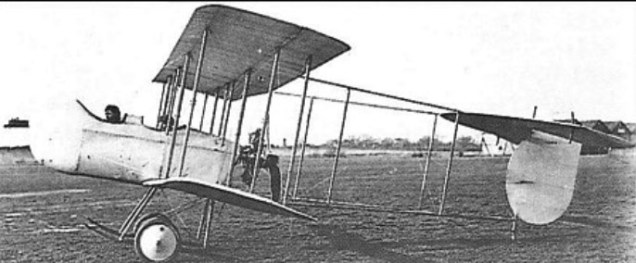
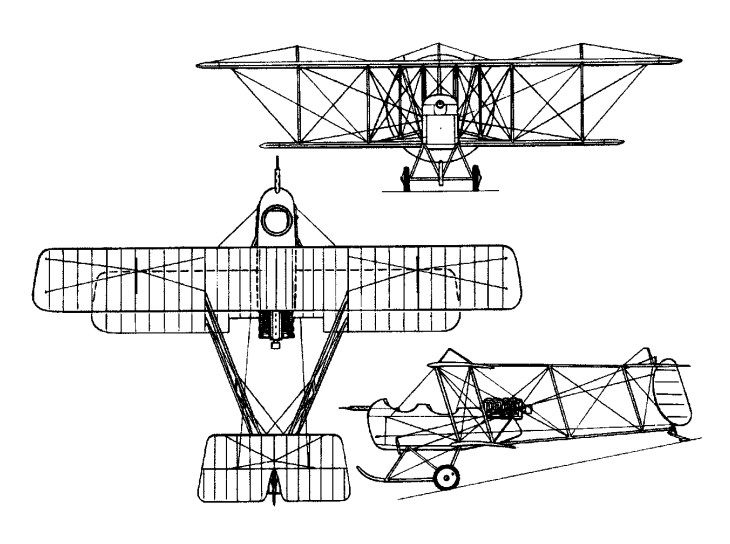
On 19 November 1912, Vickers received a contract from the Admiralty for an experimental fighting biplane armed with a machine gun. Various configurations were investigated before the desirability of placing the gunner in the extreme nose of the aircraft, in order to achieve a clear field of fire, led to choice of a fuselage nacelle carrying at its rear an engine driving a pusher propeller. This nacelle was mated with an unequal-span heavily-staggered biplane configuration, the tail surfaces being carried by paired and vertically disposed booms attaching to the upper and lower rear wing spars on each side of the engine.
Designated E.F.B. (Experimental Fighting Biplane) 1 and dubbed “Destroyer”, the Vickers aircraft was armed with a single 7.7mm Maxim machine gun on a mount affording 60 degrees elevation and traverse. The airframe of the E.F.B.1 was primarily of metal construction, the nacelle accommodating the pilot and gunner, and carrying an 80hp Wolseley eight-cylinder Vee-type engine, being of steel tube with duralumin skinning. Wing warping was employed for lateral control.
Prior to its first flight, the E.F.B.1 was displayed at the Aero Show held at Olympia, London, in February 1913.
The gun was fitted for the first flight test, made at Joyce Green, but this rendered the aircraft so nose-heavy that it briefly left the ground, then nosed down, struck the ground and turned over.
Max take-off weight: 1207 kg / 2661 lb Empty weight: 798 kg / 1759 lb Wingspan: 12.19 m / 40 ft 0 in Length: 8.38 m / 28 ft 6 in Height: 3.63 m / 12 ft 11 in Wing area: 35.77 sq.m / 385.02 sq ft Max. speed: 113 km/h / 70 mph



 All Aero