Willard-Curtiss

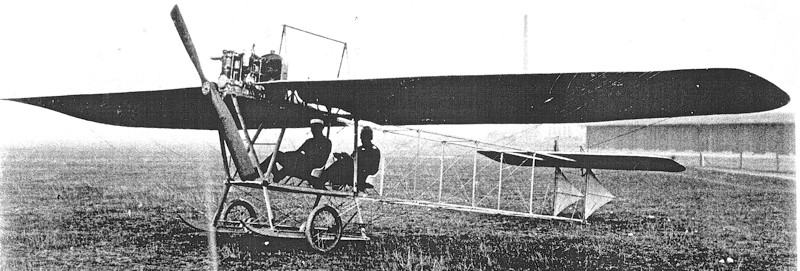
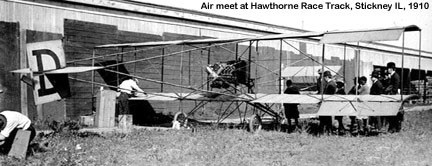
Charles F Willard, who had been leasing a Curtiss airplane for his exhibition flights, returned it, and reportedly designed a similar machine customized to his requirements, but still leased the motor from Curtiss (the one used on Curtiss’ Rheims Racer). This apparently was distinct from the 1910 Banshee Express, which he implied was his design, but was really another Curtiss product.

First flying on 12 August 1910, two were built, the second of which, christened simply The Express, had 50hp five-cylinder Gnôme rotary. Willard set a payload record with this craft by carrying two passengers with him on 14 August 1910.

Engine: Curtiss V-8, 63hp
Seats: 2

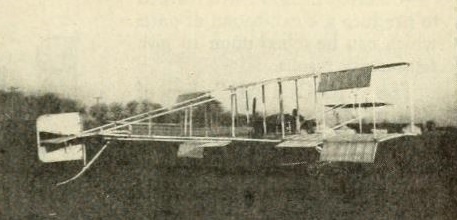
Wilcox White Ghost

Mr. Wilcox is now engaged at the factory of Moore and Morgen automobile body manufactures, 600 W. Fifth Street, here in the City of New York, building two more aeroplanes, which will be ready to try out at Garden City, L. 1., in about two or three weeks. Louis Strang has purchased one of these machine for $4,500. An effort is being made to have the other one ready for the International Aviation Meet at Belmont Park, L. 1., to defend the Cup won by Glen Curtis at Rheims. The machine which Wilcox has called the “White Ghost” will be operated by a professional aviator who has taken part in aero races abroad.

The Wilcox Aeroplane is modelled upon the Farnam style, but has a large number of decided improvements which, according to Captain Baldwin, make it the steadiest aeroplane on the field. Wilcox has formed a stock company for the purpose of building aeroplanes and has registered his machines in the United States Aeronautic Reserve in which about one thousand aeroplanes have been recorded. Aviators making the above registration, agree to give the use of their machines to the Government as scouts, absolutely free, should there be any wars.

Built in 1910 by Phillip W. Wilcox, the White Ghost was a two-place open cockpit biplane powered by a 50hp Rinek engine.

Wilcox The Columbia

In 1910 Philip W. Wilcox built his first aeroplane as the required thesis in the Civil Engineering Department, in the University carpenter shop and christened it, “The Columbia.” At the end of the spring term, the machine was taken out to Garden City, L. 1., and assembled at the Triaca School of Aviation. This work required about a month for completion. After the aeroplane had been put together, an engine from the Eastern Cordage Cos., weighing 275 pounds and developing fifty horsepower, was installed. The engine was constructed of cast iron cylinders pressed in macadamite.

The finishing touches on the aeroplane were completed about the fifteenth of June and the machine was taken out for a trial. But the engine refused to work on account of water leaking into the cylinders. Two new cylinders were then obtained from the Eastern Cordage Cos., and preparations made for another trial. Louis Strang, the famous automobile driver, who has become an enthusiastic aviator, was engaged to make the flight. The performance, however, was a failure, due to lack of speed, caused by trouble with the radiator. In running around the field, one of the wheels ran into a stump and the aeroplane was damaged to the extent of $400, Strang escaped from injury, only by a miracle.

It required three or four weeks to make the necessary repairs and get the machine ready for another flight. The next attempt was made by C. K. Hamilton. Owing to a defect in the running gear the machine collapsed after running about 200 feet, causing another smash-up. Hamilton, however, escaped any serious injury. After this unsuccessful flight, the design of the running gear was changed from the Farman style to the Curtis type.

After making this change Wilcox decided to try out the machine himself. The aeroplane went up like a bird to a height of one hundred or more feet and flew about three-fourths of a mile, circled, returned to the field and made a beautiful landing near the starting point Wilcox was so overcome with this successful flight and excitement, that he had to be dragged from the machine by Captain Baldwin, Clifford B. Harmon, Mr, Fairchilds and a number of other noted aviators who had witnessed the flight.

On the morning of June 26, Wilcox made another flight, but after he had reached a height of fifty feet, the propeller was caught by a wire and broken. The machine descended without damage. The necessary repairs were made, and another attempt was made on the afternoon of the same day. Due to lack of experience in guiding the aeroplane, the machine was overturned by the wind, fell to the ground and was broken to splinters, Wilcox escaped injury only by some mysterious chance.
Wiencziers Renneindecker

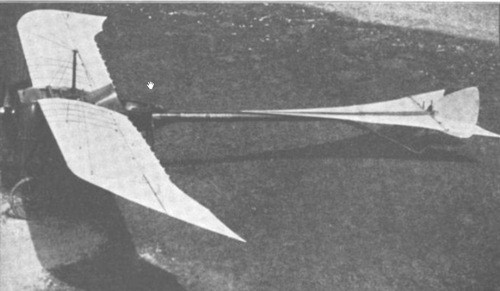
Built in Germany, the 1911 Eugen Wiencziers Renneindecker a very advanced monoplane with a very sleek fuselage which consisted of a metal tube only. The two wheel undercarriage could be folded back to the fuselage. The machine was intended as a two-seater, where the pilot sat enclosed and the passenger sat in a saddle just at his back on the steel fuselage, just like horse riding.

Wilms Dinosaur

Les Wilms, of 2142 Dayton Street, Chicago, had been experimenting in airship construction and navigation since 1895. His 1910 flying machine, besides framework and a seat for the operator, consisted of a canvas sustainer overhead, flails of canvas and a rudder of like material. The hand-propelled flails, the inventor said, acted on the principle of the feathers in a bird’s wings. The aircraft, which was named “Dinosaur,” was launched into space with the aid of an incline. Trial trips conducted privately northwest of Ravenswood manor were said to have been successful.