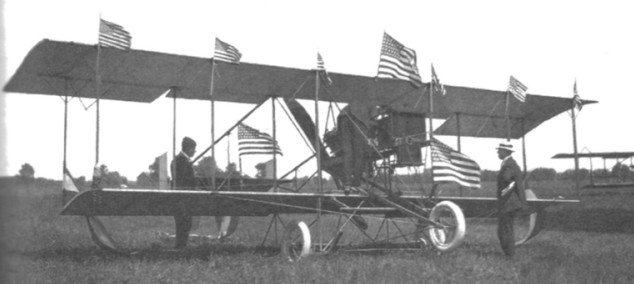
In early 1912, Osbert Edwin Williams created his second aircraft, the Williams Model 2. Williams’ initial aviation involvement, was with Albert S. Beavers of Scranton, who constructed a monoplane in 1910, and later, a biplane in 1911.
The Williams Model 1 had been abandoned sometime during the winter of 1912; as the pioneer aviator, Elling O. Weeks, was making test-flights of the new Williams Model 2 Pusher Biplane, at Forty Fort, Pennsylvania, by 22 May 1912.
Initially, the Model 2 had a central front skid, and single vertical fin/rudder, hinged at the leading edge of the elevator, similar in concept to the Santos-Dumont Demoiselle (but, not quite. The Demoiselle had its empennage hinged about a central “universal joint-type” device). The seat for the pilot was offset to the port, and the engine was centrally mounted. A full length “side curtain” running the entire length of the interplane struts just to the starboard of the engine, was shortened to fill only the upper portion of the interplane gap, by July of 1912. Ailerons were fitted on all wingtips, and a large central radiator was mounted directly in front of the Curtiss engine. By the summer, the four-wheel main undercarriage had been revised to two larger main wheels fitted to a central axle. Earlier photos, apparently taken in the winter of 1912, and in May, show two sets of twin wheels, attached to skids, similar in fashion to a Wright Model B. The wings were cut back to the trailing edge spar, to allow clearance for the “pusher” propeller. It was necessary to do this, owing to the location of the engine, and in order to obtain a proper center-of-gravity.
On 15 September 1912, the Model 2 suffered a serious accident and much damage; necessitating a reconstruction of the airframe. By November, the Model 2 was back in action, making aerial deliveries of newspapers. As rebuilt, the biplane sported a twin-wheel main undercarriage, a nosewheel, and twin, rectangular vertical rudders, now mounted at opposite ends of the elevator, replacing the earlier curved, centrally-mounted vertical rudder. In order to allow the rudders to move “in”, the elevator’s trailing edge span was reduced to allow inward motion. The offset pilot seat, and wheel-type controls, were retained, and the number “7″ was prominently displayed on the vertical rudders, in a photo taken on 20 November 1912. The ailerons were also increased in chord, and the interconnecting strut between upper and lower ailerons, was retained.
The Model 2 was the first aeroplane to be fitted with a pitot tube-type airspeed indicator. Williams’ invention, described in the November 1912 issue of Aeronautics (p 151) shows that it was a basically manometer, coupled with a ram-air tube, forcing a fluid up a vertical tube to indicate airspeed. Indeed,
It is certain that the Model 2 design continued to evolve for several years into several different variants. In 1913, the earliest Model 2 was used in the October 1913 New York Times “Aerial Derby.”
By 1915, Williams was operating a flying school at Long Lake, Fenton, Michigan; having relocated from Flint, Michigan. A solitary photo exists, taken there, which shows three incarnations of the Model 2. There was a two-place variant, with dual controls mounted on either side of the engine, and horn-balanced ailerons. A long-span variant used at the 1915 Michigan State Fair, and a variant with an extended upper span, and no lower wing ailerons. The last, apparently built in 1915, and known as; “The Banner.” It had thicker tires, and ailerons fitted to the upper wing, only. The “mystery plane” photo, shows this aircraft adorned with American flags at the August 1915 St. Clair County Fair at Port Huron, Michigan. But, while this machine was flown on throughout the country, the school machine, fitted with distinctive horn-balanced ailerons on the upper wingtips, was used into 1916.
Unfortunately, the only surviving, verifiable dimensions of the Model 2, are the dimensions of the Rome Turney radiator (30″ high, without the filler neck, and 3″ thick, at the core), and the diameter of the propeller (7′, curiously, almost the same as the 7′ 7″ diameter of the Beavers 1911 Biplane/Williams Model 1). But, there is also the curious story of W.P.A. Straith to contend with.
In additon to the aircraft he built, O.E. Williams also built a 125 hp eight-cylinder, water-cooled vee-type engine, similar to a 100 hp Curtiss Model O, the engine he apparently used throughout the career of the Model 2 (the Model 1 may have retained to 40 hp Rutenberger auto engine from its days as the 1911 Beavers Biplane). There were many notable graduates of the Williams School of Aviation. Among them; Clayton J. Brukner and Elwood Junkin of Waco fame. Lt. J. Thad Johnson, Lt. Cyrus Bettis, and Capt. E.G. Knapp, to name a few others.
Following a business dispute, and a change of the company name from the O.E. Williams Aeroplane Company to the Flint Aircraft Co., Inc.; Williams loaded his family into his 1916 Saxon touring car (which had fallen through the ice of Long Lake earlier that year), and relocated to Mobile, Alabama in 1917. At Mobile, Williams apparently constructed another Model 2, with an extended upper wing, fitted with horn-balanced, ailerons. Notably, the engine bearers were extended, as they were in the Straith Biplane. It was there, on 25 October 1917, that O.E. Williams was killed during an exhibition flight; flying at dusk in heavy winds.

 All Aero