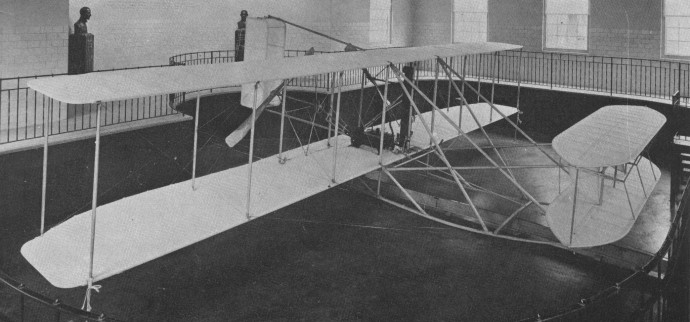
Wright Flyer III

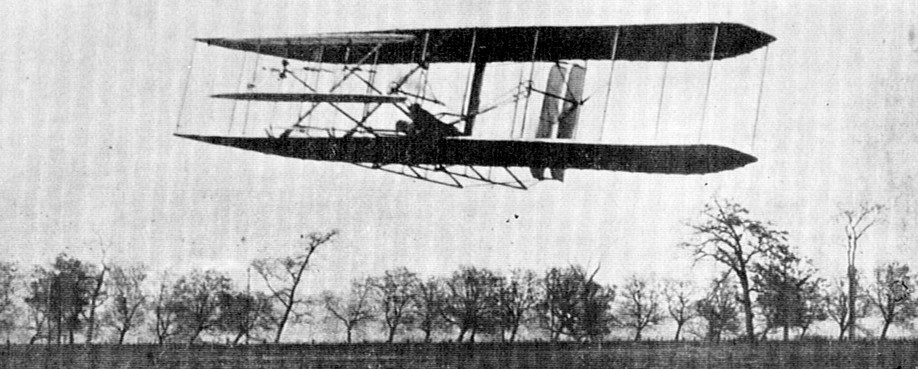
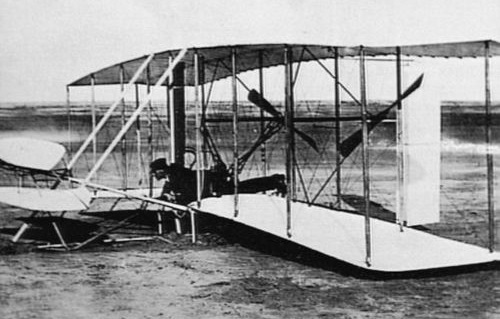
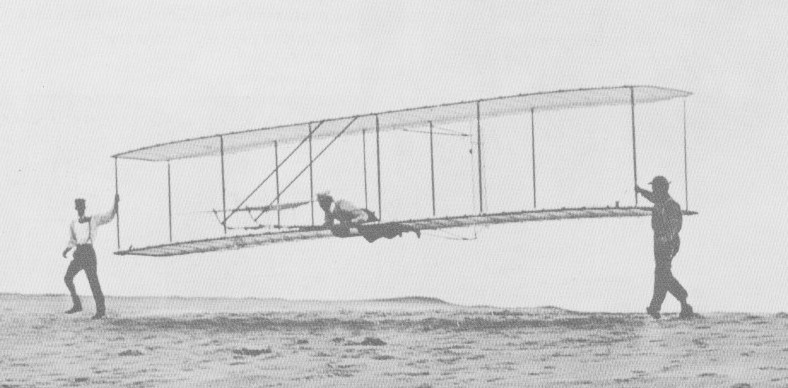
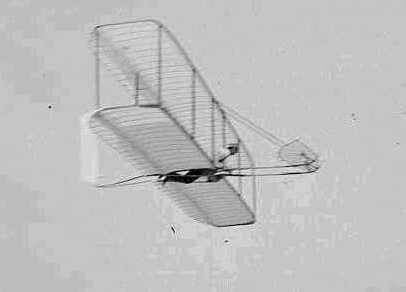
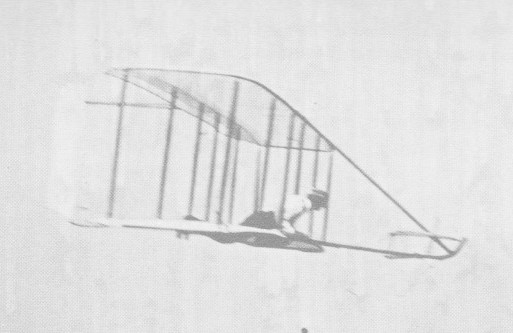
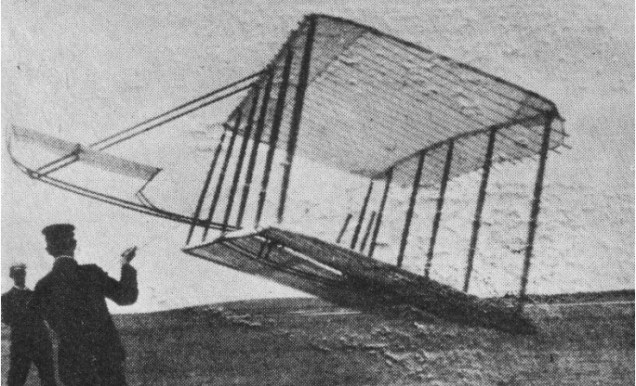
Ready now to perfect the process of learning to power- fly successfully, the Wrights built the Carillon Park machine, their Flyer III of 1905, on which they finally learnt the secrets of powered flight, and solved its basic problems. Their third Flyer was strengthened, lengthened, with a little less wing area and a little more area of front elevators and aft rudders. With this plane they could bank, turn, make circles and figures of eight, all with ease. But that was not all; for this new Flyer was splendidly robust and reliable: it could not only stand up to repeated landings on rough ground, but, by October of 1905, it had made two non-stop flights, each of over half-an-hour, during which it covered distances of over 24 miles on each occasion.

They flew this 1905 “Flyer” a little more than three hours in 49 flights, the longest of 38 minutes 3 seconds for a circular distance of 24 miles. It could bank, turn, fly figure-eights and stay airborne for half an hour, making 59 flights in 1905, including carry a passenger.

By mid-October 1905 the Wrights had completed almost four hours of powered flight with three successive aircraft in some 150 take-offs. No one else had flown for more than a few seconds.
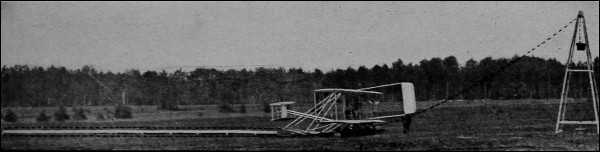
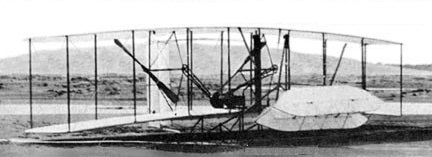
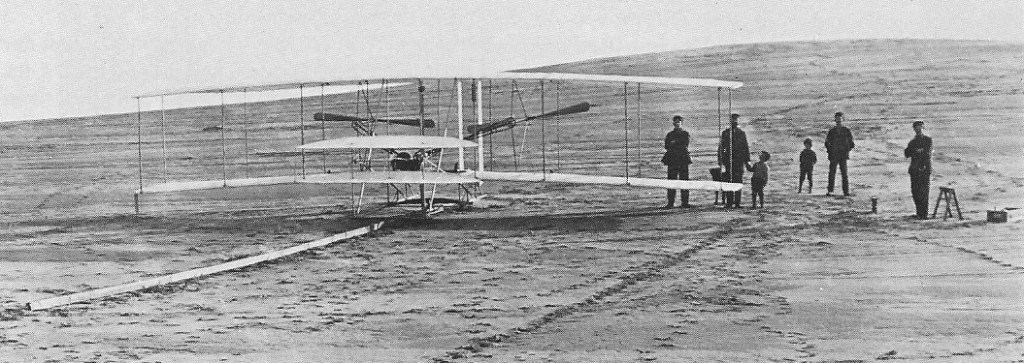
Wright Biplane on Starting Rail, showing Pylon and Weight

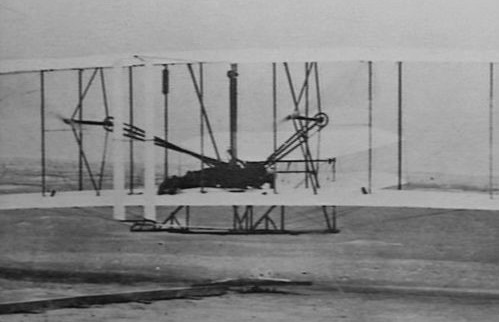
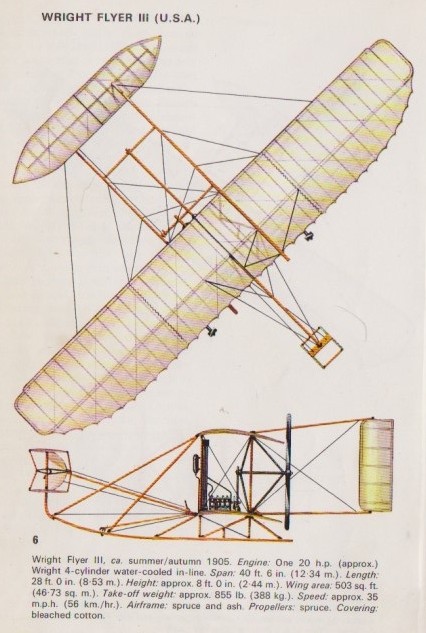
Although, in many respects, the Flyer III had a general resemblance to the first two machines, it was much more efficient. It was completed by the Spring of 1905: it was a biplane with a wing-span of 40ft 6in, the 15-20 horse-power motor driving two pusher propellers. The pilot, as in the two previous machines, lay prone to reduce head resistance. This new Flyer, like its predecessor of 1904, was taken to the Huffman Prairie, a 90-acre pasture at Simms Station, about eight miles northeast of Dayton, which was the world’s first aerodrome, and had been lent to the Wrights in 1904 by their friend Torrence Huffman, a Day-ton banker. The machine was flown by Wilbur and Orville from June 23 to October 16, and made over 40 flights. The longest flight of this famous “season” was on October 5, when the Flyer III (piloted by Wilbur) was airborne for no less than 38 minutes 3 seconds; it travelled over 24 miles, at an average speed of about 38 miles per hour, making more than 29 circuits of the pasture. The Flyer made many other excellent flights, under perfect control, including another one of over half-an-hour, one of 25 minutes, and three of over a quarter of an hour. No aero-planes, other than those made by the Wrights, could equal the performance of this Flyer until October, 1908, by which time the Wrights themselves were making flights of over 1½ hours’ duration. The one remaining problem was solved on this machine; how, by putting the nose down on tight turns, and gaining speed, a stall could be avoided. The Wrights knew that with this Flyer III they had a winner.

But owing to the difficulty of persuading the US Government to agree to buying a machine, and to the fear of industrial spying, the Wrights decided to remain grounded until satisfactory arrangements could be made for marketing their aircraft. They therefore occupied themselves with building several new Flyers and their engines, but they did not leave the ground between October 16, 1905, and May 6, 1908, when at last proper financial arrangements had been made.

Recalled from two-and-a-half years’ retirement, the Carillon Park Flyer III was then taken out of storage and altered so that it could accommodate the pilot and one passenger, both sitting upright. The machine was then dismantled and transported to the Kill Devil Hills in order to allow the brothers to regain their skill as pilots before they made their flights in public, in 1908, on the new aeroplanes they had built. They flew the Flyer III from May 6 to 14, and rapidly became as expert as ever. They also made history again; for on May 14, the brothers in turn took up their friend Mr. C. W. Furnas of Dayton, in the two first passenger flights of history, the best of these lasting 3 minutes 40 seconds and covering 212 miles, with Orville piloting.
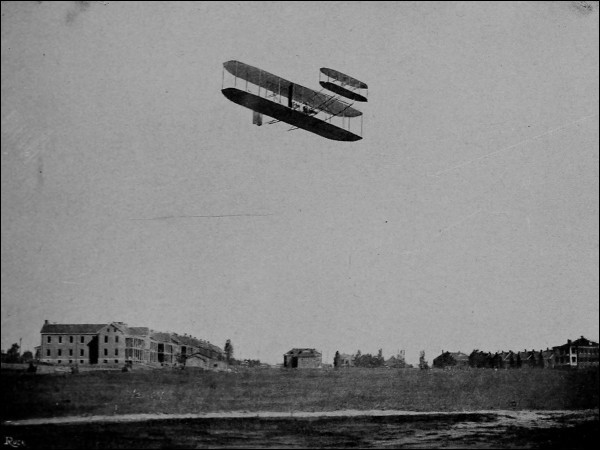
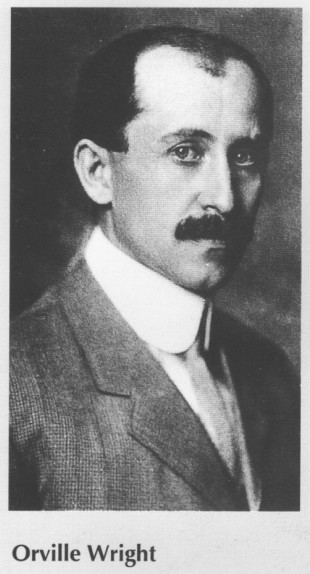
Orville Wright at Fort Myer, Va., 1908

In 1908 they launched their invention upon the World, Wilbur in France, Orville at Fort Myer near Washington. The World acknowledged their genius demonstrated by some 36 hours of controlled flight despite an accident to Orville through a broken wire.
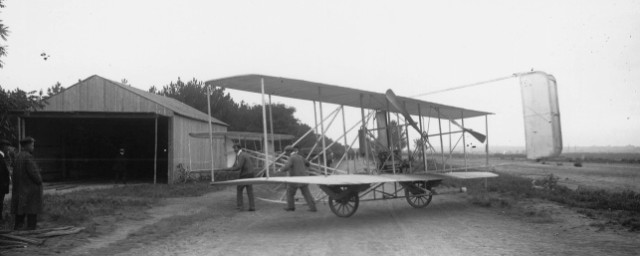
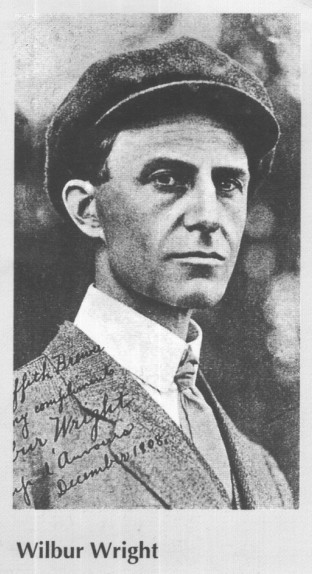
Wright Bros 1908 France

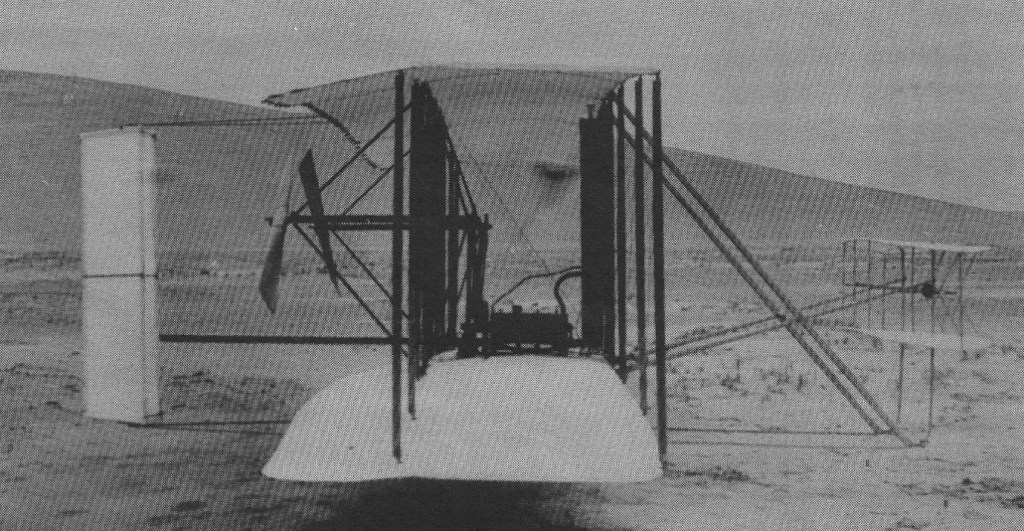
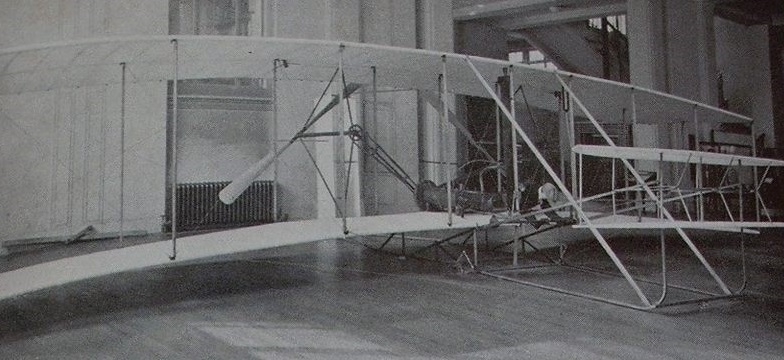
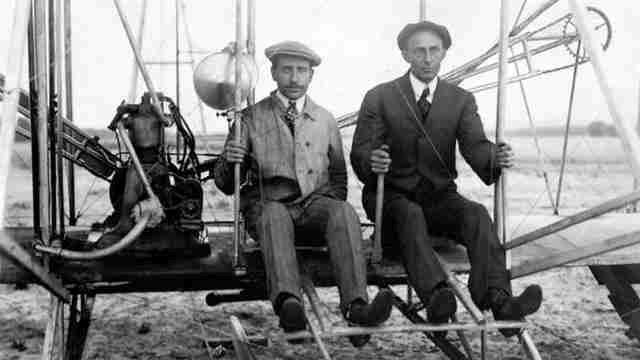
The Carillon Park Flyer III has many interesting points to note. It is a pusher biplane driven through a chain transmission by the engine lying on its side, and offset to starboard to allow for the weight of the pilot on the other side. The undercarriage of the machine consists of long skids, on which it landed at the end of a flight.

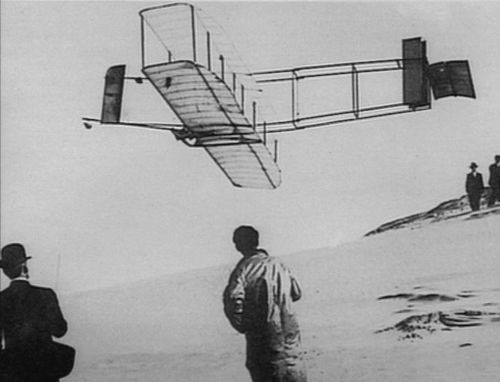
Hinged to the leading edge of the lower wing is the launching tow-rod, with its pin pointing down at the front end, over which the eye of the tow-rope is fitted. This rope ran forward to the end of the launching rail; then over a pulley-wheel; then back the whole length of the rail to the base of a wooden pylon (derrick) which stood behind the machine; then over another pulley-wheel, and up to the top of the pylon; then, it went over a third pulley-wheel fixed in the top of the pylon, and finally down a few feet to where it was fastened to a heavy weight. When the pilot was ready to take off with the engine running at full power, he released a catch which caused the weight to fall inside the pylon; this exerted a strong continuous pull on the rope, which rapidly towed the machine on its truck forward along the launching rail. When the machine reached the end of the launching rail, the pilot raised the front elevator, which resulted in the tow-rod meeting the cross-bar (joining the skids) as it rose, so that the eye of the rope was forced off the pin of the tow-rod. The Flyer was then moving at speed, and free, and became airborne; it then rose from the truck and was off on its flight. In 1905 the pilot lay prone (and well forward) on the lower wing, with his left hand grasping the elevator lever, and his right the horizontal lever which worked the double rear rudder. The curious U-shaped object seen on the lower wing is the warping cradle, into which the pilot fitted his hips, and to which are attached the cables which warp the wings by lowering the trailing (rear) edges at the end of one pair of wings, and simultaneously raising the trailing edges on the opposite side. To give his hips sufficient purchase to operate the warping system effectively, the pilot placed his feet on the foot-rest at the back. Other interesting items are the gasoline tank; the radiator; the tube-encased cycle-chains driving the propellers, one of which is crossed over in order to have the propellers revolving in opposite directions, and avoid torque; and the anemometer to record the airspeed.
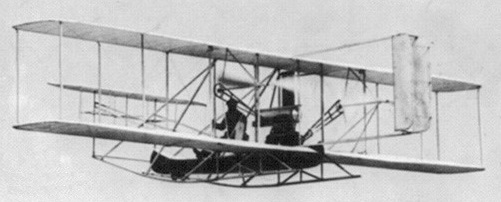
The 1905 Flyer III was offered to the US War Dept for evaluation, who turned it down when they couldn’t envision any practical use for a machine that flew. Modified in 1907 for demonstration flights, one earned national headlines. On 29 September 1909 Wilbur made a five-minute flight around the Statue of Liberty. To the amazement of the crowd, there was a red canoe attached to the bottom of the plane’s skis during that flight—if the plane went down into water, Wilbur reasoned, he could use the canoe to float to safety. This feat was repeated on 5/26/2003 by a Dayton group who had built a flying replica of Flyer 3.
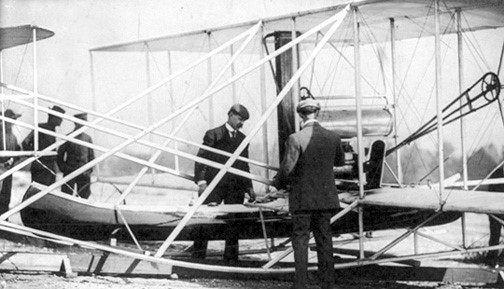
Wright Flier 3 Canoe attachment

It was Colonel E. A. Deeds, Chairman of the National Cash Register Company, who in 1946 had proposed that a permanent exhibition of early American methods of transportation be housed in Carillon Park. He then felt that the Wright brothers, who had become Dayton’s most famous citizens, and who had done so much of their work in Dayton, must be worthily represented in the exhibit; so he approached Orville Wright himself about this proposal. Orville at first suggested showing a replica of the famous “Kitty Hawk” machine of 1903 (the Wright Flyer I); but then he had another idea, and a much better one. He told Colonel Deeds that he thought it would be possible to assemble most of the original Wright Flyer III of 1905, Flyer II having been broken up, which he and his brother had flown so successfully at the Huffman Prairie; whereas a replica of the Flyer I would possess far less local interest, as it had only been flown at the Kill Devil Hills, and never at Dayton. This suggestion by Orville Wright was enthusiastically accepted by Colonel Deeds, and the delicate work of restoration was put in hand. The finished machine, in the elegant building specially constructed to house it, was displayed to the public for the first time in June 1950.
Gallery

Flyer 3
Length: 28 ft (8.5 m)
Wing span: 40 ft 6 in (12 m)
Wing area: 503 sq.ft
Weight empty: 710 lb (322 kg)
Flying wt approx: 930 lb
Speed 35 mph (56 kph)
Range 24 miles (38 km)
Engine One 20 hp Wright
No of flights: 49
Longest flight: 38 min 3 sec / 24.25 mile
Total flying time: 3 hr 5 min
First light: 23 June 1905

Flyer 3A
Length: 28 ft (8.5 m)
Wing span: 40 ft 6 in (12 m)
Wing area: 503 sq.ft
Flying wt approx: 950 lb
No of flights: 22
Longest flight: 7 min 29 sec / 5 mile
Total flying time: 30 min
First light: 6 May 1908
Wright Flyer II

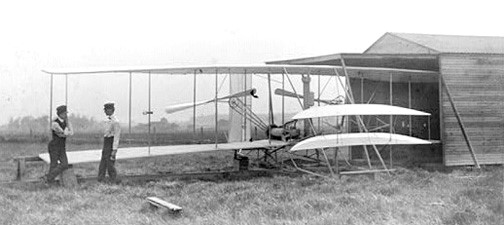
In 1904 the Wrights built their second Flyer on which they started to learn the unknown and difficult art of properly controlling a powered plane in the air. This aircraft was similar to the Flyer I, but had a new Wright engine of 15 20 horsepower and new propellers. First flown on 23 May 1904 near Dayton, at the Huffman Prairie, and with it the brothers made over 80 brief flights, including, on September 20, 1904, their first circle in the air. The Wrights in this season, also introduced their catapult launching technique.

Flyer II Huffman Prairie 1904

By the end of 1905, both brothers had made flights of more than 30 minutes, circling at very low altitudes.
With the new machine the Wrights flew for a total of 45 minutes in 105 flights, including two of five minutes and the memorable achievement of the first complete circle around the 68 acre Huffman Prairie at Simms Station, eight miles from Dayton. For the first time they used the take off accelerator with weight and derrick.

Wing span: 40 ft 4 in
Length: 21 ft 1 in
Wing area: 510 sq.ft
Flying wt approx: 915 lb
No of flights: 105
Longest flight: 5 min 4 sec / 2.75 mile
Total flying time: 45 min 5 sec
First flight: 23 May 1904

Wright Flyer I / Finningley Vintage Aircraft Group Wright Flyer I

Powerfully encouraged by the 1902 flights, the Wright brothers began immediately to construct a four-cylinder gasoline motor (its design based on a smaller unit they had already built to drive their wind tunnel) to power a still bigger aircraft to be tested during their next vacation, in the fall and winter of 1903. For the first time, they were confronted with the need to design screw propellers.

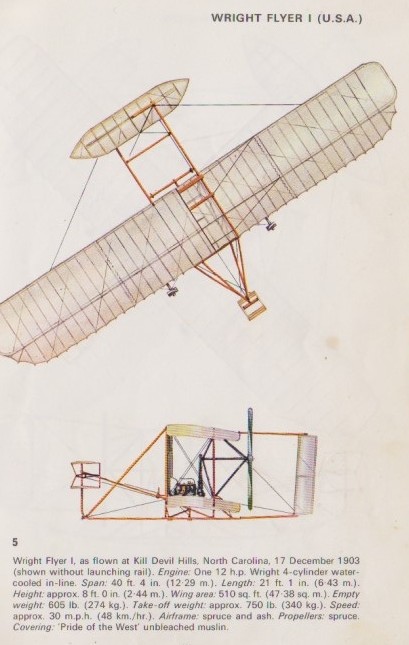
The airframe in which the first flights were made was an equal-span, unstaggered, biplane of 40ft 4in span and 510 sq ft wing area, with front biplane-elevator and aft twin-rudders, a half-gallon fuel tank and a cradle for a single, prone, pilot on the lower wing. Its empty weight was “a few pounds over 600 lb”. Loaded for the flights it weighed “a little over 745 lb” for a wing-loading of 1.46 lb per sq ft and a power-loading of 74.5 lb per hp. It was the fourth Wright-built biplane (and the first to be powered) since their first kite of August 1899, and it had deliberately been made unstable “to improve control”.

The power-plant was, like all the rest, designed and built by the Wrights in their bicycle shop at Dayton. It was a 3.3 litre (201 cu in) four-cylinder inline, horizontal water-cooled four-stroke, with low-tension magneto ignition. Running on “cooking” gasoline it was capable of 13 measured brake-horse-power at 1,750 r.p.m. and it achieved 132 lb of static thrust by driving two, 8ft 6in diameter opposite-rotating pusher propellers (likewise Wright designed and built) mounted on shafts between the mainplanes and driven through cycle-chains at a gearing of 23 to 8. Flight was sustained at 1,030 r.p.m. which yielded ten horsepower to the shafts.

Wright Flyer I – Wilbur and elevator damage after a short hop on 14 Dec 03

The new machine (which had cost them almost $1,000) was transported to their Carolina campsite in September 1903; while making preparations to test it, they continued to practice piloting with their 1902 glider. They encountered problems with the power transmission to the twin counter-rotating propellers of their new machine and it wasn’t until December 14 that they were ready to try a takeoff from their monorail “runway.”

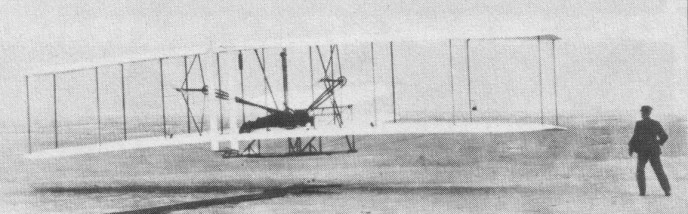
Success came three days later when four flights – the last the best, covering 852 feet in 59 seconds – were made. At 25 minutes to 11, Orville lay down on the lower wing, started its engine and, after a few minutes, rolled forward into the 27 kt wind, with Wilbur along side, holding a wingtip to balance it. The first flight on 17th December 1903 Orville covered only 120 feet, his speed was only 31 m.p.h. and the flight lasted just 12 seconds. The machine followed an undulating flight path just above the sands. The Flyer I was a canard design, believed by the Wrights to ensure greater control, but the first flight ended in a dive into the sand of the Kill Devil Hills as a result of over-correction of the forward elevator by Wilbur. It was damaged on the last landing and rather more thoroughly wrecked later by a gust of wind as Will and Orville, exhilarated beyond dreams, stood discussing their stupendous success with a group of spectators and helpers from the nearby Coast Guard station.

Wright Flier 1 with more elevator damage on 17 Dec 03. Soon after this picture was taken a gust of wind rolled the plane over.

Only three newspapers in the country thought it worthy of passing mention. US patent #821,393, filed on 23 March 1903, was issued on 22 May 1906.

Unstable, underpowered, lightly loaded, difficult to control, the “Wright Flyer” flew. The five take-offs of 1903 totalled 99.5 seconds of airborne time. The total flying distance was 1,447 feet for an average ground-speed of just under ten miles an hour, achieved against winds of up to 25 m.p.h.

Those five historic flights were:-
Monday, December 14, 1903:

  1. Wilbur Wright, 2.5secs, 100ft.
    Thursday, December 17, 1903:
  2. Orville Wright, 12secs, 120ft
  3. Wilbur Wright, 11secs, 175ft
  4. Orville Wright, 15secs, 200ft
  5. Wilbur Wright, 59secs, 852ft

They were gaining in experience and their fuel capacity of half a gallon was sufficient for 18 minutes’ duration.
The Wrights flights in December 1903 were the culmination of four years of carefully built-up experience and almost six hours of gliding airborne time in some 1,400 individual launches.

The Flyer I was unstable in pitch, flying in a series of divergent phugoidal swoops.

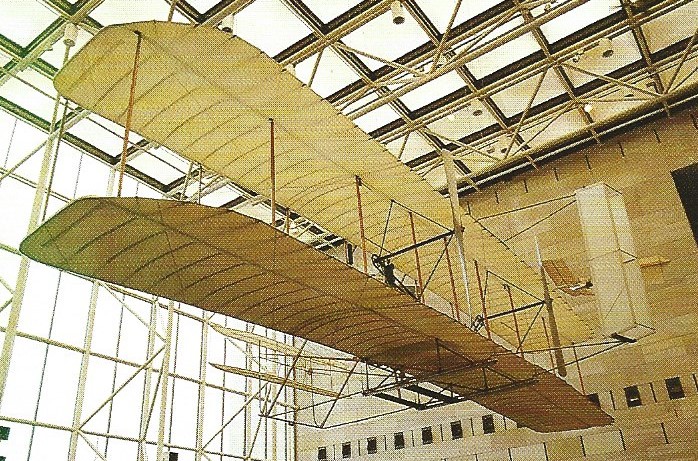
The Flyer is on display at Washington’s National Air & Space Museum.

A working replica of the Wright Flyer of 1903 was built in the early 1980s by the Finningley Vintage Aircraft Group, UK. It achieved small hops. It became part of the Finningley Station Museum and was allocated BAPC.28.

First flight: 17 Dec 1903
Engine One 12 hp Wright
Wing span 40 ft 4 in (12.2 m)
Wing area: 510 sq.ft
Wing chord 6 ft 6 in
Length 21 ft 1 in (6.4 m)
Height 9 ft. 3 in
Weight empty 605 lb (275 kg)
Flight wt approx: 746 lb
Speed 30 mph (48 kph)
Ceiling 10 ft (3m) fully loaded
Range 852 ft (260 m)
No of flights: 5
Longest flight: 59 sec / 852 ft
Total flying time: 1 min 39.5 sec

Wright 1902 Glider 3 / Dart Aircraft Wright 1902 Glider

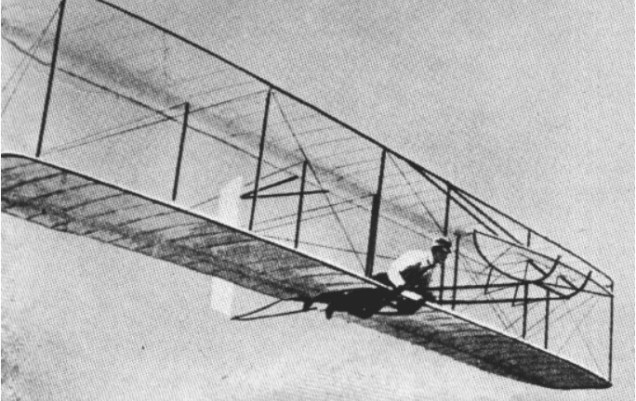
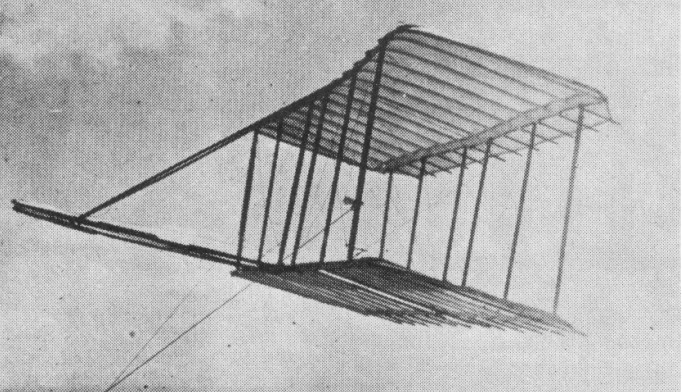
In the summer of 1902 the Wright brothers journeyed back to Kitty Hawk, this time with a huge machine that measured 32 feet in span and 303 square feet in wing area. Besides the warp and the front elevator, the new glider also sported fixed rear fins. Now they made good glides – some of over 500 feet – but were plagued by an odd tendency: about one time in 50, the airplane would turn up sideways and slide to the ground, despite full warp to lift the dropped wing. The Wrights called this “well-digging”; they had discovered the incipient spin. The solution was to install a movable tail fin, linked to work in opposition to the warp mechanism to correct the warp drag that corresponds to aileron drag in our modern airplanes. Thus they had achieved three-axis aerodynamic control. By the time of their return to Dayton that winter, they had made several hundred glides, at least one of more than 600 feet and nearly half a minute’s endurance.

The initial twin fixed fins were later replaced with a single rudder linked to the wing warping – the Glider 3B.
The Wrights made almost a thousand glides with this third biplane. They flew for up to 26 seconds and for distances of up to 622 feet-for a total airborne gliding time for that year of nearly five hours. They had begun to solve the problems of control in the air and to establish a definitive design.

While making preparations to test the 1903 powered aircraft, they continued to practice piloting with their 1902 glider and to establish new endurance records of more than one minute.

And from that 1902 glider came the first powered “Flyer” of 1903.

For Alexanda Korda’s film production, Conquest of the Air, Dart Aircraft produced a replica Wright 1902 biplane glider in 1935. The first tests were at Denham during that summer. Weyl flew the aircraft and reported that the controls worked well, though they lacked feel. It was only possible to fly the glide in a straight line owing to the interconnection between the wing warping and the rudder. The rudder was not a control but was used to counteract the yawing moment due to wing warping. Wingtip skids were fitted during the trials and normal turnbuckles were later adopted. In the end the film was never completed.

Glider 3
Wing span: 32 ft 1 in
Wing area: 305 sq.ft
Flying wt approx: 260 lb
No. of flights approx: 1000+
Total flying time approx: 4 hr

Glider 3B
Wing span: 32 ft 1 in
Wing area: 305 sq.ft
Flying wt approx: 280 lb
No. of flights approx: 60
Total flying time approx: 34 min

Wright 1901 Glider 2

In 1901, the Wright brothers began a program of research, testing wing forms by mounting them on a spar projecting ahead of a bicycle; they also assessed them in homemade wind tunnels, their first was constructed from an old starch box. Soon it became obvious that almost all the published information on aerodynamics, and particularly the tables of force measurements, were simply wrong. They re-turned to Kitty Hawk with a still-bigger glider, its wing-warping controlled by the prone pilot rocking his hips in a body cradle, and achieved a glide they measured at 389 feet.
The second manned glider, of 1901, larger and heavier was rather less successful, chiefly because it was “less manageable than our smaller machine of last year … the trouble seems in the travel of the centre of pressure”. It had no tail surfaces. But the 1901 machine was generally un-manageable, and the lift of its wing less than the previous glider’s.

Wilbur just after landing the 1901 glider. Kitty Hawk, North Carolina.

Wing span: 22 ft 0 in
Wing area: 290 sq.ft
Flying wt approx: 243 lb
No of flights approx: 60
Total flying time approx: 2 min

Wright 1900 Glider 1

The first model was flown as a kite and led to the development from it of their first full-scale glider of October 1900, with a span of 17ft 5in. It, too, was first flown as a kite at Kitty Hawk in October 1900, and, then, for twelve manned glides for a total duration of two minutes.

The glider embodyed wing-warping and a movable front elevator but with no vertical stabilizer. They chose the Carolina coastal sandhills, far indeed from Dayton, as a testing ground, thinking that the strong prevailing winds, even slopes and soft sand in which to fall might make an ideal place to learn about flying. Kill Devil Hills was the spot selected, near the Kitty Hawk telegraph station.

Like all their early machines, their first glider was unstable – a fundamentally different approach from that of earlier experimenters. They flew it mostly as a kite but also made a handful of free glides, some with one of them aboard, lying on the lower wing.

Wing span: 15 ft 5 in
Wing area: 165 sq.ft
Flying wt approx: 197 lb
Total flying time approx: 2 min

Wright Bros / Wright Aeronautical

In 1899, the Wright brothers wrote to Dr. Samuel P. Langley that they were about to begin aviation experiments and they wanted to know how to build and fly gliders. Langley replied that they should read Progress in Flying Machines and contact Chanute in Chicago.

The Wright brothers received their copy of Chanute’s book personally from the author, who became both their friend and advisor. At their invitation, Chanute visited the Wrights at Dayton, Ohio and Kitty Hawk, North Carolina. It was Octave Chanute who, at a meeting in December, 1903, of the American Association for the Advancement of Science announced to the world that the Wright Brothers had flown in a heavier than air machine.

Wright Brothers Article

The Wright brothers built first successful aircraft in the world, 1903; first practical model 1905. The invention was patented in 1906 and the Wrights sold first military aircraft in world to U.S. Army Signal Corps 1908.

There were countless personal modifications of the Wright machines in the US, such as Beckworth-Wright, J S Berger-Wright, Lemp-Wright, Parmelee-Wright, with owners often claiming hyphenated name credits, as in similar cases with many Curtiss and Burgess planes. Most were essentially A and B Fliers.

1909: Wright Co; Wright Aeronautical Co Inc.

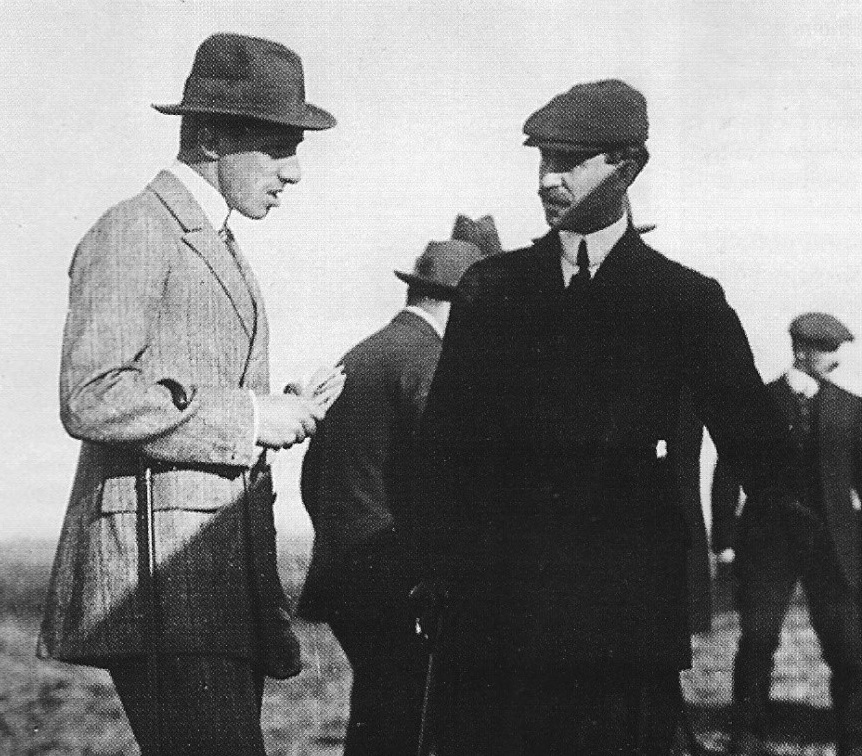
King Alfonso XIII and Orville Wright at Pau airfield, 1909

Continued producing same basic and outdated type though later, from Model I tractor biplane, aircraft were more conventional. Sold a few aircraft to U.S. Navy 1914.

Mainly an engine manufacturing company. After Wilbur’s death, 1912, Orville continued at Dayton plant as independent experimenter. Built to official designs and produced Hispano-Suiza engines during the First World War. Giuseppe Bellanca joined 1924 and Wright-Bellanca monoplane and Apache shipboard fighter produced in 1925. Bellanca left 1927 to re-form his own company (see Bellanca Aircraft Corporation).

Although the 1915 Model L was a commercial failure, the Wright Company refocused on the development of high-powered engines for airplanes and automobiles. In 1916, they acquired the Crane-Simplex Automobile Company and the Glenn L. Martin Aircraft Company. All three companies merged to become the Wright-Martin Aircraft Corporation.

In 1916 the company was sold to a NYC investment group. Became Wright-Martin Aircraft Corporation of California in 1916 when merged with Glenn L Martin Co and Simplex Automobile Co to build Hispano-Suiza motors under license from France.

In 1920 reorganized as Wright Aeronautical Corp.

In 1929 Wright Aeronautical Corp and Curtiss Aeroplane and Motor Company combined to form Curtiss-Wright Corp and in 1931 the engine divisions of Curtiss and Wright merged.

1946: Woodbridge NJ.