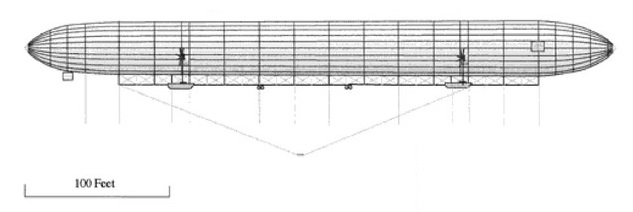
Zeppelin LZ-8 Ersatz Deutschland / Type E

Excursion flights of several hours’ duration at 100 Marks per head proved popular to Germans and foreigners alike over the four years of operation.

The first airship destined for service was the LZ-7 Deutschland which, following a successful deliver flight, was wrecked. A replacement for the LZ-7 Deutschland, the 1910 LZ-8, or the Ersatz Deutschland, was put in hand.

LZ-8
Capacity: 681,600 cu.ft
Length: 485 ft
Width: 45 ft
Height: 54 ft
Gross lift: 19.5 ton
Useful lift: 6 tons
Engines: 3 x Daimler 4 cyl, 120 hp
Max speed: 37 mph
Range ay cruise: 950 miles
Ceiling: 2000 ft
Crew: 8
Passengers: 20

Zeppelin LZ-5 / Z.2

Within hours of the news of the loss of the LZ-4 appearing in the papers a spontaneous outpouring of popular support in what he was trying to achieve was demonstrated by the German people. From all over the nation money and promises of donations came flooding in to Friedrichshafen, and within a short time more than 6 million Marks (£5 million) had been subscribed.

With the loss of the LZ-4 the army demanded an immediate replacement, for this purpose the old LZ-3 was taken in hand and enlarged and equipped with more powerful engines. At the same time work began on the new LZ-5, which was of similar size but again with more power than its predecessor, with a capacity of 530,000 cu.ft and combined propulsive output increased to 220 hp.

The Kaiser, watchful of the count’s growing popularity with the German people, proposed a board of trustees to manage the money Zeppelin had accumulated. The count countered this suggestion by forming the Zeppelin Foundation as a charitable body to continue research into dirigible flight, whilst separately in September 1908 establishing the Luftschiffbau Zeppelin GmbH.

Carl Berg’s son-in-law, Alfred Colsman, was installed as managing director, which allowed the count to continue his development work with the minimum of interference from the government and army sources.

LZ-5 was completed in May 1909 and undertook a proving flight of thirty-seven hours covering 603 miles during the course of which, whilst on the way to Berlin, it encountered adverse weather conditions causing it to make a forced landing at the village of Göppinggen near Ulm.

During this manoeuvre the LZ-5 hit a tree, severely damaging the bow section and deflating the forward gas cell. Despite this serious damage, temporary repairs were effected by removing the damaged ffirward section and after jury rigging the outer cover over the damaged area the crippled airship was flown 95 miles back to Friedrichshafen.

In due course the LZ-5 was fully repaired and subsequently delivered to the army as the Z-2, where it served successfully until the outbreak of the war, being further modified and lengthened while in service.

Zeppelin LZ-3

LZ-3 leaving the floating shed at Manzell, Bodensee, 1906

Following the disaster of the LZ-2 Zeppelin vowed he would build no further airships, however, within weeks, and persuaded by popular sympathy, he managed to raise further funds from his own resourced, and a second state lottery was promised by the King. Sufficient money was raised to allow the construction of a new airship to go ahead.

The third airship, LZ-3, was based on LZ-2, of similar dimensions and utilising the same engines, but possessed of more functional bow and stern multiple elevators and having a keel cabin installed amidships.
The new airship was built within three months, making her maiden flight on 9 October 1906, lasting two hours, covering 60 miles, and returning to base without incident.

Further flight followed: on being of eight hours, another of twelve hours where the LZ-3 sailed along the Rhine valley and onto Switzerland covering 200 miles. The performance galvanised the authorities in to action: firstly by an award of 500,000 Marks from the Government Airship Commission to aid research, and secondly the placing of an order for two Zeppelins for the Army.

The stringent conditions laid down for the purchase contract included a twenty-four hour endurance flight to cover a distance of no less than 500 miles with a crew of 20, and to include a landing on return.

Zeppelin realised the LZ-3 did not possess the endurance necessary to comply with these conditions and proposed the construction of a larger ship, the LZ-4.

With the loss of the LZ-4 the army demanded an immediate replacement, for this purpose the old LZ-3 was taken in hand and enlarged and equipped with more powerful engines. At the same time work began on the new LZ-5

Zeppelin LZ-2

Count Zeppelin had the experience to build a large rigid airship but also realised that the cost of further development was beyond his own personnel resources. Zeppelin turned to his patron the King of Wȕrttemberg, who agreed to organise a state lottery which ultimately raised 200,000 Marks to finance the building of a second airship.

In addition, he again persuaded the Ruhr aluminium magnate Carl Berg to supply the alloy for the framework, and prevailed upon Gottlieb Daimler into providing light engines of suitable power that could be developed for flight.

The floating hanger was refurbished and materials began arriving at the lakeside in early 1905 allowing work to commence, with construction proceeding at a rapid pace.

The new airship, which was completed in December 1905, was of sturdier construction than its predecessor and, whilst in outward appearance and dimensions similar to LZ-1, she was equipped with larger and more effective control surfaces fore and aft. These elevating ‘Aeroplanes’ were to replace the cumbersome sliding weights of the LZ-1, whilst the engine power had been increased to a total of 170 hp.

The LZ-2 was readied for its first flight in November 1905, but as the ship was being towed out of its floating hanger the airship went out of trim causing the bow to dip into the water, which in turn damaged the elevator planes and structure. At the same time, the tow rope attached to the motor boat parted and the LZ-2 began to drift across the lake whilst all efforts to start the engines failed. The motor boat crew chased the ship, secured to tow rope again, returning it to its shed.

After repairs the second flight took place on 17 January 1906, at first all went well with the airship reaching a speed of 24 mph and answering the helm in a satisfactory manner, but once more the forward engine broke down due to a problem with the cooling water and shortly after this the rear engine also failed. All efforts of the crew failed to restart the engines. The LZ-2 drifted on the breeze to be brought down 25 miles way outside the village of Kisslegg.

The damage on landing was not too serious and it was hoped to save the ship. Yet although held by a ground crew of soldiers and villagers later that night, with a wind of increasing force the LZ-2 was smashed into the ground and became a total loss.

Zeppelin No.1 / LZ-1

The construction of Graf Ferdinand von Zeppelin’s aluminium framework LZ 1 began in June, 1898, in a floating wooden hangar on Bodensee (Lake Constance) at Manzell (Friedrichshafen).

The hydrogen was contained in 16 cells supporting an all up weight of just under 12 tons. The parallel-sided, conical-ended craft had two gondolas fixed under the hull, each containing a four-cylinder Daimler petrol motor with an output of 16 hp. Lateral control was effected by two small rudders at the stern, whilst attitude and vertical control relied on a 500 lb sliding weight suspended on a cable beneath the ship.

Completed in the winter of 1899, the Graf decided to wait however until the summer of 1900 before attempting an ascension. The airship was inflated with hydrogen in June, and was towed out of its floating hanger by the steamboat Buchorn and, once clear of obstructions, vaned into the wind where the tow rope was released. On a near perfect day the LZ-1 rose to about 1300 ft, from where it flew 18 minutes above the calm waters of the lake on 2 July 1900 at 20:03. With a crew of four, including the Count himself, the airship covered some 4 miles against a headwind of 16 mph. The LZ-1 successfully achieved a degree of control despite the relatively low power of the engines, but problems with the sliding weight necessitated a descent on to the lake from where the ship was towed back to the hanger.

A second flight, of 30 minutes, took place on 17 October 1900. Experiments in control were undertaken, but again these tests were cut short due to engine trouble and there was some degree of structual failure of girders in the framework requiring another descent on to the water.

After some repairs and strengthening of the fractured girders the LZ-1 made its third and final flight of some 20 minutes, achieving a speed of 17 mph during which it again exhibited its ability to answer to the helm. This time the flight was terminated because of water in the petrol, but the ship again returned safely to its shed.

The following year Zepplin disbanded the joint stock company while personally assming its liabilities. The Count had the LZ-1 dismantled and the shed beached and closed up. He dismissed all the workers apart from Kober, whom he retained to work on a more advancd desighn he had conceived.

Length: 419 ft
Diameter: 38 ft 6 in
Height: 48 ft 6 in
Envelope capacity: 400,000 cu.ft
Gross lift: 12.5 ton
Useful lift: 2.75 ton
Engines: 2 x Daimler 16 hp
Max speed: 17 mph
Range at cruise est.: 180 mi
Ceiling: 2000 ft
Crew: 4

Zenker Bremen I

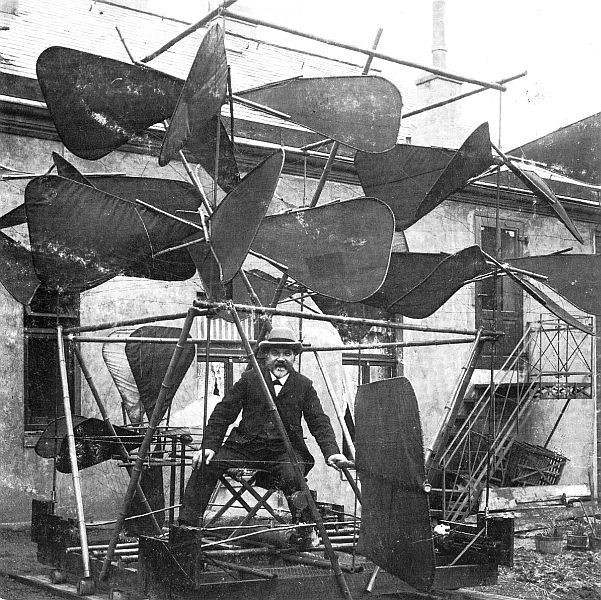
Carl Zenker, of Bremen, Germany, designed this “steerable airship” Eight horizontal propellers provided vertical lift. Its construction from bamboo rods and cloth took from August 1873 till March 1900, and cost about 40,000 Marks. Herr Zenker stated proudly that the craft, “Requires no balloon to become airborne, and operates at a nominal 6hp”. Weighing 660lb and driven by “fluid air and compressed air”, a speed of 1km in 2mins (about 18.5mph) was estimated. Horizontal flight was to be achieved by means of twin propellers, and the craft was steered by a single rudder. One could own a Zenker contraption for a mere 10,000 Marks, from four to six months after receipt of the order.

Zbierański and Cywiński Biplane

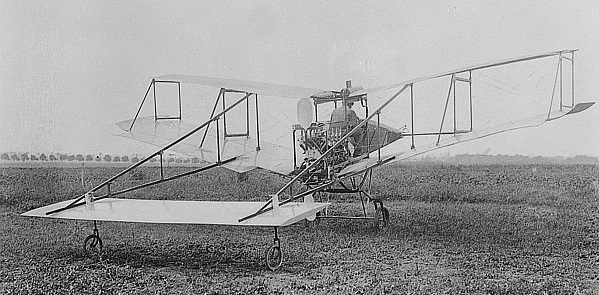
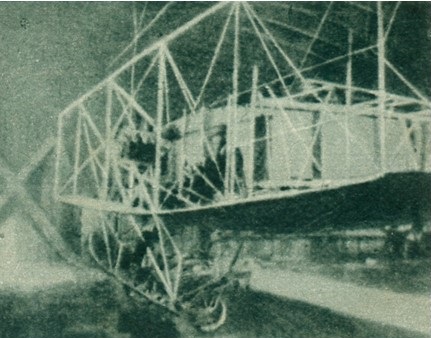
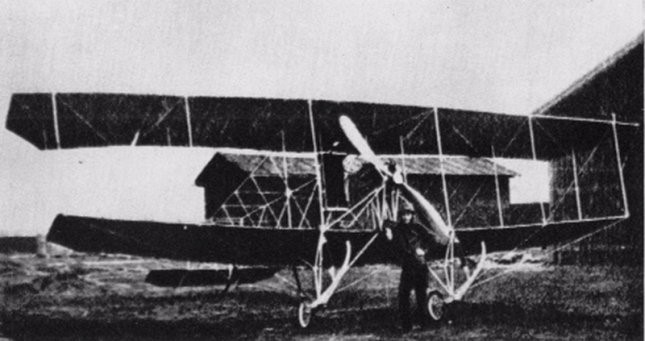
On the initiative of the Association of Technicians at the Technical Association in Warsaw in the autumn of 1909, Czeslaw Zbierański went to Paris to get acquainted with the aviation technique of the time. On his return, he designed a wooden plane using a pulling propeller engine, while the biplanes at that time had pushing propellers. After the approval of the project by Wheeler Zbierański left for France to buy materials. Having encountered a Voisin airplane with a steel tube construction, he decided to build a hull from the tube.

Stanisław Cywiński became Stanisław Cywiński’s co-worker, who in the spring of 1910 adapted the project to steel construction and elaborated on the design. The hull of the aircraft was built in the summer of 1910, in a shed on the premises of E. Krzemiński’s lamp factory at ul. Solec 103 in Warsaw. After the construction of the hangars of the Warsaw Aircraft Association “Awia” on the Mokotowskie Field, they moved in the early autumn of 1910 to the hangar No. 1. There construction was completed. In the autumn of 1910 Cywiński bought the engine for the plane.

The biplane was rectangular, double-girder, wooden construction panels, supported by steel pipe posts and crossed with wires. Canvas cover. Controls were only on the upper wing. Truss lattice made of steel pipes connected by screws. Tubes stiffened by ash rods. Rear hull triangular section. Trusses framed by wires. With fabric covering

In May 1911, while attempting to fly an improper connection of the wires to the spark ignition caused gasoline to burn and burn part of the airfoil. In the summer the plane was renovated.

On September 25, 1911, the plane was flown by Michał Scipio del Campo, flying 15-20 km, at a height of 50-60 m, within 15 minutes. The engine was too heavy and too weak, so the Gnome engine from the Morane-Borel aircraft belonging to M. Scipio del Campo was mounted.

When the Russian army took over at the beginning of 1912, the plane was evacuated by Russian lieutenant Krachowiecki, fictitiously buying it. Cywinski dismantled the engine, and Zbierański donated the craft to the Union of Students of the Lviv Polytechnic. The plane was transported to Cracow in 1912, where it was exhibited in the Oleander area and then stored for over a year. There at the beginning of the war in 1914, it burned down during the fire of the exhibition buildings.

Engine: ENV type D, 29 kW (39 – 40 hp)
Wingspan: 10 m
Length: 8.5 m
Height: 3.3 m
Wing area: 31-34 sq.m
Gross weight: 240 kg
Useful weight: 100 kg
Total weight: 340 kg
Speed: 70 km / h
Flight time: 1 h 30 min