Ziegler, Albert

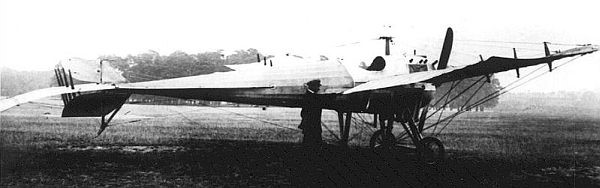
Albert Ziegler, born in Zeiden (today Codlea) next to Kronstadt (Braşov), Transylvania, worked as an engineer in the motor and aviation business in Switzerland, France and England before coming to Germany in 1911. There he assisted Prinz Sigismund von Preußen in building a glider, and was employed by Rumpler, Wright and Garuda. In 1912 Ziegler acquired a used 50-55 hp Argus engine and a shed at the Bornstedter Feld near Potsdam from the Siemens-Schuckert company, where at least a year was needed to realise his “Pfeil-Eindecker”.

Zerbe Air Sedan

In 1909 Californian Professor Jerome S. Zerbe built the four place cabin quadruplane Air Sedan. There were four short-span, double-cambered, forward-staggered wings, apparently with a ganged variable angle of attack. The cabin was plywood-clad.

Powered by a 100hp Gnôme or 90hp LeRhône rotary, it was flown by Tom Flannery from a field on the Washington County fairgrounds for a distance of about 1,000′ before being damaged on landing. No other flights were recorded.

Zerbe Multiplane / Quintaplane

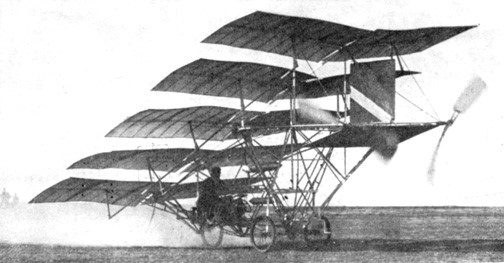
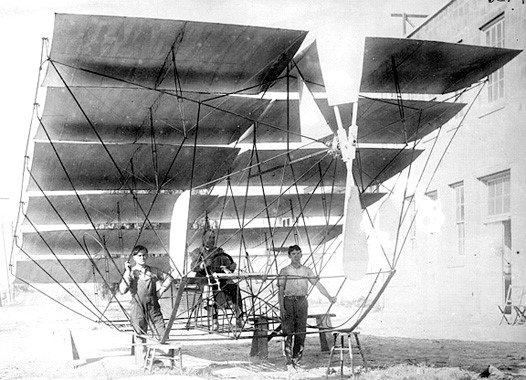
James Slough Zerbe, known as Professor Jerome S. Zerbe built three multiplanes circa 1910. The Quintaplane of 1910 had five wings attached to what appears to be a flying motorcycle.

Whether or not it ever flew is unknown, but the second five-wing multiplane built by Californian Professor Jerome S. Zerbe, came to grief on January 11, 1910 during the 1910 Los Angeles International Air Meet at Dominguez Mesa. It was reported as being “a casualty before becoming airborne.”

James Slough Zerbe, known as Professor Jerome S. Zerbe built three multiplanes circa 1910.
Multiplane of 1910.

The second five-wing multiplane built by Californian Professor Jerome S. Zerbe, came to grief on January 11, 1910 during the 1910 Los Angeles International Air Meet at Dominguez Mesa.
Zeppelin Hansa

DELAG, the Deutsche Luftschiffahrts-Aktiengessellscaft, was funded in part by the Hamburg-Amerika Shipping Company and from money raised by those cities involved in the undertaking. Each city, in addition, provided ‘aerial harbours’; erecting airship sheds at their own expense to house the fleet of airships. Although no scheduled passenger services ensured, excursion flights of several hours’ duration at 100 Marks per head proved popular to Germans and foreigners alike over the four years of operation.

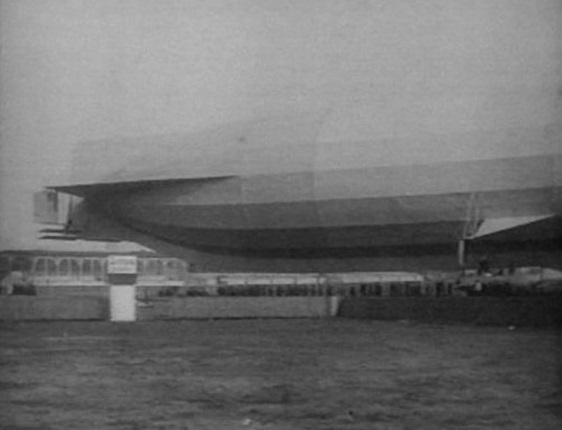
The first airship destined for service was the LZ-7 Deutschland. Following this in the years preceding the war came the airships LZ-10 Schwaben, Sachsen, Viktoria Luise and the Hansa, which between them carried over 35,000 fare-paying passengers in 1588 flights, covering 170,000 miles without serious mishap.

Zeppelin Viktoria Luise

DELAG, the Deutsche Luftschiffahrts-Aktiengessellscaft, was funded in part by the Hamburg-Amerika Shipping Company and from money raised by those cities involved in the undertaking. Each city, in addition, provided ‘aerial harbours’; erecting airship sheds at their own expense to house the fleet of airships. Although no scheduled passenger services ensured, excursion flights of several hours’ duration at 100 Marks per head proved popular to Germans and foreigners alike over the four years of operation.

The first airship destined for service was the LZ-7 Deutschland. Following this in the years preceding the war came the airships LZ-10 Schwaben, Sachsen, Viktoria Luise and the Hansa, which between them carried over 35,000 fare-paying passengers in 1588 flights, covering 170,000 miles without serious mishap.

Zeppelin Sachsen

DELAG, the Deutsche Luftschiffahrts-Aktiengessellscaft, was funded in part by the Hamburg-Amerika Shipping Company and from money raised by those cities involved in the undertaking. Each city, in addition, provided ‘aerial harbours’; erecting airship sheds at their own expense to house the fleet of airships. Although no scheduled passenger services ensured, excursion flights of several hours’ duration at 100 Marks per head proved popular to Germans and foreigners alike over the four years of operation.

The first airship destined for service was the LZ-7 Deutschland. Following this in the years preceding the war came the airships LZ-10 Schwaben, Sachsen, Viktoria Luise and the Hansa, which between them carried over 35,000 fare-paying passengers in 1588 flights, covering 170,000 miles without serious mishap.

Zeppelin LZ 10 Schwaben

Zeppelin LZ 10 Schwaben

Zeppelin LZ 10 Schwaben was built in 1911 and operated by DELAG (Deutsche Luftschiffahrts-Aktiengesellschaft) for passenger service. The first airship destined for service was the LZ-7 Deutschland. Following this in the years preceding the war came the airships LZ-10 Schwaben, Sachsen, Viktoria Luise and the Hansa, which between them carried over 35,000 fare-paying passengers in 1588 flights, covering 170,000 miles without serious mishap.

Zeppelin LZ 10 Schwaben