Aerial Experiment Association White Wing

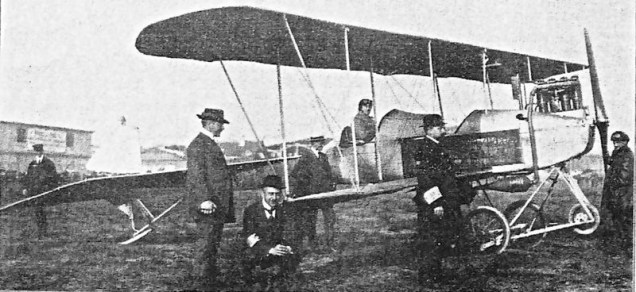
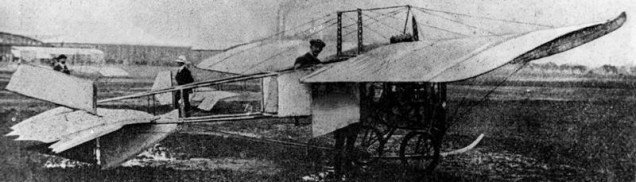
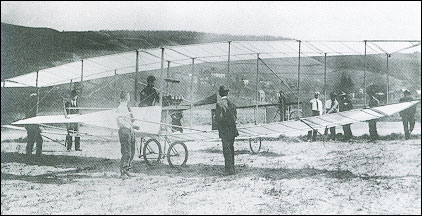
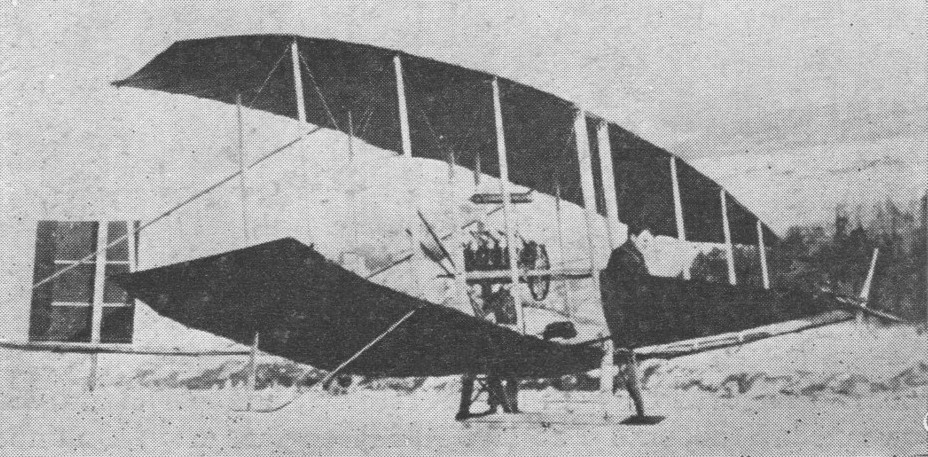
The second AEA aeroplane was White Wing, sponsored by Canadian F.W Baldwin, jointly designed by Baldwin and Curtiss. It was similar to Red Wing, except for the substitution of three wheels for the ice runners, and used the same Glenn Curtiss built engine.

“White Wing,” as a biplane with front elevator and rear stabilizers and rudder connected by wires to a four-axis steering wheel, and a rudimentary aileron system controlled by body motions of the pilot. Its three-wheel, rubber-tired undercarriage was Curtiss’ idea, a carryover from sidecar motorcycles.

An innovation was the addition of movable lateral control surfaces on all four wingtips that later came to be called ailerons. In principle, these had the same effect as the Wright’s wing-warping, but Curtiss claimed mechanical and control differences. The method of control reflected Curtiss’s motorcyle experience – a yoke embracing the pilot’s shoulders. When he wanted to bank for a turn, he leaned in the desired direction and the proper control movement was automatically applied.

After many reassessments and revisions, White Wing made four flights, the first on 18 May, 1908, with Baldwin at the controls. The distance covered was 85m at a height of 3m. The third flight was the longest, at 310m with Glenn Curtiss flying. White Wing crashed on 23 May after McCurdy had flown 167m.

Take-off weight: 274 kg / 604 lb
Wingspan: 12.87 m / 42 ft 3 in
Wing area: 37.9 sq.m / 407.95 sq ft
Aerial Experiment Association Red Wing

The first aeroplane of the AEA was the White Wing, designed and sponsored by Lt Thomas.E. Selfridge.

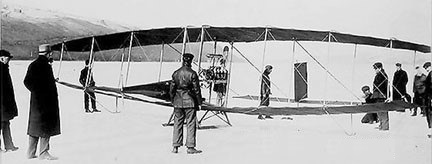
Named for its red fabric coloring, Glenn Curtiss built the engines for the Aerial Experiment Association Red Wing and the White Wing early in 1908.

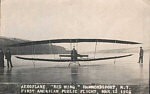
Dubbed “Red Wing” after its amber fabric sealant, and it was finished in three months at Curtiss’ shop at Hammondsport. Ready for a trial run on March 10, 1908, Selfridge and Bell were on business in Washington DC, so the honors were handed to Baldwin. Powered by a 20-hp Curtiss motorcycle engine, Red Wing ran across the ice on its steel skids for about 250 feet, then lurched into the air to fly about 300 more feet at an altitude of six feet before finally stalling and crumpling into a heap.

Having no lateral control, it crashed on its first flight at Lake Keuka NY on 12 March 1908 after flying a distance of 318’11” (p: Baldwin).

The first public flight of an airplane in the US.

Aerodrome #1, Red Wing
Engine: Curtiss B8 air-cooled V-8 40hp pusher. Actual flight efficiency est. less than 20hp.
Wingspan: 43’4″
Length: 26’3″
Useful load: 185 lb
Seats: 1

Aerial Experiment Association / AEA

The Aerial Experiment Association was formed at Hammondsport, NY, in September 1907, at the Canadian home of Dr Graham Bell (leader) and Mrs Bell (prime mover and financier in the amount of $30,000), Glenn Curtiss and three others. McCurdy and his friend, Frederick “Casey” Baldwin, two young graduates from the University of Toronto, decided to spend their summer vacation in Baddeck Nova Scotia, Canada. McCurdy had spent his youth there and his father was the personal secretary of Dr. Bell. Discussing the field of aviation and some of Bell’s aeronautical ideas, Bell’s wife, Mabel, suggested they form an association to exploit their collective ideas. She agreed to fund the fledgling organisation.

Curtiss, McCurdy, Bell, Baldwin, Selfridge

Aerial Experiment Association Article

Dr. Bell also invited Glenn H. Curtiss, to participate in the venture. As an American motorcycle designer and manufacturer, he had acquired considerable experience with light-weight gasoline engines. The United States government took interest in some of the AEA’s ideas and proposed that it should have an observer participate in the plans and discussions. Thus, Lieutenant Thomas Selfridge joined the group. US Army Lieutenant Thomas Selfridge, who was appointed by US President Theodore Roosevelt after Bell requested some aid. Selfridge, by the way, would be the first ever airplane fatality, when he flew aboard a Wright Bros. plane in September of 1908.

Initial plans were to build four flying machines, and for each member to personally oversee at least one project. The first of these was to be Bell’s kite, equipped with one of Curtiss’ motors. It took shape by December of that year.

With no shortage of ideas, the group built three prototypes in sequence, each building on the experience of its predecessor. These were the Red Wing, the White Wing and the June Bug. The June Bug with Glenn Curtiss at the controls broke several aviation records and won the Scientific American award for the first official one-kilometre flight in the United States of America.

The AEA’s fourth effort was the Silver Dart, designed and piloted by McCurdy.

By the beginning of 1909, AEA was showing signs of fading out. Selfridge had died in the Orville Wright crash at Fort Myers, Mrs Bell’s funding was running out, and both Baldwin and Curtiss were dedicating more time to their own projects. By then thoroughly refocused on aviation, Curtiss made exhibition flights with the “June Bug,” and even tried to fly it as a boat from Lake Keuka, but with no success. There was talk of the four surviving members forming a commercial company, but nothing came of it, and on March 31, 1909, the Aerial Experiment Association was unceremoniously disbanded, with commercial rights to its designs and patents assigned to Glenn Curtiss.

AEG Wright Type

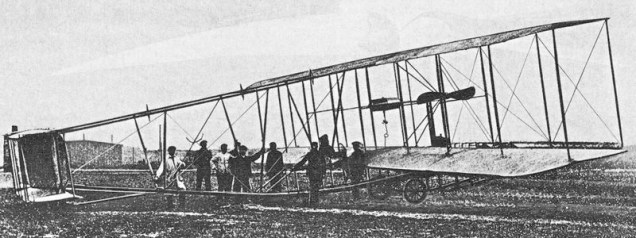
The first aircraft in 1912 was of wooden construction and modeled after the biplane of the Wright brothers. It had a wingspan of 17.5 m, powered by an eight-cylinder engine producing 75 hp; unladen weight was 850 kg and could attain a speed of 65 km / h.

Engine: 1 x 8-cylinder, 75 hp
Wingspan: 17.5 m
Empty weight: 850 kg
Max speed: 65 km / h.

AEG Z.1

The Allgemeine Elektrizitäts-Gesellschaft decided in 1910 to start an aeroplane department (Abteilung Flugzeugbau) at Berlin-Hennigsdorf. At the beginning they had no knowledge of design and production methods for aircraft, so as other firms they started with analyzing a proven machine. They chose a Wright biplane. After analyzing it they realized the limitations of building aircraft in wood. To gain experience in designing and building metal machines they decided in 1910 to start with a research machine which was the responsibility of chief designer Oberingenieur Paul Stumpf. The design was an open-fuselage all-metal tube construction of large dimensions, with a span of 17.5 m. It was a single-seater, with the pilot placed in the open aft of the wings. In front of the wings a small platform construction held the 75 hp Körting engine, which drove a tractor propeller mounted in the middle of the wings via a chain. The factory identification was Z. 1, with Z for Zweidecker (Biplane).

Span: 57’5″
Weight empty: 1870 lbs
Speed: 40 mph

AEG (Allgermeine Elektrizitas Gesellschaft)

Electrical company Allgermaine Elekritzitäts Gesellschaft (AEG) formed an aviation division (the Flugtechnische Abteilung) in 1910 which designed and built its first aircraft in 1910; the Z.1. Early designs included a Wright-type biplane, a monoplane, flying-boat, and floatplane, but quantity production began with the Z 6 (B1) biplane of 1914 and introduced steel-tube construction.
Having produced a total of 658 ‘C’ types, the majority being the C.IV, and production of G series totaled 542,
AEG operated until 1919.

Adorján A.II Strucc / Ostrich

The “Strucc” (“Ostrich”) was the second monoplane design of Hungarian engineer János Adorján. It was equipped with a 25 hp engine of Adorján’s own construction and made some short flights at the June 1910 Budapest aviation meeting.

The “Strucc” (Ostrich) obtained the 3rd prize in the 2nd International Air Race of June 1910.

Engine: 25 hp 2 cylinder
Span: 26’3″
Length: 24′
Weight: 617 lb