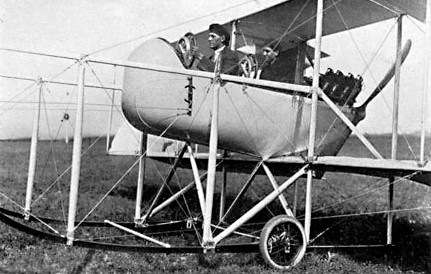
Circa 1910 the 2 seat Aeromarine 8 was powered by a pusher motor, and controlled by canard stabilisers with twin rudders between the wingtips. One was built.
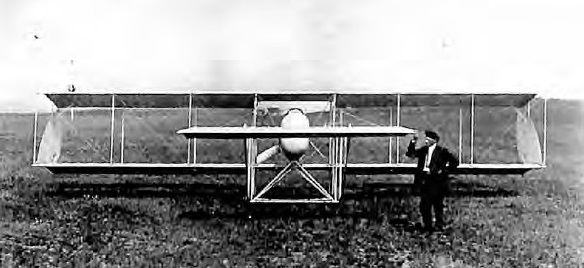
Circa 1910 the 2 seat Aeromarine 8 was powered by a pusher motor, and controlled by canard stabilisers with twin rudders between the wingtips. One was built.
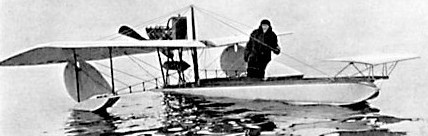
Circa 1909, Aeromarine’s first effort was a single seat canard pusher flying boat.
The beginnings of the company dated to 1908, when Inglis M. Uppercu began to finance aeronautical experiments by a small firm at Keyport, New Jersey.
In 1914, Aeromarine Corp itself was founded at Keyport with Uppercu as president. Aeromarine built mostly military seaplanes and flying boats, the most significant of which were the models 39 and 40. The company broke new ground in aviation by offering some of the first regularly scheduled flights. Aviation promoter Harry Bruno worked with Aeromarine to commercialize the transportation potential of airflight.
1914: Renamed Aeromarine Plane & Motor Co (fdr: Inglis M Uppercu);
1917: Relocated to Keyport NJ.
1920: Aeromarine West Indies Airways Inc, Key West FL, established.
After the war, converted D.H.4s, built 25 Martin bombers (completed winter 1923/24) and undertook flying-boat conversions for civil use.
In 1923 built metal-hulled flying-boat and biplane mail-carrier.
1921: Became distributing agent for $4 million surplus USN aircraft and motors.
1924: Ended aircraft operations, and established Healey-Aeromarine Bus Co, Nutley NJ.
1928: Formed as a component of Aeromarine Plane & Motor Co Inc. to begin aircraft production as (Frank) Boland Aeroplane Co, Newark NJ; acquired manufacturing rights to Klemm L.25 and the name, Aeromarine-Klemm, came into use. The firm renamed itself Aeromarine-Klemm Corporation in 1929 and began producing mostly Klemm aircraft designs, until the Great Depression forced its closure in 1930.
1931: Receivership (assignor W L Dill), with employees reorganizing as Aeromarine Plane & Motor Co.
The firm also built aero engines.
1935: Assets sold to Burnelli Aircraft Corp.
1936: Engine rights sold to Lenape Aircraft & Motors Inc, Matawan NJ.
1937: Design briefly revived by Keane Aircraft Co, Keyport.
Macchi
Aeronautica Macchi
Societa Anonima Nieuport-Macchi
Nieuport-Macchi
Sig. Giulio Macchi was assisted by Nieuport in forming Societa Anonima Nieuport-Macchi at Verese in 1912, mainly to building Nieuport designs under license but also several original parasol monoplanes. During First World War built Nieuport XIs under the designation Nieuport 110 or 11000, as well as Nieuport XVII, Nieuport 27 and 29. Also undertook the manufacture of the French Hanriot HD1 sesquiplane fighter at its Varese plant during 1915.
A Lohner L.40 flying-boat captured in May 1915 was copied by Macchi within a month as the L.1 and began a series of single-engined biplane flying boats. During First World War built the M-3 fighter and M-5 biplane flying-boat, which developed into M-7 which won 1921 Schneider Trophy, an achievement repeated by M-39 in 1926. MC.72 floatplane set world airspeed record of 709.19km/h on 23 October1933.
Societa Anonima Nieuport-Macchi was renamed Aeronautica Macchi in 1922.
Pre-Second World War commercial flying-boats included the 12-seat MC.94 and 26-seat MC.100. The MC.200 Saetta fighters was produced from 1937, and developed into the MC.202 Falgore, and MC.205 Veltro.
After the Second World War, the company began producing motorcycles as a way to fill the post-war need for cheap, efficient transportation. The motorcycle branch was sold in 1974.
Post-war developments included MB.308 two/three-seat cabin monoplane, also built in Argentina by German Bianco Sa, MB.320 six-seat light twin and 150 M.416 license-built Fokker S.11 trainers. Joint program with Fiat to build Vampire FB.52As, followed by MB.326 jet trainer, first flown December 10,1957 and later produced also in two-seat and single-seat armed strike trainer forms. Lockheed of U.S.A. acquired a shareholding in Aermacchi in 1959, which became known as Aermacchi in 1961, as a subsidiary of Aeronautica Macchi.
Production began 1960 of Aermacchi-Lockheed AL.60 light cabin monoplane, built under rights obtained from Lockheed of USA. 1981 reorganization of Aeronautica Macchi into a holding company, made Aermacchi SpA a subsidiary, undertaking aircraft activities.
In 1983 Aeritalia bought a 25% shareholding.
First flight in August 1976 of the MB-339 jet trainer and light attack aircraft, while in 1996 Aermacchi took over L-90TP RediGO from Valmet of Finland (redesignated M-290TP RediGO). In January 1997 Aermacchi acquired SIAI Marchetti, inheriting the S211 jet trainer and SF260 piston/turboprop light aircraft. Partner programs include the AMX combat aircraft with EMBRAER of Brazil and Alenia of Italy, and Yak/Aem-130 jet trainer with Yakovlev of Russia. In 1992 the AMX (previously Aermacchi had a 23.8% share of the programme) was transferred entirely to Aermacchi to form a single source for jet trainers.
Since the mid-1990s, Alenia Aermacchi has participated in programs for the supply of engine nacelles for civil aircraft. It produces cold parts for engine nacelles: inlets, fan cowls and EBU, the systems-to-engine interface. In 1999, the company established a joint venture (MHD) with Hurel-Dubois, a French company specializing in the development and manufacture of thrust reversers, to obtain the full responsibility for the development of nacelles installed on maximum 100-seat aircraft.
In July 2003, Aermacchi was integrated into the Finmeccanica Group as Alenia Aermacchi, which increased its shareholding to 99%.
Other work includes production of major components and assemblies for foreign military and commercial aircraft and in 2005 Aermacchi had 1795 employees.
Since the beginning, the design and production of military trainers have been Alenia Aermacchi’s core business.
The products include:
SF-260, piston-engined or turboprop-powered screener/primary trainer
MB-326, turbofan engined trainer and light attack aircraft
M-311, basic turbofan trainer
MB-339CD, advanced and lead-in fighter trainer
M-346, advanced and lead-in fighter trainer of the new generation
Alenia Aermacchi has cooperated in international military programs:
AMX Program :
Alenia Aermacchi took part in the AMX program with Alenia Aeronautica and Embraer of Brazil with a total share of 24%. Alenia Aermacchi developed and manufactured the fuselage forward and rear sections and installs some avionic equipment in the aircraft. A Mid-Life Updating program was required by the Italian Air Force to upgrade the aircraft capabilities.
Panavia Tornado program :
Alenia Aermacchi designed and produced wing pylons and wing tips, roots, trailing edges and flaps, which represented a 5% share in the overall program.
Eurofighter program :
Alenia Aermacchi had a share of more than 4% in the Eurofighter program, for the design and development of wing pylons, twin missile and twin store carriers, ECM pods, carbon fiber structures and titanium engine cowlings.
C-27J program :
After participating in the G-222 transport aircraft program, the company was involved in the Military Transport Aircraft C-27J Spartan, for the production of outer wings.
The 1909 SELA-1 Fregates monoplane was designed by G.Badini and built by Societe d’Etude pour la Locomotion Aerienne in France.
Span: 32’10”
Length: 21’4″
Weight: 506 lb
Speed: 40 mph
Designed and built by A.M.C. in 1909 in the UK, the monoplane featured a folding undercarriage
Span: 44′
Length: 44′
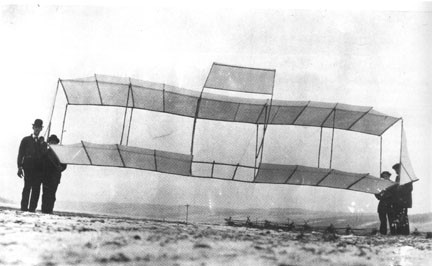
Alexander Graham Bell, inventor of the telephone, had a passionate interest in aviation and had experimented with scientific kites since 1891. He was also a good friend of the Dr. Samuel P. Langley, the builder of the unsuccessful Aerodrome. Bell was Langley’s successor determined to develop a practical airplane with the apparent blessing of the U.S. Army.
In September of 1907, he organized the Aerial Experiment Association to build a practical airplane.
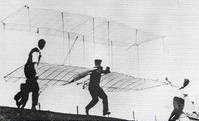
Initial plans were to build four flying machines, and for each member to personally oversee at least one project. The first of these was to be Bell’s kite, equipped with one of Curtiss’ motors. It took shape by December of 1908, but Bell wanted to test it as a glider before engine installation, so Selfridge, somewhat experienced in flight, was towed by a motorboat across a lake near Baddeck. The kitelike machine rose to an estimated height of about 170 feet, but then settled in the water still on tow, ruining many of its silk cells. While it was tediously undergoing repair, the group’s thoughts shifted to more conventional aircraft, such as those being flown in Europe at the time.
A concept carried forward from Bell’s 1902 kite designs, the 1907 kite-glider Cygnet I, was towed by a motorboat to an altitude of 168′ (p: T Selfridge), but was destroyed in landing on the water.
As Cygnet II, it was modified with tricycle gear, 26’4″ span, and an 8-cylinder Curtiss motor, with no success.
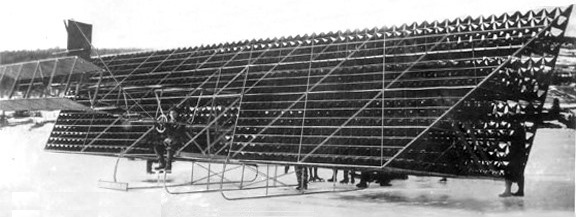
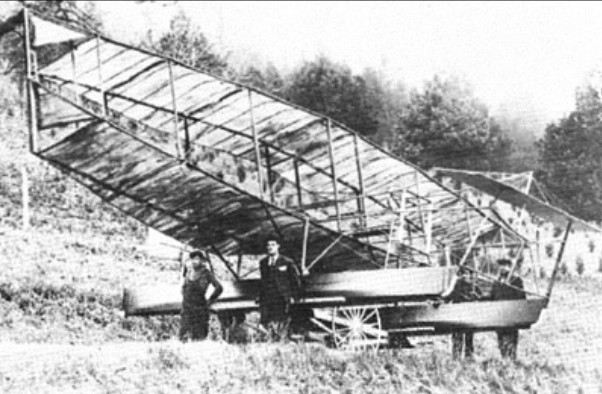
The 1909 Aerodrome #5 / Cygnet was designed by Alexander G Bell, it was a “flying wall” on skids with a huge frontal surface composed of 360 tetrahedral cells arranged in a rectangular wing form, and with the pilot perched well out in front on skids. Tested at Baddeck, Nova Scotia, on 22 and 24 February 1909, it failed to fly.
It did finally fly, as Cygnet III, with 70hp Gnôme rotary to help overcome its frontal mass, from ice-covered Lake Bras d’Or, Nova Scotia, on 1 March 1912, attaining 43mph (p: J McCurdy).
Span: 40’0″ (?>52’6″)
Length: 13’1″
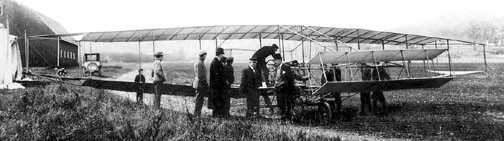
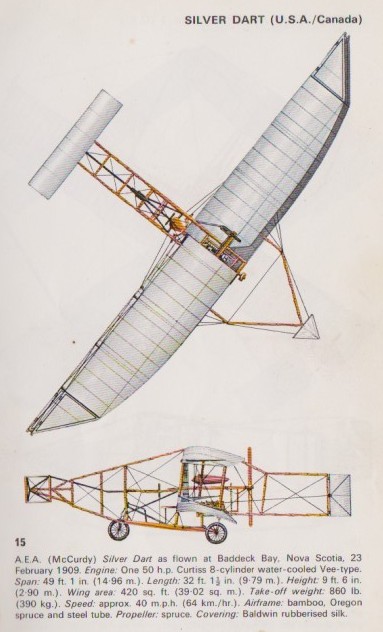
The AEA’s fourth effort was the Silver Dart, designed and piloted by John Alexander Douglas (J.A.D.) McCurdy. Made from steel tube, bamboo, friction tape, wire and wood, it was covered with silvery rubberized silk balloon-cloth, its propeller was carved from a solid block of wood, and it had no brakes. It was first test-flown in Hammondsport, NY, on 6 December 1908 and was then shipped to Dr. Bell’s summer home in Baddeck on 6 January 1909.
The Silver Dart was made principally of bamboo, ash, spruce, metal tubing, and wire cable. The wings were covered with silver-coloured, rubberized balloon cloth – hence the name Silver Dart.
Its engine was a Curtis V-8 water-cooled engine that probably put out no more than 35 or 40 horsepower at 1,600 rpm. It spun a 2.43 m-diameter (8’) propeller. The Silver Dart had its two-plane elevator mounted on the front – canard style. It was 3.65 m (12’) wide and made the aircraft sensitive around its pitch axis.
On February 23rd, 1909 it made history with McCurdy at the controls when it became the first controllable powered aircraft to fly in Canada. About two weeks later on March 10th 1909, McCurdy flew the aircraft on a 20-kilometer circular flight around Baddeck Bay.
The Silver Dart made about 30 flights in the Baddeck area before the AEA proposed a demonstration to the Canadian Army. The Army was not all that enthusiastic but did invite the AEA to Petawawa, ON. The sandy and hilly take-off and landing areas made getting off the ground very difficult. On their 5th demo flight – with Casey Baldwin on board as a passenger – McCurdy struck a rise in the ground and crash-landed (on August 2, 1909).
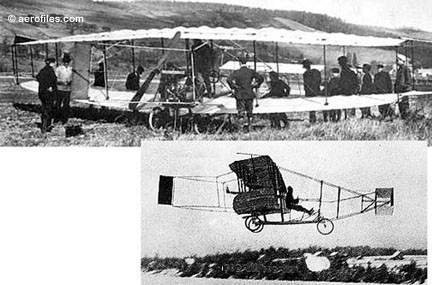
That was the end of the Silver Dart’s career after 50 flights.
Only four pieces of the original aircraft remain – the fuel tank and radiator in the Bell Museum in Baddeck, and the engine and propeller in the Canadian Aviation Museum in Ottawa.
On 3 February 1959, Canada celebrated the 50th anniversary of the Silver Dart flight by flying a replica Silver Dart over the same ground, and J.A.D. McCurdy was made an Honourary Air Commodore.
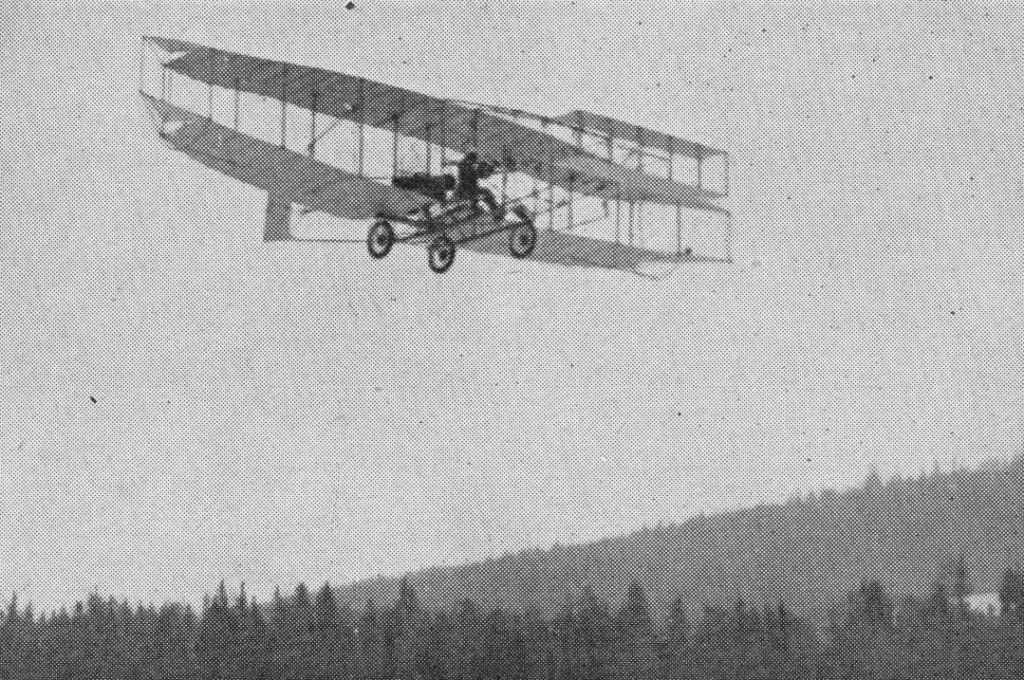
Engine: 50hp Curtiss water-cooled V-8
Wing Span: 49 ft 1 inch (15 m)
Length: 39 ft 4 in (12 m)
Height: 9 ft 7 in (2.9 m)
Empty weight: 610 lb (277 kg)
Gross weight: 860 lb (360 kg)
Take off speed: 38 mph (61 km/h)
Cruise speed: 43 mph (69 km/h)
Ceiling: 70 ft
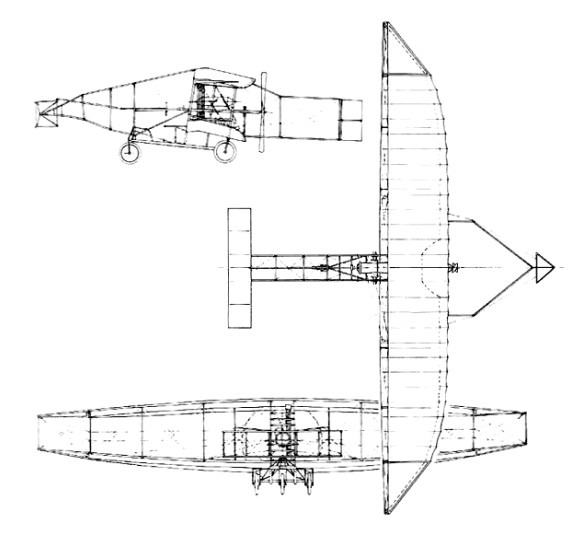
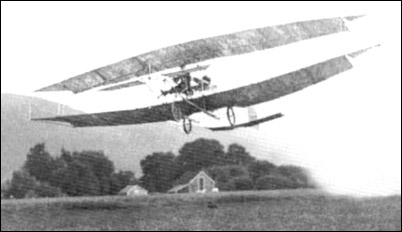
When in late 1907 the Scientific American had announced a magnificent silver trophy (it featured a world globe and a replica of Langley’s ill-fated Aerodrome) as an annual award for aviation competition, it went pretty much ignored by America’s relatively small fraternity of aeronauts until AEA decided to try for it. To this goal Curtiss’ “June Bug” design was dedicated.
The June Bug was one of the lightest of biplanes, having a wing spread of forty-two feet and an area of 370 square feet. The wings were transversely arched, being furthest apart at the center: an arrangement which has not been continued. It had a box tail, with a steering rudder of about six square feet area, above the tail. The horizontal rudder, in front, had a surface of twenty square feet. Four triangular ailerons were used for stability. The machine had a landing frame and wheels, and weighed, in operation, 650 pounds.
Coincidentally, aviation’s “dope” also originated here when plain varnish used to water-proof fabric coverings soon cracked with use and a more flexible replacement was created by AEA from a test mixture of paraffin, turpentine, and gasoline. Over the years that basic formula was much modified and improved, but June Bug had the first coat of actual dope. How they came to choose that word, which stems from the Dutch term “doop,” for a sauce or mixture, is not known.
The June Bug was a further refinement of White Wing, was sponsored by Curtiss and was more successful with the same 40 hp lightweight V-8 engine. First flown on 21 June, it made numerous flights, including a straight run of 1042m on the seventh flight. On 4 July1908, Curtiss made a pre-arranged flight to win the first task, or ‘leg’, of the Scientific American Trophy, which called for a straightaway flight of one kilometre. After a couple of false starts, he won this with ease by flying 1.6km at a speed of 62.76km/h in 1 minute 42.5 seconds.
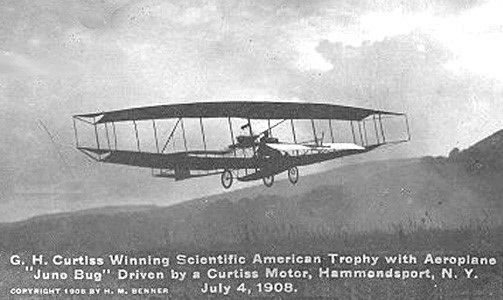
The machine made several test flights from 450 to 3,420 feet, which Scientific American reported as the longest flights ever “publicly accomplished by a heavier-than-air flying machine in America at any accessible place.” (Hammondsport was likely more “accessible” to the magazine than was Huffman Prairie, Ohio, whence the Wrights had made flights in 1905 up to 24 miles over the heads of any public that cared to look up!)
However, on his eighth venture into the sky, and in the USA’s first officially-recorded “public flight,” Curtiss travelled 6,000 feet in 01m:42s at 39 mph to win the trophy on July 4, 1908. Yet, to dull the flush of victory, this event precipitated a letter from the Wright Brothers warning of patent infringement on their control system. Despite this legal snarl, AEA managed to get the aileron system patented in 1911, which was later transferred to Curtiss, and which would eventually lead to a full-blown court battle between the brothers and Curtiss that would drag on for years until the Wrights finally won.
In 1909 Curtiss exhibited intricate curved flights at Mineola, and circled Governor’s Island in New York harbor. In 1910 he made his famous flight from Albany to New York, stopping en route, as prearranged. At Atlantic City he flew fifty miles over salt water. A flight of seventy miles over Lake Erie was accomplished in September of the same year, the return trip being made the following day.
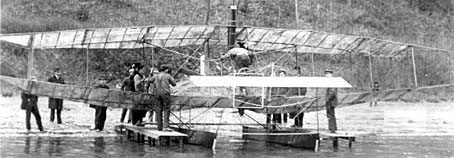
Curtiss fitted twin pontoons to his June Bug, renamed it Loon, and tested it in June 1909. It attained a surface speed of 27mph would not leave the water. During subsequent attempts it went out of control, sank in the shallows, and became frozen in the ice.
On January 26, 1911, Curtiss repeatedly ascended and descended, with the aid of hydroplanes, in San Diego Bay, California.
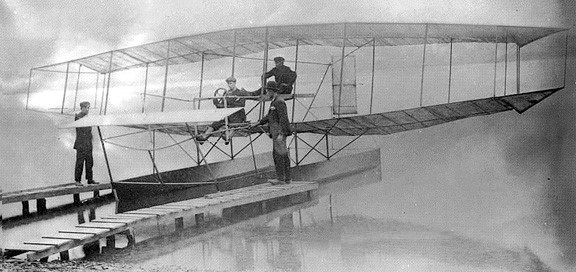
The June Bug was used by Curtiss for a total of 32 flights. It then crashed on 2 January 1909 and went into retirement.
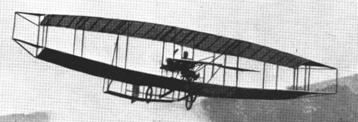
Wingspan: 12.95 m / 42 ft 6 in
Wing area: 34.37 sq.m / 369.96 sq ft
Length: 8.4m / 27ft 6in
Take-off weight: 279 kg / 615 lb
 All Aero