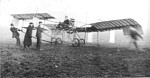
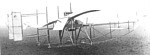
The company was founded by Count Giovanni Agusta in 1923, who flew his first airplane in 1907 and several more were built before the First World War. The firm was revived in 1923, specialising in light aircraft. The MV Agusta motorcycle manufacturer began as an offshoot of the Agusta aviation company at the end of the Second World War as a means to save the jobs of employees of the Agusta firm.
In 1952 Agusta was granted a license to build Bell Model 47 helicopters, the first Agusta-built example flying in May 1954, and over 1,200 were built before production ended in mid-1970s. The company also produced Bell Iroquois models as Agusta-Bell 204B and 205, 212 and 206 JetRanger helicopters. In 1967, under Sikorsky license, production of SH-3D helicopters began, and in 1974 production of HH-3F (S-61R); production of final HH-3F Combat SAR version lasted into mid-1990s. Together with Elicotteri Meridionali, SIAI-Marchetti, and other Italian companies, Agusta became involved in production of the Boeing Vertol CH-47C Chinook. Other license-built helicopters include AB-412EP/Griffon/Maritime Patrol versions of the Bell 412EP and Griffon, AMD-500E version of the McDonnell Douglas MD 500E, and Agusta-Boeing 520N NOTAR helicopter.
The company also had ambitions to design and build its own helicopters. The Agusta A.101 and the Agusta A.106 can be considered the best of its earlier attempts. Others included the AB.102, A.103, A.104, and A.115. Agusta-designed helicopters include the twin-turboshaft A109 civil/military multipurpose type (flown August 1971), A 119 Koala single-turboshaft wide-body helicopter (first flown February 1995), and A129 Mangusta tandem two-seat attack helicopter (first flown September 1983) and its more-powerful International variant with five-blade main rotor as standard (first flown January 1995).
It also produced a small line of aero engines such as the GA.70 and GA.140.
Developed in the 1970s, the Agusta A109 has undoubtedly been the company’s biggest success. The A109 is a commercial and military twin turbine helicopter, of which the latest variants are still in production, hundreds having already been sold.
Agusta acquired 30% of SIAI-Marchetti in 1970, increased its stake to about 60% by 1973 and reached complete ownership in 1983.
In 1983 the Agusta A129 Mangusta anti-tank helicopter partook in its first official flight engagement. It was the first attack helicopter to be designed and produced in Western Europe. However, this helicopter has been a limited commercial success so far, seeing service with the Italian Army, and only now has a modernized variant being developed for the Turkish Army.
The 1980s saw the start of several collaborative projects for Agusta. In 1981 Agusta and Westland of Britain started the EH101 medium-lift naval helicopter project in order to satisfy the requirements of the Royal Navy and the Italian Navy. In 1985 the company started a collaborative programme with the aeronautic industries of Eurocopter Deutschland; Eurocopter, and Fokker in order to develop and produce the NHI NH90, a 9-ton twin engine multi-role medium helicopter in order to satisfy the requirements of their respective countries’ armed forces.
1990s projects include the Agusta A109 Power, an improved version of the A109 (1994) and the Agusta A119 Koala (1997), a single-engine design based on the A109.
Agusta became involved in a notorious Belgian bribery scandal when it was revealed that the company had paid the two Belgian socialist parties who were then (1988/1989) in the government to assist the company in getting the contract for attack helicopters for the Belgian army.
1995: 520 Via Giovanni Agusta, Cascina Costa di Samarate, Varese I-21017, Italy.
In 1998 Agusta formed a joint venture with Bell Helicopter Textron called the Bell/Agusta Aerospace Company. Its aim was to develop the Bell/Agusta AB139 helicopter and the Bell/Agusta BA609 tiltrotor aircraft. Bell later withdrew from the AB139 project, which is now known as the AgustaWestland AW139.
In July 2000 Finmeccanica and GKN plc agreed to merge their respective helicopter subsidiaries (Agusta and GKN-Westland Helicopters), forming AgustaWestland.



 All Aero