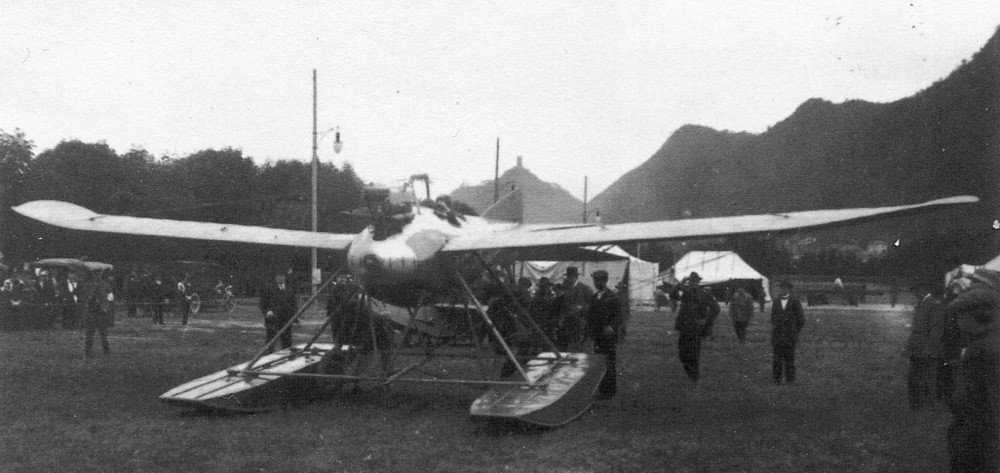
The 1913 Albatros Wassereindecker was a streamlined three-seat float-equipped monoplane with 100 hp Mercedes engine. It was flown by Hellmuth Hirth in the October 1913 Gran Premio dei Laghi, which was a race around several Italian lakes around Como.
The 1913 Albatros Wassereindecker was a streamlined three-seat float-equipped monoplane with 100 hp Mercedes engine. It was flown by Hellmuth Hirth in the October 1913 Gran Premio dei Laghi, which was a race around several Italian lakes around Como.
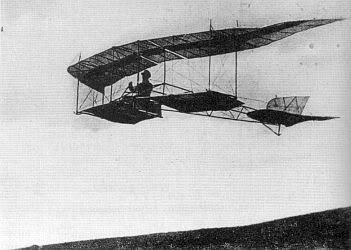
The foundation laid by Lilienthal and Ursinus was advanced by Darmstadt Technical Institute’s tests at Wasserkuppe in July 22, 1912 when a new record for time aloft and distance was established by pilot Hans Gutermuth, who flew the F.S.V. X. glider for one minute fifty-two seconds covering a distance of 840 meters. A replica of that plane, built by Otto Becker’s team is now on display in the Glider Museum at Wasserkuppe.
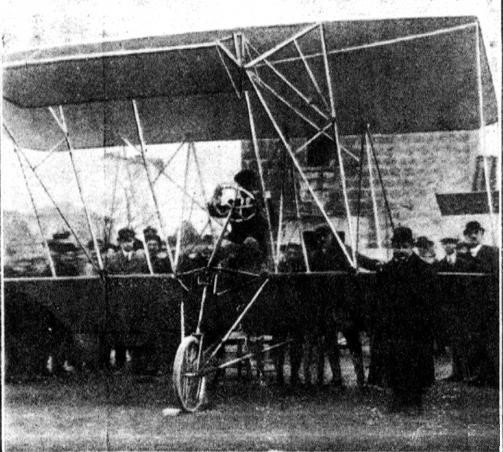
The 1911 Aitken biplane was designed and built by Willem H. Aitken in the USA.
The Airex RX-10 was a 1000hp 2170ci 11 cylinder air-cooled radial.
The Airex RX-2 was a 200hp 632ci 11 cylinder air-cooled radial.
Astoria NY.
USA
Early 1900s engine builder.
In the summer of 1911 British businessman George Holt Thomas acqured the manufacturing rights from the Maurice and Henry Farman Aircraft Company to build their aircraft. At the same time he negotiated the rights to build the French Le Rhone and Gnome engines. Within nine months he had created the Aircraft Manufacturing Co Ltd, based at Hendon, London, and combined it with his two other companies, the Aeroplane Supply Company and Airships Ltd, with a capital of £14,700.
In the summer of 1912 a ‘Military Trials’ was held and the Aircraft Manufacturing Co submitted the Maurice Farman 70 hp biplane. The aircraft performed reasonably well but did not get a contract to build for the RFC. The company was awarded a £100 consolation prize.
For the next two years Holt Thomas acted just as an agent for the Farmans, and the company became “Airco”. Holt Thomas was approached by Geoffrey de Havilland with the suggestion that they build their own aircraft. Holt Thomas offered him a job as a designer and to establish the firm’s own design department at a salary of £600 plus commission on every aircraft sold.
Based at Hendon, London, the company made several types of military aircraft, generally known as D.H. rather than Airco. These were the D.H.1 and 1A two-seat pushers; D.H.3 and 3A twin-engined pushers; D.H.4 two-seat tractor (representing, as a fast day-bomber, one of the greatest aeronautical advances of the First World War); D.H.5 single-seat tractor with backward stagger; D.H.6 tractor trainer; D.H.9, an extensively developed D.H.4; D.H.9A, an even greater advance; D.H.10 and 10A, built in pusher and tractor forms (notably tractor); D.H.11 twin-engined bomber; and D.H.14 and 15 single-engined bombers.
Early civil transport types were the D.H.16 and D.H.18. Other companies controlled by Airco built flying-boats, air engines and airships. After the war Holt Thomas founded Air Transport and Travel Ltd.
The Aircraft Manufacturing Co. was sold in 1919 to the B.S.A.-Daimler group who, disappointed at the failure of air transport in 1919-20, shut the firm down. Almost immediately de Havilland and C.C.Walker, financed largely by Holt Thomas, out of money which he got by selling B.S.A. shares which he received in payment for the A.M.C. Ltd, started de Havilland Aircraft Co. Ltd. Airco name was temporarily revived January 1958 for production of D.H.121 jet transport.
On 1 January 1929 George Holt Thomas, founder of Aircraft Manufacturing Company Ltd, died.
Oakland CA.
USA
In 1911 the Aircraft Engine Co Inc built an 80 hp aircraft engine.
The Aichi Watch and Electric Machinery Co, Nagoya, Japan.
Aichi Tokei Denki Kabushiki Kaisha was established in 1899 as a manufacturer of electrical equipment and watches, but first built airplanes in 1920 and aero engines in 1927.
From 1920s essentially a supplier to the Japanese Navy, but built civil types also, including a mail plane for the Japan Air Transport Company. Aichi established a working relationship with Ernst Heinkel Flugzeugwerke in Germany. Wishing to contend in early 1931 for an Imperial Japanese navy requirement for a two-seat carrier-based dive-bomber, Aichi requested Heinkel to design and build an aircraft to meet the navy’s specification. Required for operation with float or wheel landing gear, the resulting Heinkel He 50 prototype flew in the summer of 1931 with twin floats. A second version, with wheel landing gear, was supplied to Aichi under the export designation He 66.
The aircraft DIA type of 1934 sank US gunboat Panay in 1937. Later D3A monoplane was perhaps the most famous of the company’s types, duplicating German interest in dive-bombers. Code-named “Val” by the Allies, this type attacked Pearl Harbor December 7,1941, and was also successful against British warships in the Indian Ocean. H9A1 twin-engined flying-boat was built in numbers; also notably E16A reconnaissance floatplane; B7A attack bomber; and the M6A catapultlaunched submarine-borne bomber, intended to attack such targets as the lock gates of the Panama Canal.
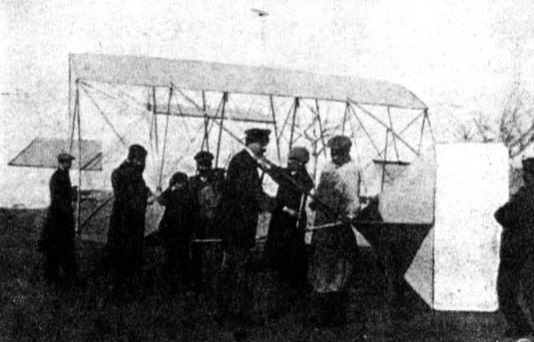
The first flight of the bird was in Caserta on 23th February 1910. Agusta was willing to develop the glider, fitting it with an engine and also his patented aircraft parachute, but the usual lack of funds stopped the project.
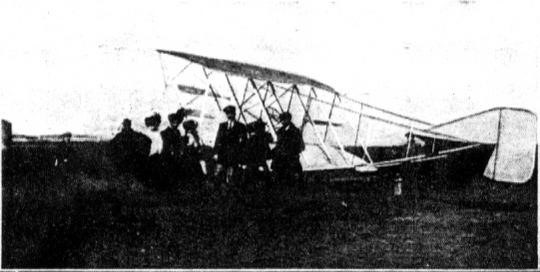
 All Aero