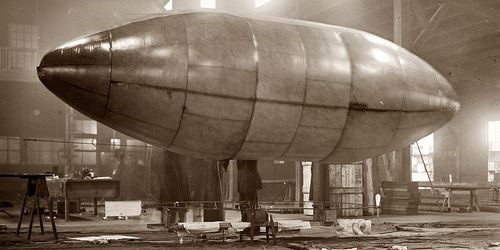
The Anthony Wireless Airship of 1909.
The Anthony Wireless Airship of 1909.
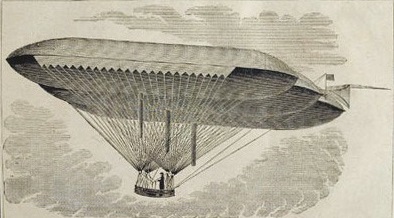
First American dirigible airship invented by Dr. Solomon Andrews of Perth Amboy, New Jersey. On August 9, 1862, Dr. Andrews wrote to US President Lincoln suggesting he could produce an aerostat to aid the armies of the Union. Constructed to demonstrate the capabilities of his invention, it was flown four times during the period from June through until September 4, 1963. Motor-less yet able to navigate against the wind using lift force and ballast to ascend and descend while traveling horizontally. To understand how the “Aereon” could have made a round trip of twenty or thirty miles to reconnoitre the Confederate army positions and report back to the Union army commanders, it’s necessary to understand that the “Aereon”, by compartmentalizing the gas and stiffening the three gasbags, was built into a gliding wing that could be tilted upwards and downwards slightly by moving the center of gravity in the car forward or aft. The flying ship “flew” by pointing it in the direction you wish to go and then dumping ballast, causing it to go shooting off on a flat trajectory as it ascends. By using this difference in specific gravity between the balloon and the surrounding atmosphere as its propulsion, once the “Aereon” reached its maximum allowable or favourable height, the pilot then vented gas causing the craft to glide downward. This could be repeated as long as the gas and ballast hold out.
The 1910 Edward F Andrews pusher biplane, the first two-engine airplane, powered by two 36hp Adams-Farwell rotary engines, was designed and built by Edward F. Andrews in the USA.
Andrews designed and constructed the single-place open cockpit biplane, which flew at Daytona Beach for about 100 yards at an altitude of six feet before the rear elevators vibrated loose and the machine came apart.
In 1913 Andreansky designed and built an aircraft of some kind. Possibly in Czechia.
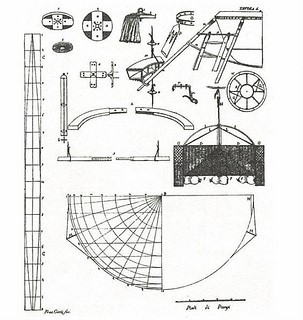
The first hot air balloon to fly in Italy. The balloon was owned and operated by Paolo Andreani, and flew for the first time on 25 February 1784. This was the first manned flight to have taken place outside of France.
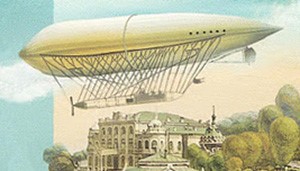
Russian non-rigid dirigible “Kiev” «Киев» was designed and constructed by Fedor Ferdinandovich Anders [Федор Фердинандович АНДЕРС].
The first flight is given as August 6, 1911 in the city of Kiev. It is claimed that the non-rigid “Kiev” was the first Russian dirigible built with private funds that carried passengers commercially.
Engine: 1 x 50 hp
Envelope: 1000 cu.m
Length: 35.5 m
Diameter: 7 m
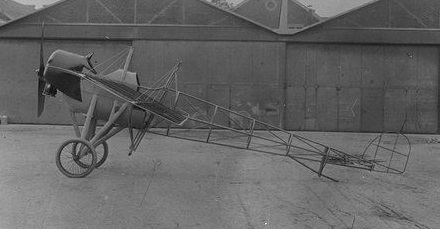
Two-seater designed by Félix Amiot, a famous designer of the 1920s and 30s, this first Amiot machine was built in a garage in the Quartier des Ternes, Paris during 1913. Test flown in 1913 at Issy-les-Moulinaeux but crashed on the field. Of all-metal construction, whereas Amiot had devised a unique method for fitting hollow metal pipes together; a system of construction that was patented in many countries. Félix Amiot started his firm Amiot–S.E.C.M in 1916, building Bréguet and Morane-Saulnier machines under licence.
The American Motor & Aviation Co built a 100-125 hp, 441ci, five-cylinder, air-cooled rotary, aero engine. Built in the early 1900s, it received ATC 181,
In 1911 the American Motor & Aviation Co built a 35hp, six-cylinder, air-cooled rotary, aero engine.
Denver CO and Long Beach CA.
Aero engine builders circa 1911.
 All Aero