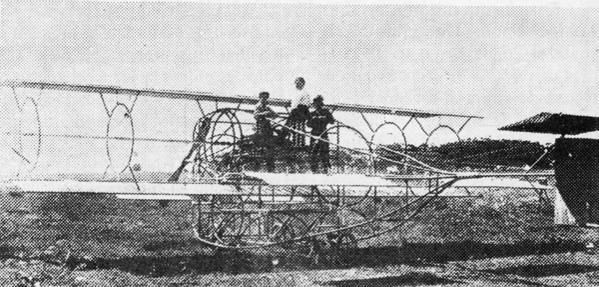
Designed by Argentinian amateur Enrique Artigalá and known as the Argentino 1ro, quoted as fitted with a 50 hp Gnôme and built during 1911.
Designed by Argentinian amateur Enrique Artigalá and known as the Argentino 1ro, quoted as fitted with a 50 hp Gnôme and built during 1911.
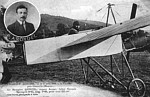
The 1911 Arondel monoplane was designed and built by P. Arondel in France.
Span: 28’4″
Length: 25′
Weight: 500 lb
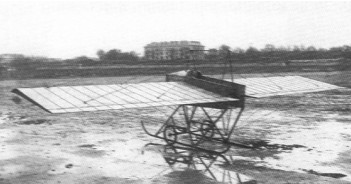
At the Paris Air Show in 1913, Arnoux exhibited his “Stablavion” monoplane, a low-wing two-seater motorized by a 55 hp pusher engine. Flight tested at Issy-Les-Moulineaux.

Arnoux’s first biplane, built in 1909, was followed in 1912 by a monoplane. The airfoil section had a reflex camber. Flight tested at Issy-Les-Moulineaux.
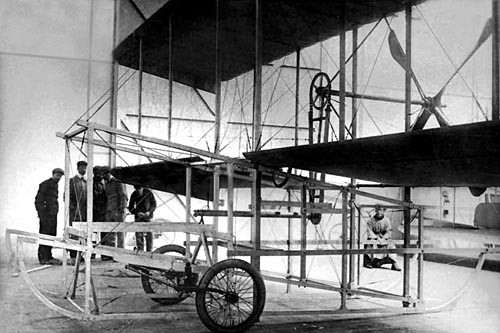
Arnoux’s first biplane, built in 1909, was devoid of sweep or dihedral.
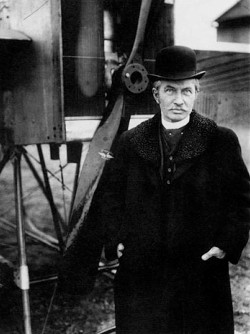
The French aeronautical engineer René Arnoux was a pioneer in the development of the tailless airplane. Arnoux’s work is very significant in that he is the real originator of the “flying plank” class of tailless airplane. All his planes used a plain straight rectangular (or slightly tapered) wing, without any sweep-back, dihedral, stagger, or stabilizing wing tips.

A monoplane design of Léopold Arnal, who patented some features of the design in Belgium, pertaining to the landing gear and a sort of starting ‘hook’ which made the rows of personnel holding the machine when the engine was running superfluous. The pilot could handle this hook from the cockpit. It was built in October 1910 at Cateau (Belgium). Tests were made on 9 October and 21 November 1910 which ended in (small) crashes. In January 1911 “Le Mistral” was exhibited at the Brussels Aero Show.
The War Office renamed the H.M. Balloon Factory the Army Aircraft Factory in 1911 (later the Royal Aircraft Factory).
The 1910 Armstrong monoplane was designed and built by Gordon Armstrong in the UK.
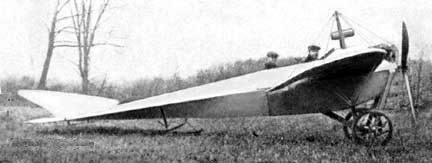
The 1910 Armitage 2-seater monoplane was designed and built by George Armitage in the USA.
 All Aero