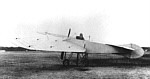
The 1913 Badaire monoplane was designed and built by Maurice Badaire in France.
The 1913 Badaire monoplane was designed and built by Maurice Badaire in France.
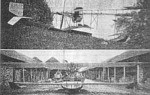
The 1913 Bachelier-Dupont-Baudrin biplane flying-boat was designed and built by Bachelier, Dupont and Baudrin in France.
Span: upper 36’9″ lower 29’6″
Length: 26’3″
Weight empty: 836 lbs
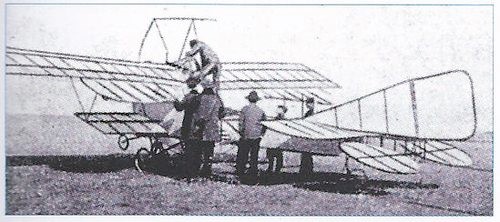
The 1910 Monoplano, designed by Ing. Omero Bacchiega of Tortona (midway between Genova and Milano), was constructed of beech and bamboo with metal rods for added strength. It was fitted with a 25 hp Anzani engine, driving a 2 meter diameter propeller.
In 1913 Babcock built a replica German Taube, with a gull-wing. The open cockpit, single place Taube was a mid-wing monoplane.
In 1913 Babcock built one copy of the Curtiss pusher. A single seat, open cockpit biplane.
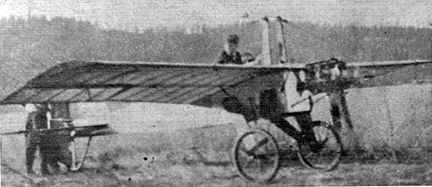
In 1910, Babcock built a vaguely Blériot copy. The first confirmed aircraft built and flown by Vearne C. Babcock and equipped with a 35 horse-power Curtiss engine.
A single place, open cockpit, mid-wing monoplane, only one was built.
It was listed as scheduled to fly at an air meet in Seattle, Washington, on June 11, 1911, however, poor weather brought the meet to a premature close.
Babcock built two airworthy copies of the Wright Biplane; in 1905 and 1909.
They were likely sold for exhibition work.
Born at Benton Harbor, Michigan, USA in 1886, Verne Clifton “Bob” Babcock’s first design was a copy of the Wright Flyer built in 1905, it was wrecked on takeoff at Bangor,
1905: Verne Clifton Babcock
Benton Harbor WA.
USA
1907: Babcock-Breininger Aeroplane Supply Co,
Seattle WA.
USA
Michigan in 1907. Babcock moved to Seattle, Washington, and built a second Wright copy in 1909, the same year he and a partner formed Babcock-Breininger Aeroplane Supply Co., building several more derivative aircraft. Babcock moved on to several other aviation training and engineering activities throughout the USA before forming Babcock Aircraft Co. in Akron, Ohio, in 1924.
1924: Babcock Aircraft Co,
Stow Field,
Akron OH.
USA
The company experienced several reorganizations and in 1930 it was acquired by the S. Taubman Aircraft Co., and became known also as Babcock-Vlcek Co.
1930: Acquired by S Taubman Aircraft Co, aka Babcock-Vlchek Co,
Akron.
USA
1938: Babcock Aircraft Corp,
Deland FL.
USA
In 1938, Babcock formed the Babcock Airplane Corp. at De Land, Florida and during WW II built Waco CG-4 assault gliders. Babcock left the aviation industry in 1945, and sold the rights to produce his LC-13 to Bartlett Aircraft Corp. at Rosemead, California. Bob Babcock passed away on February 13, 1972.
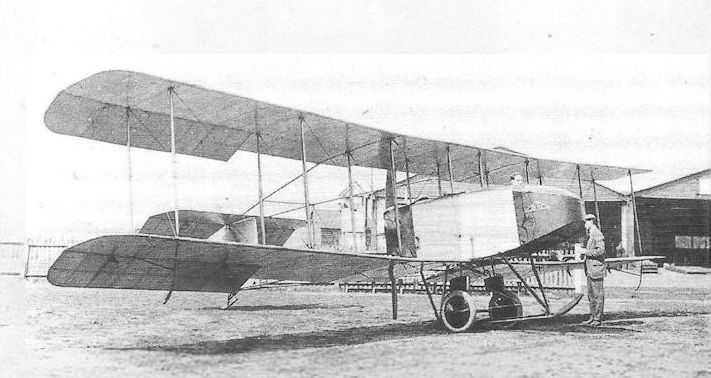
The Avro 508 was a two-seat biplane built at the Manchester works in December 1913 and delivered at Brooklands for assembly and test a month later.
It was a twin boom, three bay pusher biplane of fabric covered wooden construction having equal span mainplanes structurally similar to those of the Avro 504 prototype. A wide center section carried the first pair of interplane struts at its extremities, the dihedral commencing at this point as on the Avro 503. Ailerons were used for lateral control and the machine was noteworthy as the first Avro type to have aileron cables located inside the wing leading edge and running over buried pulleys.
A square-section nacelle, built up from four ash longerons and spruce cross struts, accommodated two crew in tandem. The observer/gunner sat in the nose for maximum field of vision with the pilot behind. Fuel and oil tanks were located behind the pilot’s seat and just ahead of an 80 hp Gnome rotary engine mounted on steel tube bearers.
Tail booms were of steel tubing braced by streamline section spruce struts, the rear extremities of which were built into the tailplane structure. For ease of dismantling, the booms were jointed just ahead of the tailplane leading edge. The rudder was an elongated version of the comma type.
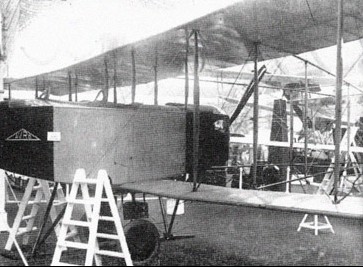
The Avro 508 was not adopted for the Royal Flying Corps and the single machine built made but two public appearances. The airframe was shown without covering at an exhibition at Belle Vue Gardens, Manchester on January 1-3, 1914 and the complete aircraft was shown on the Avro stand at the Olympia Aero Show, London on March 16-25, 1914.
Engine: One 80 hp Gnome
Wingspan: 44 ft. 0in
Wing area: 468 sq. ft
Length: 26 ft. 9 in
Height: 10 ft. 0in
Empty weight: 1,000 lb
All-up weight: 1,680 lb
Maximum speed: 65 mph
Endurance: 4.5 h
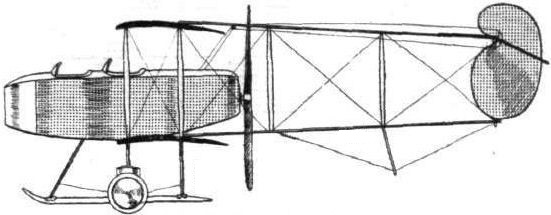
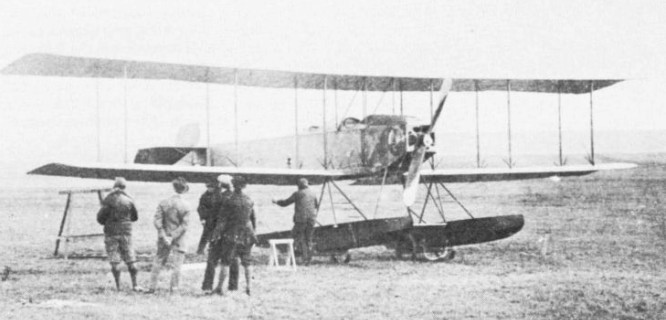
The Avro 503 was a development of the earleir Avro 501, powered by a 100 h.p. Gnome and was initially known as the Type H. it was a slightly larger version of the Avro 501 and featured less of a overhang on the mainplane and no inclined struts. Designated as the Avro Type H. 501, the seaplane was designed for simple and fast dismantling of the aircraft.
The prototype of the Avro 503 first flew from Avro’s facility at Shoreham on the River Adur on 28 May 1913. On the following day led Avro test pilot FP Raynham made the first landing on the sea near Brighton. The floats were damaged and were reinforced at the front. On 12 June 1913 was a one hour demonstration flight over Brighton, followed by Raynham taking a passenger. Following a demonstration flight in front of the Inspector of Naval Aircraft an order for three was placed for the RNAS. All machines from September 1914 were converted into land planes.
The Avro 503 was built under licence by Gotha as the WD.1.
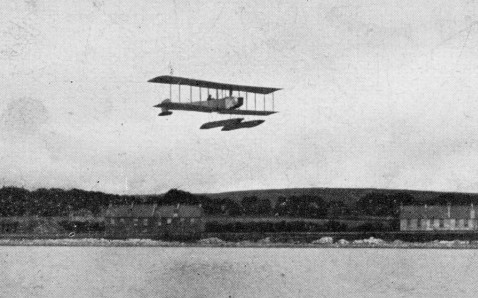
Another 503 was ordered by the Peruvian government, however the delivery did not take place due to the outbreak of the First World War.
A 503 crashed on 11 From August 1915 and another on 7 April 1917
The prototype, now called the Avro 503, was bought by the German government in late June 1913 and became the first aircraft to fly almost 40 miles (64km) across the North Sea from Wilhelmshaven to Heligoland. It had been test flown in England by a German Naval Officer named Captain Schultz in June 1913.
The Avro 503 was built under licence by Gotha as the WD.1.
Specifications
Engine: Gnome, 74.6 kW (100 hp)
Span (upper) 50ft 0in / 15.24m
Span (lower) 47in 0in / 14.33m
Length 33ft 6in / 10.24 m
Height 12ft 9in / 3.89m
Wing Area 567 sq ft / 43.4 sq.m
Max take off weight: 2,200lb / 998 kg
Maximum Speed: 50 mph / 80.5 km / h
Initial climb rate: 225ft/min / 67 m / min
Seats: 2
Accident Report
Date: 07-APR-1917
Time: 11am
Type: Avro 503
Operator: Royal Air Force
Registration: A533
Fatalities: Fatalities: 0 / Occupants: 1
Other fatalities: 2
Airplane damage: Written off (damaged beyond repair)
Location: Walsall, West Midlands, England
Phase: En route
Nature: Military
Departure airport: Tern Hill
Destination airport: Castle Bromwich
Narrative:
An RAF Avro 503 of 43 Reserve Squadron was flying over the West Midlands on the 7th April 1917. The engine of the aircraft failed forcing the crew to made a forced landing. But the landing went wrong while over the town of Walsall the plane crashed into a house then into the garden on Brewer Street, Walsall killing two people on the ground, Frances Ann North (65) and her grand-daughter Edna May Vass (only 10 months old) of 5 Brewer Street, Walsall. The pilot (Second Lieutenant Mann RFC) and one person on the ground were injured in the crash.
The pilot was too ill to attend the inquest.
 All Aero