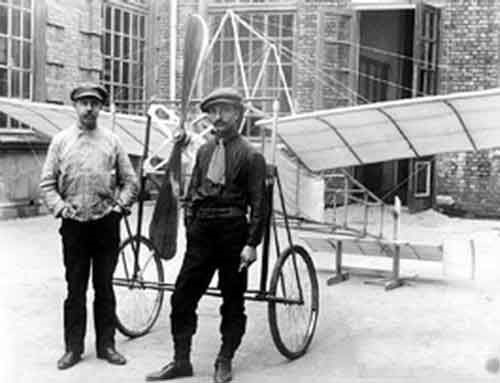
Baldwin, Thomas Scott

Thomas Scott Baldwin was born on June 30, 1854 to Jane and Samuel Yates Baldwin in Marion County, Missouri and orphaned as a young teenager. He worked as a brakeman on the Illinois railroad, then joined a circus working as an acrobat. In 1875, he started an act combining trapeze and a hot air balloon. He eventually turned to jumping from a balloon, getting credit for inventing the modern parachute in 1885.

Baldwin, holder of Dirigible Balloon Pilot license #1, is also credited with the invention of the first practical parachute, in 1885, although he never bothered to patent his idea. On January 30, 1885 he made one of the earliest recorded parachute jumps from a balloon. Baldwin repeated the feat on multiple occasions as a paid entertainer, netting $1500 from one dangerous jump over the water from 600 feet at Rockaway Beach in August 1887 marred by parachute difficulties.

c.1887: (Thomas Scott) Baldwin Airship Co (lighter-than-air),
Quincy IL;
USA

In 1900, Baldwin created a small pedal-motorized powered airship. It never served as anything more than a curiosity. In 1902-1903 he supervised the construction of the California Eagle based on the ideas of August Greth and financed by the American Aerial Navigation Company of San Francisco. It incorporated a French DeDion Bouton automotive engine and paddle propeller based on marine technology so prevalent in airship design in the period.

After collaborating with Greth and John J. Montgomery in 1903-1904, Baldwin acquired sufficient knowledge to begin his own independent airship project.

1902: San Jose CA
USA

In June and July, 1904 Baldwin built an aerodynamic cigar-shaped, hydrogen gas filled, balloon. He created the dirigible “California Arrow”, which incorporated a 7-HP Hercules motorcycle engine manufactured by Glenn H. Curtiss of Hammondsport, New York.

The Army bought it and designated its first dirigible “SC-I” (Signal Corps Dirigible Number 1). Baldwin picked up the sobriquet: “Father of the American Dirigible.” He received the Aero Club of America’s first balloon pilot certificate.

1906: Hammondsport NY.
USA

1909: Baldwin Aeroplanes (airplanes, and Eastern distributor of Hall-Scott motors).

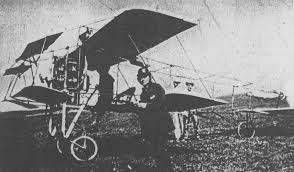
In 1910 Baldwin designed his own airplane, and it was built by Glenn Hammond Curtiss. On September 10, 1910 Baldwin made history with the first airplane flight over the Mississippi River. The St. Louis flight started just east of Bellefontaine Cemetery. Baldwin and his Red Devil plane took off at 5:11 p.m. 200,000 citizens lined the riverfront on both sides to watch the red biplane fly from the north St. Louis field and land in Illinois across the river from Arsenal Street. On the return flight, the aviator astounded the crowds by flying under both the Eads and McKinley bridges at fifty miles per hour (80.5 km/hr). Baldwin landed at 6:05 back at his starting place.

Baldwin at the wheel of the Red Devil

Baldwin flew it at an air meet in Kansas City, Missouri, on October 7, 1910. He spoke to State University of Iowa engineering students on October 11, 1910 and flew demonstrations at the Iowa City, Iowa fairgrounds on October 12–13, 1910. The flight on October 12 was unsuccessful. On October 13, he flew two flights, one of which was photographed by Julius Robert Hecker. On the second flight he did not gain sufficient altitude and the plane was damaged on a barn but he was uninjured. He then took his airplane to Belmont, New York. He put together a company of aerial performers including J.C. “Bud” Mars and Tod Shriver in December 1910 and toured countries in Asia, making the first airplane flights in many of those locations. The troupe returned to the United States in the spring of 1911.

1911: Contract builders (C and A) Wittemann Aeronautical Engineers
Staten Island NY.
USA

In 1914 he returned to dirigible design and development, and built the U.S. Navy’s first successful dirigible, the DN-I. He began training airplane pilots and managed the Curtiss School at Newport News, Virginia. One of his students was Billy Mitchell, who would later become an advocate of American military air power.

1914: Merged with Connecticut Aircraft Co (lighter-than-air).

When the United States entered the World War I, Baldwin volunteered his services to the United States Army. He was commissioned a captain in the Aviation Section, U. S. Signal Corps and appointed Chief of Army Balloon Inspection and Production. Consequently, he personally inspected every lighter-than-air craft built for and used by the Army during the war. He was promoted to the rank of major during the war.

After the war, he joined the Goodyear Tire and Rubber Company in Akron, Ohio, as a designer and manufacturer of their airships.

Captain Thos. S. Baldwin, PO Box, 78, Madison Square, N.Y.

1921: T S Baldwin retirement.

1922: Acquired Orenco holdings (pres: William Bennett).

T.S. Baldwin died on May 17, 1923, in Buffalo, New York, at the age of 68. He was married to Cary Poole. He was buried in Arlington National Cemetery in Arlington, Virginia, with full military honors.

He held Aero Club of America licenses:
Balloon Pilot Certificate #1
Airship Pilot Certificate #9
Airplane Pilot Certificate #7

Baldwin was inducted into the National Aviation Hall of Fame in 1964.
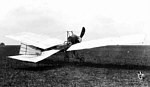
Baird 1910 monoplane

It is unknown when Baird first developed an interest in aviation, but he certainly corresponded with early pioneers such as Louis Bleriot and S. F. Cody about the finer points of aircraft design. A visit to the Blackpool Aviation Week in October 1909 seems to have given focus to his enthusiasm, and when he returned to Rothesay he began work on an aircraft of his own design, the Baird Monoplane. This was generally similar in layout to the aircraft in which Bleriot had made the first crossing of the English Channel on 25 July 1909, albeit with a unique control system. His aircraft also had a four-cylinder air and water-cooled engine made by Alexander Brothers in Edinburgh. The body was constructed from tubular steel and the wings were covered in silk sewn by Mrs Baird.

The completed Baird Monoplane went on display in Rothesay during the summer of 1910, and was a star attraction at the Bute Highland Games on 20 August 1910. It is unclear whether Baird himself had been one of the 250,000 people to attend the Lanark Air Show, the first to be held in Scotland, between 6 and 13 August 1910, but given his interest in aviation it would seem odd had he not been there.

Early on the morning of 17 September 1910, the Baird Monoplane was transported by cart across Bute to Ettrick Bay, on the island’s west coast. It was a fine day, and a small crowd had gathered, including a correspondent of Flight magazine. Baird started the engine, and advanced the throttle. According to the report in that week’s Flight the aircraft accelerated over the sand and took off correctly, but having cleared the ground then veered to the right, landing with a crunch that buckled one of the main wheels and slightly damaged a wing.

Having succeeded in making (albeit briefly) the first flight of an entirely Scottish aircraft, it is not known if Baird ever flew his monoplane again. What set his achievement apart was the entirely Scottish nature of the undertaking.

It is said that the engine from the Baird Monoplane was given to a museum in Glasgow in the 1950s, and the propeller was donated to the National Museum of Flight in 2010, to mark the centenary of the flight.

While it was on show over the summer of 1910, the Baird Monoplane was examined by Thomas Sopwith, who would later become an aviation pioneer in his own right and an aircraft manufacturer. With Baird’s permission, Sopwith drew on some of the novel ideas in the Baird Monoplane when he later began building his own aircraft, which went on to have a significant impact during World War One. Baird’s name was also remembered when, in 2010, the small Bute Airstrip near the southern end of the island was renamed in his honour as Baird Airstrip.

Baird, Andrew Blain

Andrew Blain Baird lived from 1 January 1862 to 9 September 1951. He was a blacksmith in Rothesay on the Isle of Bute who on 17 September 1910 completed the first flight by an entirely Scottish designed and built heavier-than-air aircraft, the Baird Monoplane.

Baird was one of three sons born to a fisherman, who lived beside Luce Bay in Galloway. The young Andrew was apprenticed to a local blacksmith before working first as a lighthouse keeper on Lismore and then in an ironworks at Gartcosh on Clydeside. In 1887, at the age of 25, he set himself up as a blacksmith in Rothesay on the Isle of Bute. In 1892 he married Euphemia Martin at Glecknabae Farm on the island. They later had two daughters, who died in infancy, and two sons who survived into adulthood.

It is unknown when Baird first developed an interest in aviation, but he certainly corresponded with early pioneers such as Louis Bleriot and S. F. Cody about the finer points of aircraft design. A visit to the Blackpool Aviation Week in October 1909 seems to have given focus to his enthusiasm, and when he returned to Rothesay he began work on an aircraft of his own design, the Baird Monoplane. This was generally similar in layout to the aircraft in which Bleriot had made the first crossing of the English Channel on 25 July 1909, albeit with a unique control system. His aircraft also had a four-cylinder air and water-cooled engine made by Alexander Brothers in Edinburgh. The body was constructed from tubular steel and the wings were covered in silk sewn by Mrs Baird.

While it was on show over the summer of 1910, the Baird Monoplane was examined by Thomas Sopwith, who would later become an aviation pioneer in his own right and an aircraft manufacturer. With Baird’s permission, Sopwith drew on some of the novel ideas in the Baird Monoplane when he later began building his own aircraft, which went on to have a significant impact during World War One. Baird’s name was also remembered when, in 2010, the small Bute Airstrip near the southern end of the island was renamed in his honour as Baird Airstrip.

Bahyl Helicopter

On 13 August 1895, Jan Bahyl was granted a patent numbered 3392 by emperor Franz Joseph. On the following years he made several attempts reaching a height of 0.5 meters in 1901, 1.5 in 1903 and on 5th May of 1905 at Pressburg he flew up using his petrol-engine helicopter to a height of 4 meters for over 1500 meters that was also recorded by the International Airship Organisation.

Bahyl, Jan           

Jan Bahyl, born in Zvolenska Slatina (Austro-Hungary) in 1845, graduated from the Banska Stiavnica Mining Academy with a diploma in technical drawing in 1869. During his year long army service, he was noticed by his superiors, having made some technical improvements for the Hungarian army, and was enrolled into the technical staff.
As well as being entrusted with complex building tasks while in the army, Bahyl was also able to study at the Vienna Military Academy, where he graduated in 1879 and was made a lieutenant.
During his time in the army Bahyl was able to work on a number of inventions, many of which involved hydraulics. His first notable invention, which he actually financed with his own money, was the Steam Tank. This was bought by the Russian army, the money from which enabled Bahyl to dedicate the rest of his life to inventing.
Bahyl was granted 7 patents in all, including the invention of the tank pump, air balloons combined with an air turbine, the first petrol engine car in Slovakia (with Anton Marschall) and a lift up to Bratislava castle. Perhaps, he is best remembered though for constructing a petrol motor-driven helicopter, which he himself flew up to 4 meters high and for over 1500 meters, in 1905.
On 13 August 1895, he was granted a patent numbered 3392 by emperor Franz Joseph. On the following years he made several attempts reaching a height of 0.5 meters in 1901, 1.5 in 1903 and on 5th May of 1905 at Pressburg he flew up using his petrol-engine helicopter to a height of 4 meters for over 1500 meters that was also recorded by the International Airship Organisation.