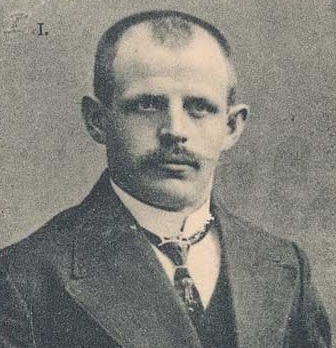
Anton Baltes
Buchhloz
Dusseldorf
Worthstr. 3
Germany
Designed an early biplane
Anton Baltes
Buchhloz
Dusseldorf
Worthstr. 3
Germany
Designed an early biplane
The Balsan monoplane was designed and built by Balsan in France circa 1911.
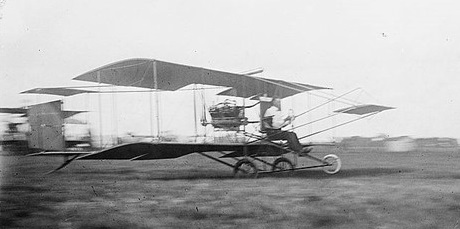
When Thomas S. Baldwin returned from the 1910 Pacific tour, he began testing a new airplane at Mineola, New York. The new aircraft was similar to the basic Curtiss Pusher design but was constructed of steel tubing instead of wood with cloth wings. The aircraft was constructed by C. and A. Wittemann of Staten Island, New York, and was powered by a 60 horsepower (45 kW), Hall-Scott V-8. It was capable of 60 mph (97 km/h). Baldwin named his new aircraft the “Red Devil III”, and thereafter each of his designs would be called a “Baldwin Red Devil”. Tony Jannus flew actress Julia Bruns in a Red Devil on October 12, 1913, in a New York Times Derby.
About half-a-dozen steel biplanes have been produced in 1911 by Captain Baldwin, and he and other aviators, Badger, Hammond, Miss Scott Mass, etc., have flown these at various exhibitions and meets.
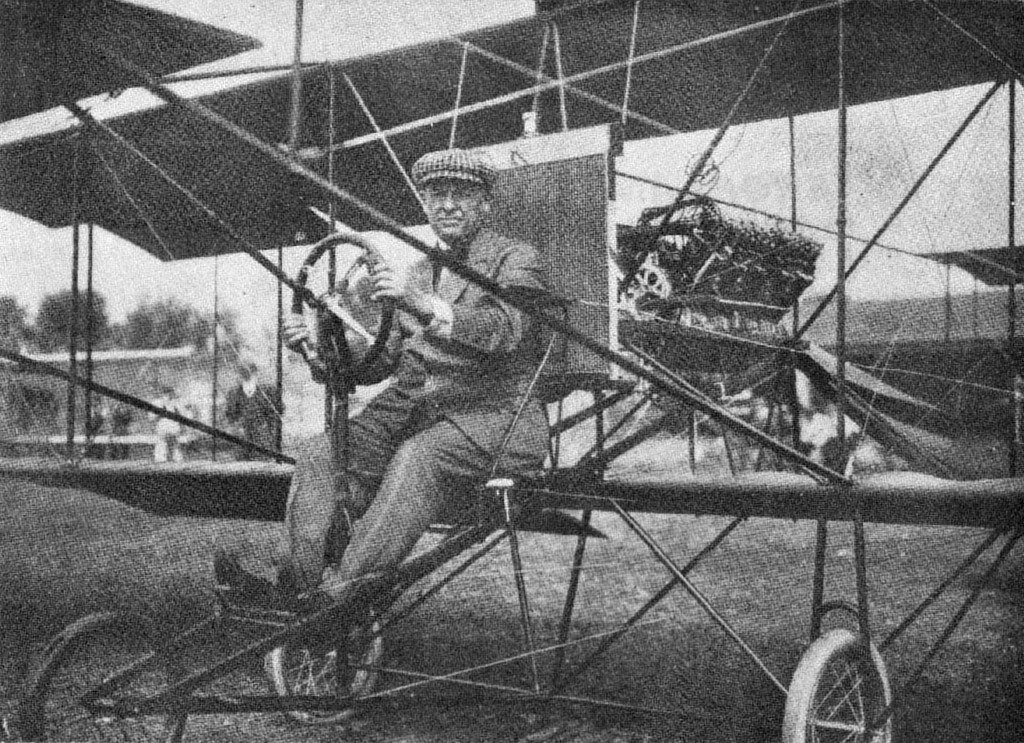
Three or four were built; one built for James C “Bud” Mars for his exhibition 1910-11 tours of the USA, Hawaii, and the Orient. Subsequent versions, built by Wittemann, had 60hp Hall-Scott or 75hp Rausie, wingspan of 31’3″ and 32’0″ length.
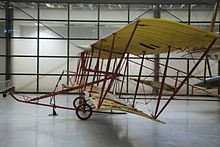
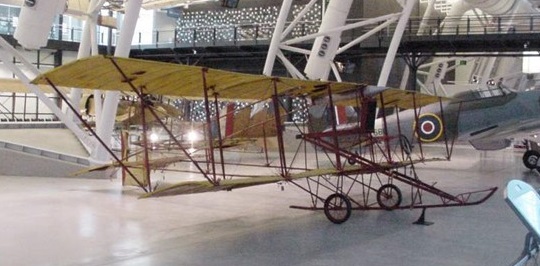
Baldwin Red Devil
Engine: Hall-Scott, 50-60 hp
Propeller: Requa-Gibson
Prop diameter: 7 ft / 2.13 m
Prop pitch: 6 feet / 1.82 m
Span: 28 ft 8 in / 8.75 m
Length: 28 ft 3 in / 8.60 m
Speed: 60 mph / 97 kph

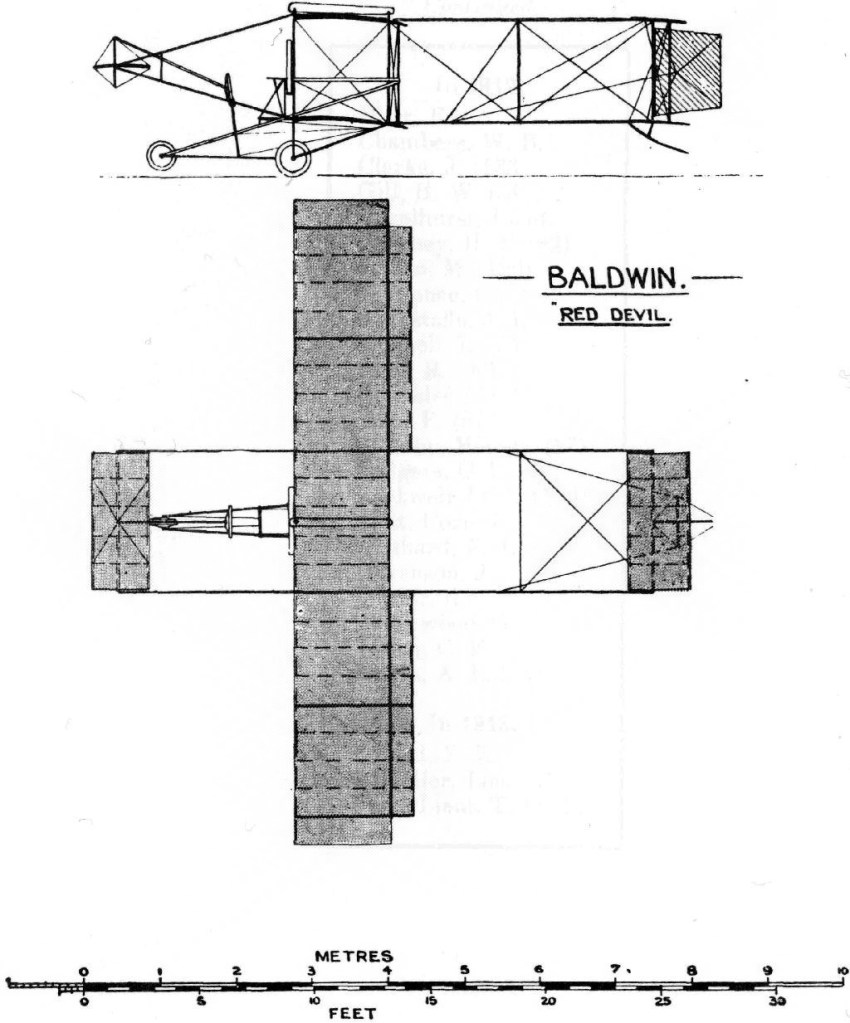
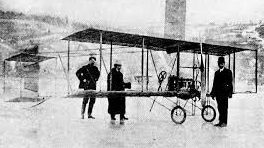
In 1910 Thomas Scott Baldwin designed his own airplane, and it was built by Glenn Hammond Curtiss. It used a 25 horsepower (19 kW), four-cylinder Curtiss engine that was later replaced by a Curtiss V-8 engine.
On September 10, 1910 Baldwin made history with the first airplane flight over the Mississippi River. The St. Louis flight started just east of Bellefontaine Cemetery. Baldwin and his Red Devil plane took off at 5:11 p.m. 200,000 citizens lined the riverfront on both sides to watch the red biplane fly from the north St. Louis field and land in Illinois across the river from Arsenal Street. On the return flight, the aviator astounded the crowds by flying under both the Eads and McKinley bridges at fifty miles per hour (80.5 km/hr). Baldwin landed at 6:05 back at his starting place.
Baldwin flew it at an air meet in Kansas City, Missouri, on October 7, 1910. He spoke to State University of Iowa engineering students on October 11, 1910 and flew demonstrations at the Iowa City, Iowa fairgrounds on October 12–13, 1910. The flight on October 12 was unsuccessful. On October 13, he flew two flights, one of which was photographed by Julius Robert Hecker. On the second flight he did not gain sufficient altitude and the plane was damaged on a barn but he was uninjured. He then took his airplane to Belmont, New York. He put together a company of aerial performers including J.C. “Bud” Mars and Tod Shriver in December 1910 and toured countries in Asia, making the first airplane flights in many of those locations. The troupe returned to the United States in the spring of 1911.
The Philippines can claim south-east Asia’s earliest encounter with manned powered flight, when American aviator James C. “Bud” Mars thrilled spectators in his Skylark pusher biplane (a modified Curtiss design) at the Manila Carnival on February 21, 1911. Mars was part of a Pacific Aviation Exhibition tour organised by fellow American Capt Thomas Baldwin, who followed Mars’s Skylark display at the Carnival with a demonstration of his own Baldwin Red Devil, the pair having arrived with their dismantled aircraft aboard a steamer from Hawaii ten days previously. The exhibition had not gone so well in Hawaii, where the locals had quickly established a principle that has caused headaches for airshow organisers ever since; why pay for a ticket to enter the showground when you can see an air display from any nearby vantage point? The Manila Carnival organisers must have found a way to sidestep this issue, as the pair of aviators made numerous flights during the week-long festival. Baldwin sold his machine before the duo moved on to complete the Pacific tour with visits to Thailand, Hong Kong and Japan.
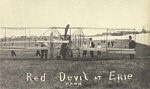
The Red Devil was later used by the first flight school in the Philippines, opened by Lt Frank Lahm of the US Army Signal Corps in March 1912.
When he returned from the Pacific tour, Baldwin began testing a new airplane at Mineola, New York. The Red Devil III.
Span: 28’9″
Length: 28’3″
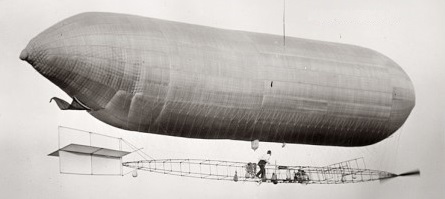
The No. 9, the “Baldwin-9” followed in 1909. Number 9, was an “Exhibition airship”.
In the Baldwin design, this girder-gondola framework was made of bamboo, Oregon spruce, and metal. The “square” frames of the skeleton are 1 meter apart and the No 9 has 24.
In 1909, Baldwin built the No. 10 for George L. Tomlinson, a wealthy industrialist and aviator. The d’Orcy Airship Manual says the Tomlinson airship was a “Baldwin-9 type.” According to the d’Orcy Airship Manual, the major difference between the Baldwin-9 and the Tomlinson (Baldwin 10) was a barely perceptible “0.6 m” difference in gas-bag diameter.
The Tomlinson and the Baldwin-9 particiated in the Hudson-Fulton Celebratin of Summer 1909.
Works No: 9
Year: 1909
Length: 58 ft / 26.2 m
Diameter: 6.1 m
Volume: 530 cu.m
Engine: Curtiss, 20 hp
Speed: 35 kph
Works No: 10
Name: Tomlinson
Year: 1909
Length: 26.2 m
Beam: 5.5 m
Volume: 500 cu.m
Engine: 20 hp
Speed: 36 kph
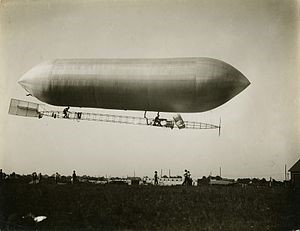
On April 18, 1906, a massive earthquake struck San Fransisco. This was the great quake of 1906. Baldwin had one airship remaining, which he had relocated to Hammondsport, New York, before the earthquake. Baldwin then moved to Hammondsport and, in collaboration with Glenn Curtiss was able to use Curtiss’s facilities for his continued airship work.
Baldwin’s demonstration of the abilities of the “California Arrow near the end of 1904, very much impressed the US Army, and in 1907 announced a request for bids for an airship, the result of urgings by Chief Signal Officer Brigadier General James Allen. Baldwin was awarded a contract to provide the Army with an airship.
The “square” frames of the skeleton are 1 meter apart and the SC-1 has 30. The SC-1 has some tubes near the pilot used for pressure control of the inflated balloon.
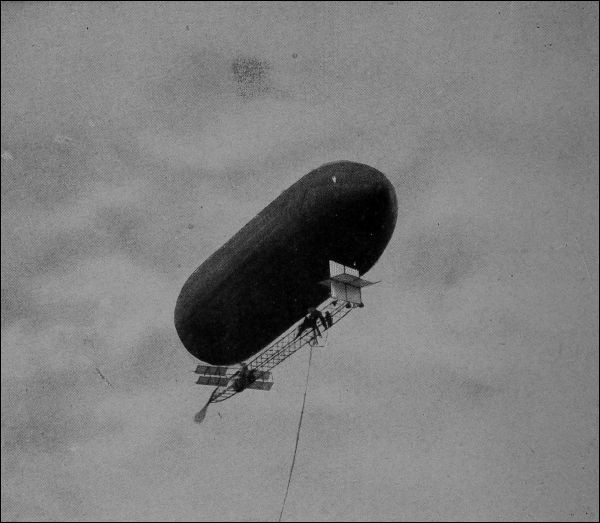
In 1908 he delivered a 95-foot long airship which could be crewed by two, and the Army accepted it, and it entered inventory as “Signal Corps No. 1”. Signal Corps Dirigible No. 1 was the first powered aircraft ordered for the Signal Corps by the Aeronautical Division of the United States Army. The craft fell short of a 2-hour, 20 mph objective to meet a $8,000 per unit award. The Army formally accepted the craft as Signal Corps Dirigible No. 1 paying $5,737.50 on 5 August 1908. The Army tested SC-1 at Fort Myer, Virginia and on 12 August, 1908 the first test flights were made with Thomas Baldwin as pilot, and another aviation pioneer as flight engineer – Glenn Curtiss. On 28 Aug. 1908 Lieutenants Frank Lahm, Thomas Selfridge and Benjamin Foulois were taught to fly the craft. Selfridge, known as being the first fatality from a heavier-than-air craft aboard a Wright Brothers aircraft (the Wright Flyer) flown by Wilbur Wright on September 17, 1908, less than one month after his first training on the SC-1.
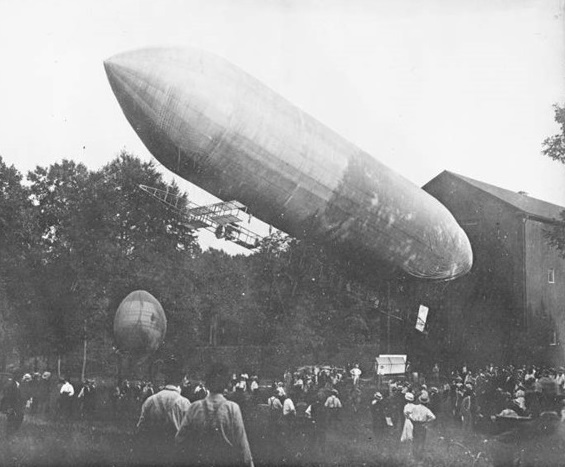
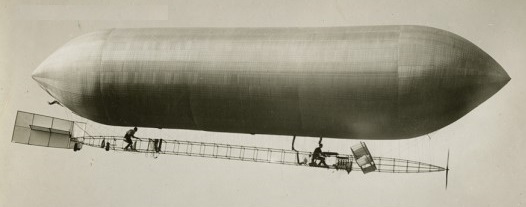
Lieutenants Lahm and Foulois became the first “US Army Airship Pilots” on May 26th, 1909 when they became the first “airmen” to ascend in the SC-1 without Baldwin. After Second Lieutenant John G Winter Jr of the 6th Cavalry was assigned to duty in the Aeronautical Division, the balloon detachment was transferred to Fort Omaha, Nebraska.
On 26 May, pilot Lieutenant Lahm and Lieutenant Foulois made a flight in SC-1 at Fort Omaha, and manoeuvred the craft at will. SC-1 remained there until scrapped in 1912. The Army did not purchase another dirigible until after World War I.
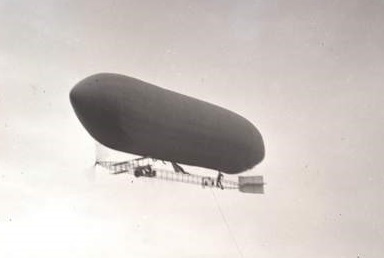
After working with the Army to train Army Officers to fly the airship, Baldwin built at least another couple of airships in 1909. He then moved into heavier-than-air work, but joined the Army in WW I where he served the Signal Corps as Chief of Balloon Inspection and Production.
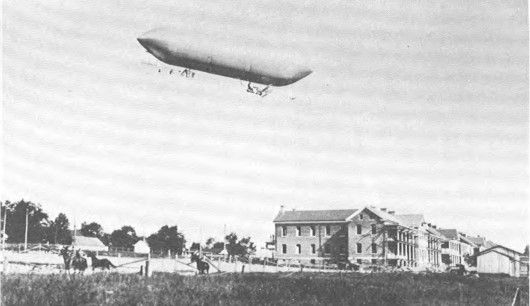
Powerplant: 1 × Curtiss, 20 hp (15 kW)
Volume: 800 cu.m
Length: 36 m
Diameter: 18 ft 6 in / 6 m
Weight: 1,360 lb
Useful lift: 1,360 lb (620 kg)
Maximum speed: 17 kn; 32 km/h (19.61 mph)
Cruise speed: 12 kn; 22 km/h (13.75 mph)
Crew: 2
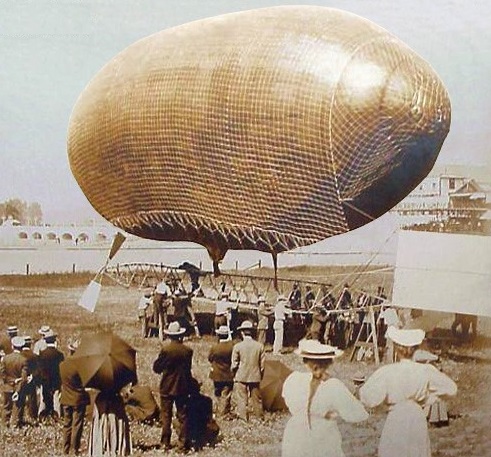
Works No: 6 ‘City of Portland’ was an exhibition airship designed, built, and owned by T.S.Baldwin.
No.7 was a Baldwin-6 type touring airship of Capt. Hildebrandt, Berlin.
Designed and built by Capt. T.S.Baldwin at the Lewis & Clark Exposition sire aerodrome, ‘City of Portland’ was flown from 19 August until 2 September 1905 by the brothers Lincoln and Hillery Beachey. On 2 September the City of Portland was scheduled to race airship Gelatine, but because of strong winds its pilot, George Tomlinson, withdrew. Lincoln Beachey took off nether the less and was quickly swept across the river into Albina District. There he got caught up in a tree and tore a 10 ft hole in the side of the gasbag.
As a consequence of the catastrophic damage done to the envelope of City of Portland, coupled with the wear and tear from repeated flight to Gelatine’s gondola, the dirigibles were amalgamated; with the gasbag from the Gelatine being fitted onto the gondola of the City of Portland. This remodelled airship continued to carry the Gelatine name and flew for the duration of the fair.
Works No: 6
Name: Baldwin-6
Year: 1908
Length: 29.1 m
Beam: 5.8 m
Volume: 580 cu.m
Engine: Curtiss, 20 hp
Speed: 25 kph
Works No: 7
Name: H.1
Year: 1908
Length: 29.1 m
Beam: 5.8 m
Volume: 580 cu.m
Engine: 20 hp
Speed: 28 kph
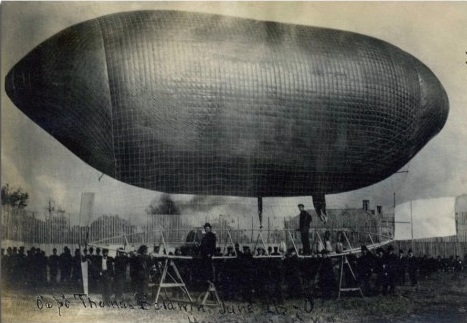
Upon hearing about the first dirigible flights in France in 1898, Thomas Scott Baldwin traveled across the Atlantic to learn more. Unlike a hot-air balloon, which flies, literally, whichever way the wind takes it, a powered dirigible moves under its own power, and can therefore be taken exactly where you want it to go and can also return to where you start. Baldwin also sought the insight of the aviation pioneer and professor at Santa Clara College, John J. Montgomery, whose propeller designs were adopted by Baldwin, and August Greth, a French doctor living in San Francisco who had become fascinated by military observation balloons while serving in the French army in Algeria.
Baldwin began experimenting and ultimately built a non-rigid aircraft featuring a 52-foot-long, 17-foot-diameter gas bag of oiled Japanese silk that tapered to a point at both ends. The silk gas bag contained 8,000 cubic feet of hydrogen to keep the California Arrow aloft. It was a completely “basic” design, a suspended triangular frame catwalk as a “control car” under a set of square-mesh nets of strong cord which, upon inflation of the the gas bag, contain and held the gas bag captive. Baldwin constructed a 30-foot-long, triangulated-framed control car suspended from the gas bag by an extensive rope net. The control car had enough space for one man, the pilot, who could move fore and aft to shift himself as ballast as needed. The rudder was attached to this frame. The Gas-bag envelope was 54 feet long, the control “car” was made up of square cedar struts (painted a silver color resulting in an “aluminum” appearance) and piano wire cross bracing making the entire frame very rigid. The gas bag is cigar-shaped, made of Japanese silk “painted” with linseed oil to seal the silk and make it both impervious to gas, and relatively waterproof, had a capacity of 8,000 cubic feet of hydrogen.
What Baldwin did not have, and what he could not fabricate himself, was the appropriate engine. He found the right powerplant being made by a young motorcycle manufacturer in Hammondsport, New York, by the name of Glenn Hammond Curtiss. The compact and lightweight V-twin “Hercules” made between five and seven horsepower, enough to move the 520-pound dirigible under its own power, the output shaft of which was connected to a rudimentary propeller. The Curtiss engine weighed only 60 pound, and was located in the control car frame just forward of the center of gravity, and so geared as to generate 150 revolutions per minute at the propeller shaft. Though this was Curtiss’s first brush with the aviation industry, it would not be his last, as he would go on to found the very successful Curtiss Aeroplane and Motor Company, a leading U.S. aircraft manufacturer in the 1920s and early 1930s. The total weight of the airship was only 520 pounds, and had an estimated life capacity of about 500 pounds over the airship’s weight.
The altitude of Baldwin’s early airships was not regulated by means of a gas valve attached to the balloon. They had no valve. When the gas-bag is filled with hydrogen the neck of the gas inlet was simply tied-off with a piece of rubber. Elevation was provided by the volume of gas in the gas-bag, and the payload weight. Then after rising to a certain height the gas, which expanded due to the decrease in atmospheric pressure, would exert pressure against the constraint of the rubber tie around neck of the gas inlet. Overcoming the tie-off, some gas volume would be release allowing the machine to settle and stabilize at altitude. Of course, as the sun further heated the gas, the whole process would repeat, limiting the vehicle’s altitude and endurance.
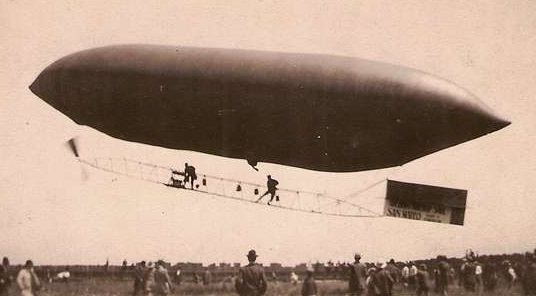
Ascent and descent was affected by a weight which could be shifted from bow to stern, or vice-versa and permits the nose of the airship to be raised or lowered. The pilot could also scramble forward or aft on the gondola’s framework, thus subtracting of adding to the tilt of the nose. Using the thrust of the propeller alone, the airship was then “pulled” in the desired direction, though the pilot also had the luxury of reversing the rotation of the propeller if need. Directional turns were provided by a 5 by 3.5 foot rudder, which could be activated by the pilot from anywhere along the frame. Only about 20 pounds of ballast was carried for emergencies.
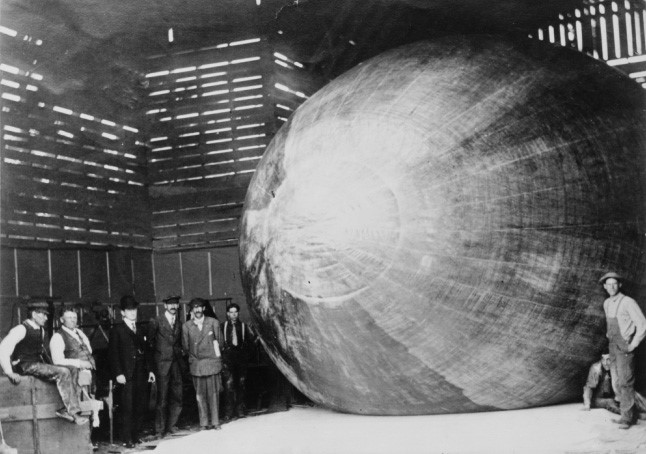
Baldwin first flew the California Arrow in August of 1904, successfully completing a 20-block round trip in Oakland, California. With Lincoln Beachey as his pilot, the Arrow underwent the first controlled circular flight in America on August 3, 1904 at Idora Park in Oakland, California. But the real goal was to bring it to St. Louis for the Louisiana Exposition World’s Fair held that year. Organizers had secured sponsors for a $100,000 prize to be given to the first aircraft that could successfully navigate a predefined course and return to the start. A now overweight Baldwin hired another aviation pioneer, the much thinner and lighter Augustus Roy Knabenshue, to pilot the Arrow. Knabenshue won the prize for Baldwin, who garnered instant acclaim for creating the first successful self-propelled dirigible in the U.S. A 1905 Pope-Toledo touring car was the object of a “race” between the car and the airship.
First flown at Hammondsport, N.Y. on June 28, 1907 by Glenn Curtiss, Capt. Baldwin’s Curtiss-powered machine was driven by an a 4-bladed propeller and sported a rudder emblazoned with the “Stars and Stripes”. Often referred to as Baldwin Airship No.4, the dirigible was entered in the St. Louis airship races in October and finished a distant third behind the Strobel airships of Lincoln Beachey and Jack Dallas.
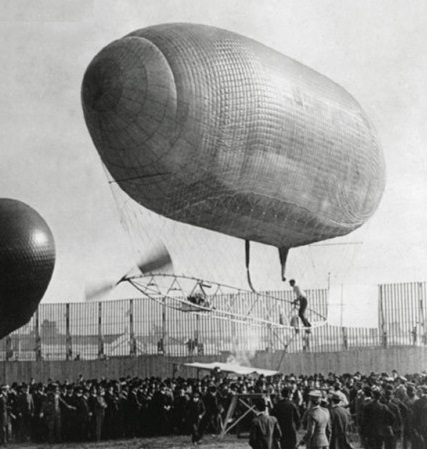
Baldwin and Knabenshue crisscrossed the country demonstrating the California Arrow, including racing Barney Oldfield across Los Angeles, with Oldfield confined to the ground in an automobile. Not long after, Baldwin secured contracts from both the Army and Navy to build their first dirigibles, based on what he had learned building the California Arrow.
Eventually, Baldwin and the crowds grew tired of this act as well, though Baldwin continued to work with hot-air balloons, even fabricating them in San Francisco.
On April 18, 1906, a massive earthquake struck San Fransisco. This was the great quake of 1906, and Thomas Baldwin’s manufacturing facility on Market Street was destroyed. He lost five airships including the California Arrow.
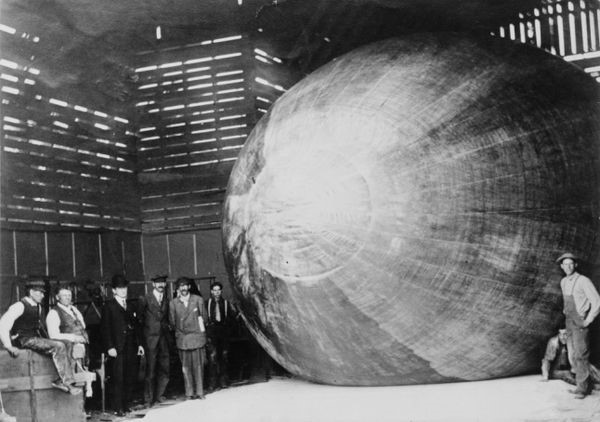
In 1902-1903 Thomas Scott Baldwin supervised the construction of the California Eagle based on the ideas of August Greth and financed by the American Aerial Navigation Company of San Francisco. It incorporated a French DeDion Bouton automotive engine and paddle propeller based on marine technology so prevalent in airship design in the period. After collaborating with Greth and John J. Montgomery in 1903-1904, Baldwin acquired sufficient knowledge to begin his own independent airship project.

Baldwin, known for his balloons and parachutes and, in 1910, his Red Devil airplanes, was the first to debut an aerial rowboat. Baldwin had already built the California Arrow, the first U.S. airship to make a controlled circular flight, when he won a contract with a Los Angeles amusement park to exhibit a dirigible that could be rowed through the air like a boat. In 1905, Baldwin came up with a 38-foot-long hydrogen-filled gas bag with a kayak-shaped frame underneath. In lieu of an engine were bamboo oars with paddles made of silk. A canvas bag filled with sand maintained neutral buoyancy.
Baldwin’s non-rigid dirigible could do about 4 mph on a calm day, but even a slight headwind would stymie it. Because Baldwin was too heavy to pilot the craft, he hired 23-year-old L. Guy Mecklem. On the craft’s maiden voyage, Mecklem became stranded 2,000 feet above the crowd with a broken oar and a malfunctioning safety valve on the bag. “The sun got hotter and the hydrogen expanded and nothing I could do…would stop it” from rising, he recalled. After the sun set, Mecklem was able to land in an orange grove.
The next day, Baldwin strung a 300-foot-long wire between two poles and attached a guideline to the aerial rowboat so it could slide along the wire. Mecklem spent the next two weeks practicing how to row back and forth.
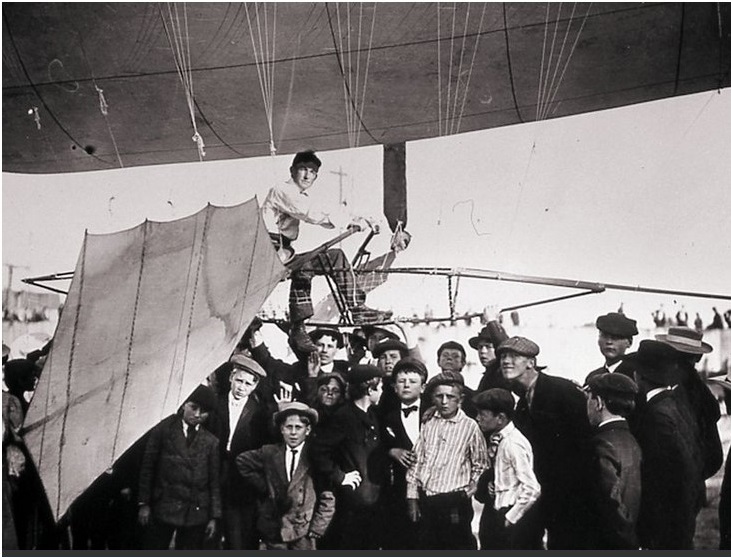
“We could put on a pretty good show,” Mecklem recalled in his unpublished autobiography. Ascending a few hundred feet, he bombed his audience with bags of peanuts. He’d also throw his handkerchief overboard and paddle down to retrieve it. His favorite stunt was aiming the tip of the gas bag at a girl in the grandstand and rowing away at the last second as she tried to dodge it.
Alva L. Reynolds challenged Baldwin to an airship race in his own version. When Baldwin’s pilot, the balloonist Roy Knabenshue, asked for $20,000 in expense money, Reynolds said Knabenshue was “afraid to race.”
Baldwin’s aerial rowboat proved a remunerative attraction, though a short-lived one: One night its hydrogen inexplicably ignited, destroying the craft.
 All Aero