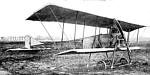
The 1911 Bastier biplane was designed and built by Bastier in France.
Span: top 32’10” bottom 23′
Length: 31’2″
Weight: 992 lbs
Speed: 50 mph
The 1911 Bastier biplane was designed and built by Bastier in France.
Span: top 32’10” bottom 23′
Length: 31’2″
Weight: 992 lbs
Speed: 50 mph
The 1911 Barucki II biplane was designed and built by Eng.Barucki in Poland.
The 1911 Barucki I monoplane was designed and built by Eng.Barucki in Poland.
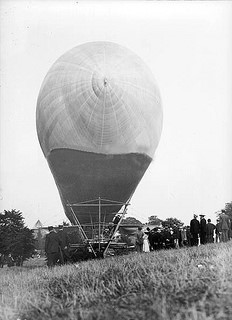
The ascent of the Barton-Rawson airship at the Alexandria Palace, UK, Saturday, July 22nd, 1905. A view taken at the entrance of the shed showing the airship pulled out.
Ryszard Bartel was born in Sławniów village near Pilica on 22 March 1897. He was interested in aviation from his youth, and in 1911 he built his own gliders capable of short flights. In 1916, he enrolled in the Warsaw University of Technology, being one of three founders of the Aviation Section of that university’s Students’ Mechanical Club. In 1917, he completed a pilot course, and he joined the underground aviator organization (Warsaw was under German occupation at that time). In 1918, after Poland regained its independence, he volunteered for the Polish Air Force. He completed further military flying courses and he took part in the Polish-Soviet War, flying Breguet 14s in the 16th Reconnaissance Squadron and in the Central Lithuanian Air Squadron. He was demobilized in December 1920, and graduated from the Warsaw University of Technology in 1924 as an Engineer. He also took second place in the first Polish soaring competition in 1923.
In 1925, his design of the Bartel BM-1 Maryla fighter aircraft received an award in the first Polish contest for military aircraft, but the design was not built. In 1924-1926 he worked in France, supervising production of aircraft for Poland and he also undertook research on aerodynamics there. From 1926, he was a chief designer of the Samolot aircraft manufacturer in Poznań. He designed and built there a prototype of a trainer aircraft, the Bartel BM-2 (1926), then trainers Bartel BM-4 (1927) and Bartel BM-5 (1928), built in small series for the Polish Air Force (the BM-4 was Poland’s first domestic design that was put into production).
From 1930 he worked in the Aviation Department of the Polish War Ministry, then, from 1932 to 1937, in the PZL aircraft works in Warsaw, which had obtained several of the Samolot projects upon that company’s closure. His duties included overseeing aircraft production. During 1937-1939 he was a technical director for the Lubelska Wytwórnia Samolotów (LWS) works and supervised licensing some Polish designs to Romania and Turkey. During World War II he stayed in Poland and worked under the German occupation as a teacher in technical schools.
After Poland’s liberation in 1945, Bartel worked in the Polish Civil Aviation Department of Ministry of Communication, but in 1948, with the advent of Stalinism in Poland, the communist authorities removed him from work in aviation, along with many other pre-war experts. He worked among other places in the Polish Normalization Institute. From 1951 he was a professor at the Warsaw University of Technology. He retired in 1966. From the 1960s, his passion became the history of the Polish aviation industry. He was active in aviation associations such as the Polish Aero Club.
He received the Knight’s Cross of the Polonia Restituta and the Polish Cross of Merit (silver in 1927, gold in 1948). Bartel also held a Field Pilot Badge (1922).
Bartel died on 3 April 1982.
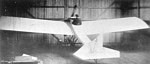
The 1911 Barnwell monoplane was designed and built Harold Barnwell in the UK.
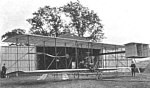
The 1909 Barnwell canard biplane was designed and built in Scotland by Frank and Harold Barnwell. It was flown only briefly.
Span: 48′
Weight: 1568 lb

Frank Barnwell was born in Lewisham in south east London but the family moved to Glasgow the year after his birth he and was educated at Fettes College in Edinburgh, after which he served a six-year apprenticeship with the Fairfield Shipbuilding and Engineering Company, of which his father was a partner, between 1898 and 1904. He attended the University of Glasgow at the same time and received a BSc in naval architecture in 1905. He then spent a year in America working as a draughtsman for a shipbuilder.
In 1907 he returned to Scotland and established the Grampian Motors & Engineering Company in Stirling in partnership with his brother Harold. The brothers had built an unsuccessful glider in 1905, and between 1908 and 1910 they constructed three experimental powered aircraft. The first lacked sufficient power to fly, but the second, a canard biplane, made the first powered flight in Scotland, piloted by Harold in July 1909. but was wrecked on the second attempt to fly it. The third, a mid-wing monoplane, was built during 1910 and flown by to win a prize for the first flight of over a mile in Scotland on 30 January 1911 at Causewayhead under the Wallace Monument.
Harold joined Vickers, while Frank joined the Bristol company, then called the British and Colonial Aeroplane Co.
In late 1911 Barnwell was hired to work as a designer for a secret department set up by the British and Colonial Aeroplane Company to work on an unconventional seaplane project for the Admiralty in collaboration with Dennistoun Burney, resulting in the unsuccessful Bristol-Burney seaplanes. He then co-designed the Bristol Scout with Harry Busteed. When war broke out in 1914 Barnwell enlisted in the Royal Flying Corps and after qualifying as a pilot at the Central Flying School, Upavon, he joined 12 Squadron RFC but in August 1915 was released from service to become chief designer at Bristol. Here he put his experience of service conditions to use by designing the Bristol Fighter, one of the outstanding aircraft of the war. With the exception of a short period between October 1921 and October 1923, when he briefly emigrated to Australia to work as an aviation advisor to the Australian Government, he worked as Bristol’s head of design for the rest of his life, designing aircraft such the Bristol Bulldog and Bristol Blenheim.
Barnwell was killed in an aircraft crash in 1938, piloting a small aircraft he had designed and had constructed privately, the Barnwell B.S.W.
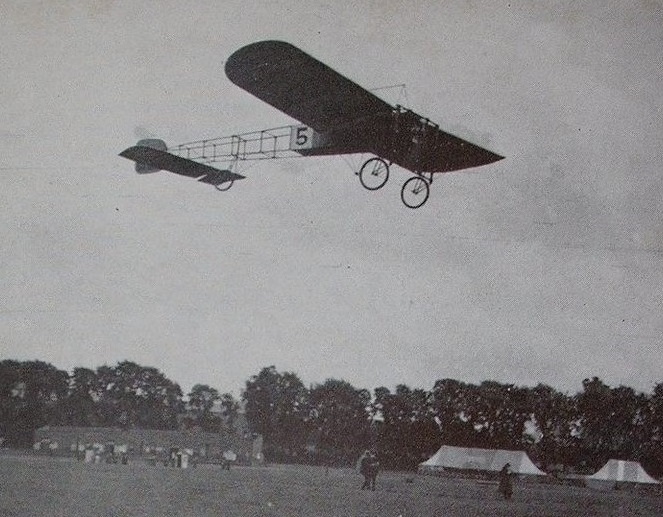
Englishman G.N.Barnes flew a monoplane of his own design at Wolverhampton in July 1910.
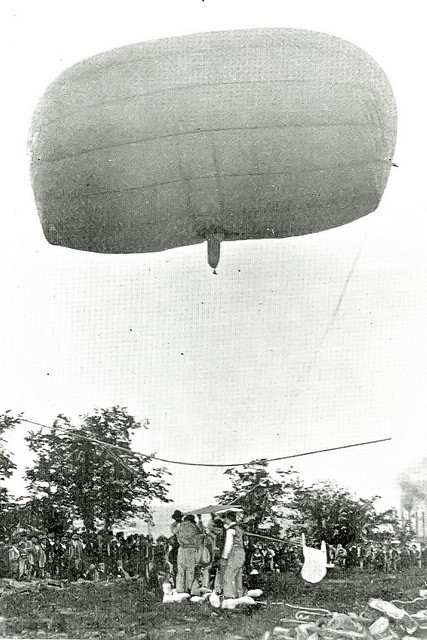
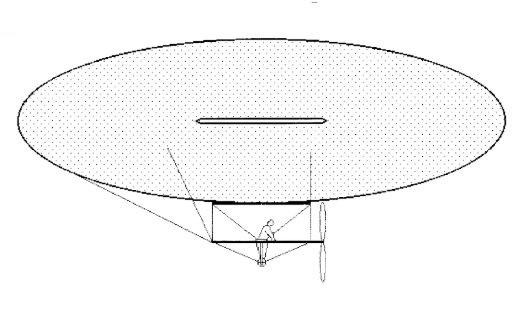
Professor Arthur W. Barnard, Director of Physical Training for the YMCA of Nashville, built this airship, which measured 18 feet in diameter and 46 feet in length. It was filled with hydrogen and used a propeller of 8 feet diameter. Barnard pedalled his Centennial Airship in Nashville at the Tennessee Centennial Exhibition of 1897. He went a distance of some 20 miles with the help of a strong wind, but on the return the spar broke off one of the propellers and he landed twelve miles short of returning to the Exhibition grounds. During another ascension the balloon split at the height of a half mile. It descended with great rapidity, but when some distance from the ground it formed a kind of a parachute and the professor landed safely near the exposition grounds. He received a shaking up, but was not injured.
 All Aero