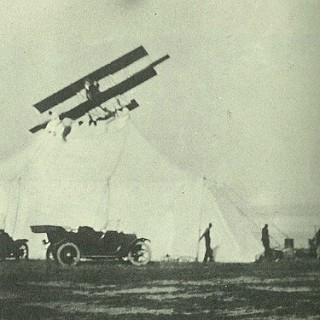
The Looper was built in 1912 and was a special headless version, built for Lincoln Beachey and stressed for aerobatics. On 7th October 1913, that Beachey’s machine fouled the ridgepole of a tent during a test flight and hit two couples who were sitting there. Ruth Hildreth, was killed outright, while her sister, Dorothea, suffered a laceration due to the propeller along with a fractured hip and arm. Their escorts, both US Navy Lieutenants, sustained fewer injuries. Ironically, Beachey was wearing a safety harness and survived the crash relatively unscathed, though he was mortified at what had happened.
After a brief retirement in 1913, Beachey returned to the air to master the inside loop, a maneuver first mastered by a French aviator. Spurred on by national pride and the spirit of competition, Beachey directed Curtiss to design and build a reinforced airplane able to sustain the forces of a loop. Beachey completed his first loop in November 1913.
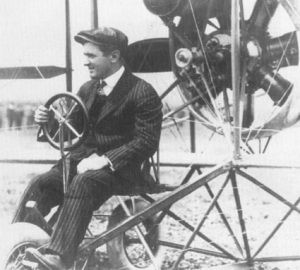
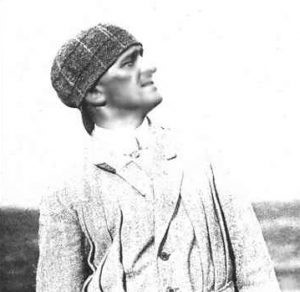
Beachey at the controls
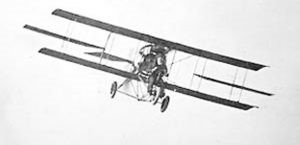
Despite this, Beachey was not satisfied. His airplane was structurally reinforced to stand up to the forces of aerobatics, but its engine would stop running when inverted. In early 1914 technology advanced and Beachey travelled to France to acquire a pair of Gnome rotary engines. This innovative design was composed of seven cylinders arranged in a circle around the propeller shaft. When running, both the 80-hp engine and the propeller whirled around. The Gnome operated equally well upside down as right side up. Beachey directed his crew to install a Gnome engine in his newest airplane, giving rise to his “Little Looper”. On tour throughout the United States, Beachey conducted many flights over the rest of the year, expanding his repertoire and exposing millions of people to aviation.
Beachey’s reputation had swelled across North America as a result of his demonstration flight. Tens of millions of Americans saw Beachey fly the Little Looper through its aerobatic routine, captivating communities with the wonder and promise of aviation from coast to coast. As a “headless” Curtiss-type pusher with no forward-facing horizontal stabilizer, the Little Looper afforded Beachey an exceptional perch exposed at the front of the airplane, with unparalleled visibility and a strong feel for the airstream in any maneuver.
The Hiller Aviation Museum displays the original Little Looper.
Engine: LeRhône, 84-hp Span: 25 ft 1 in Length: 18 ft 4 in Height: 8 ft 0 in Weight, empty: 750 lbs Weight, gross: 890 lbs Max speed: 84 mph Endurance: 45 minutes
Lincoln Beachey and his brother Hillery started experimenting with monoplane aircraft construction after the January 1910 Los Angeles meeting. He was present at the Wright team’s inaugural meeting at the Indianapolis Motor Speedway in June 1910, but he didn’t make any flights in his monoplane. Two weeks later, perhaps hoping to learn by studying aeroplanes up close, Beachey secured a position as “chief assistant” to Charles Willard. In that capacity, he brought his monoplane to the Curtiss team’s meeting at Minneapolis in late June 1910. He made some short flights there, but the machine reportedly never got more than three feet off the ground. On June 24th he damaged the machine by crashing into a fence, and after that it seems to have lost interest in it.
Lincoln Beachey grew up racing bicycles down the hills of his hometown. At eighteen he learned to fly powered airships, and experienced his first taste of the aviation spotlight piloting a dirigible at the Lewis & Clark Centennial Exposition in Portland, Oregon in 1905. A year later he made an unauthorized but well-received landing on the White House lawn.
Beachey piloted one of six airships flown at the Dominguez Air Meet of 1910, the first public flying exhibition held in the United States. For Beachey, Dominguez provided a life-changing humiliation. Beachey raced a fellow airship pilot around a closed circuit course and won decisively, yet there was little opportunity to savor the triumph. During the race, French aviator Louis Paulhan took flight in a Farman monoplane. Paulhan had shown a penchant for showmanship throughout the meet, dazzling the crowds with maneuvers more daring than the conservative routines flown by other pilots. As the airship race drew to a close, Paulhan swooped down and circled merrily around the lumbering dirigibles.
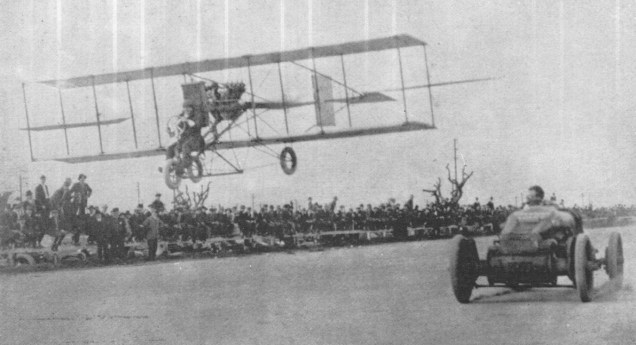
Beachey scooped up handkerchiefs with the wingtips of his Curtiss biplane, flew under Niagara Falls bridge and beat the racing motorist Barney Oldfield in his aircraft vs car race at Los Angeles in February 1914.
Aircraft vs car race at Los Angeles in February 1914
In early 1915 Beachey began flying his design team’s newest creation, a sleek monoplane dubbed the Taube, or dove. Beachey had been drawn to monoplanes since his humiliation at Dominguez in 1910, as they had less drag and greater speed than biplanes. The Taube proved significantly faster than the Little Looper, making for more spectacular maneuvers. It also featured a tractor propeller arrangement, considered safer than the traditional pusher configuration.
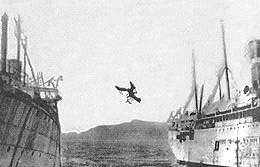
On March 14th, 1915, Beachey flew his Taube in a special routine offshore from San Francisco. In a rapid decent he pulled out too quickly, and the Taube’s wings collapsed from the load. Remarkably, corner reports indicate that Beachey survived the initial impact despite the terrific speed, but drowned before rescuers could reach him.
Beachey crashes to his death
Lincoln Beachey, who by 1914 had been named by Orville Wright as the world’s most outstanding aviator of the age.
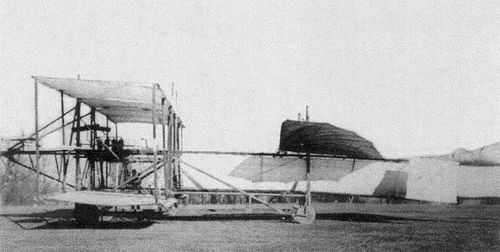
A joint venture between Stanley Beach (son of the publisher of “Scientific American”, one of the founders of the Aeronautic Society (New York) and aeronautic editor of Scientific American) and the controversial aviation pioneer Gustave Whitehead. It was developed and redesigned during a two-year period, but never flew.
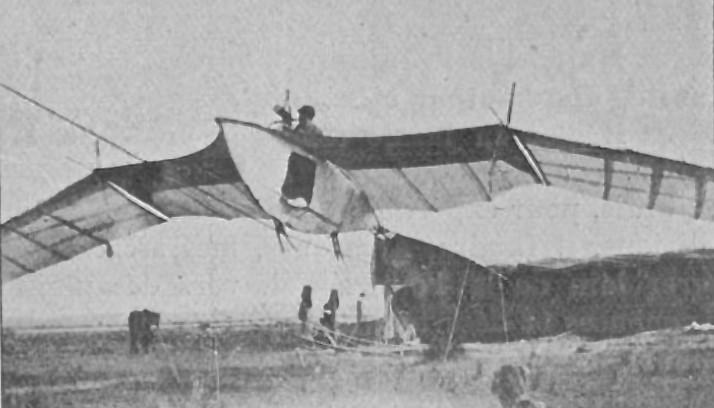
Albert Bazin built a series of gliders from 1904 up to 1907. In 1907 he built this ornithopter with a 12 hp three-cylinder engine. It had no rudder, since the machine “was built to fly straight forward, the shortest distance between one point and another being the straight line”. The area of the different wings could be extended and decreased, thereby achieving lateral control. It was apparently tested suspended from a wire.
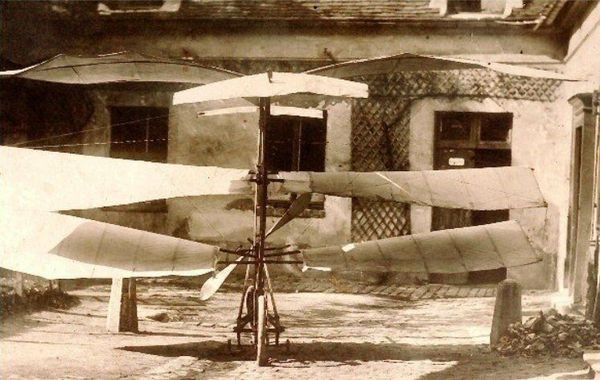
The “Weißen Adler” (“White Eagle”) airship was built in Dresden by Georg Baumgarten in 1879. Baumgarten became acquainted with the wealthy Leipzig bookseller Dr. Friedrich Hermann Wölfert, who liked him for his experiments in airships. Together they built the 26 meters long airship, which had three gondolas and had propellers driven by hand cranks. Their first airship, the “Dreigondelluftschiff” rose on 31 January 1880, the first time in Leipzig-Plagwitz. However, the flight ended with an accident, but with no injuries, but the airship was destroyed.
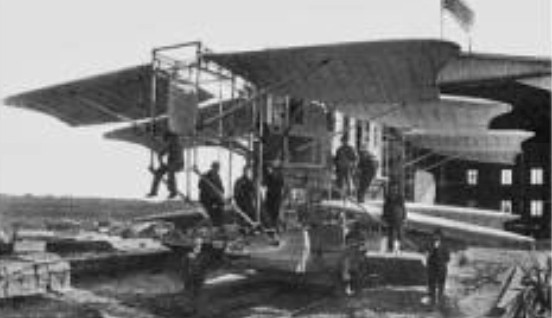
Matthew A. Batson built the Air Yacht during 1912 and 1913 with the intention of flying it on a transantic flight from Georgia to Liverpool, England. The airframe consisted of six forty-foot wings and a gondola type cabin, fixed with struts and braces to a seventy-foot pontoon. Powered by three 120 hp Emerson six cylinder engines, the craft was sucessfully launched but reportedly never achieved sustained flight.

 All Aero