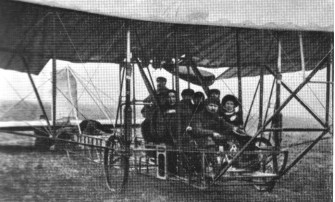
Bleriot carried six passengers in his Aerobus in 1911.
Bleriot carried six passengers in his Aerobus in 1911.
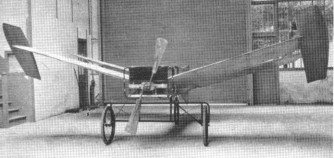
Bleriot’s first completely successful aeroplane was this tandem-wing, Antoinette-powered Libellule, in which he flew 25 m on 11 July 1907, and 184 m, before crashing, on 17 September. It had rotating wingtip controls.
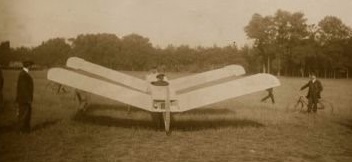
Built in 1907 and powered by a 24 hp Antoinette engine.
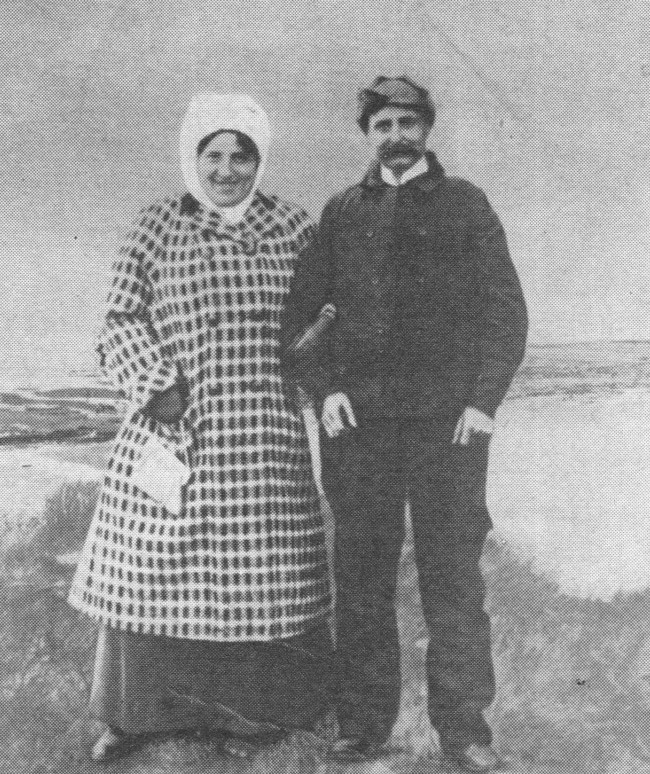
Louis Blériot built the I Ornithoptère model – datable to 1900-1901 and patented in 1901 – with a span of 1.5 m and powered it with a carbonic acid engine. In 1902 Blériot built another machine to size which he tried to fly (span 9 m, weight 70 kg), but despite the successive replacement of three chemical engines it was a failure.
The French aviation pioneer Louis Bleriot achieved a unique place in aviation history by making the first crossing of the English Channel in a powered aircraft (his Type XI monoplane) on July 25, 1909. This success resulted in the formation of the above company to produce the Type XI monoplane, and many significant flights were made with these aircraft.
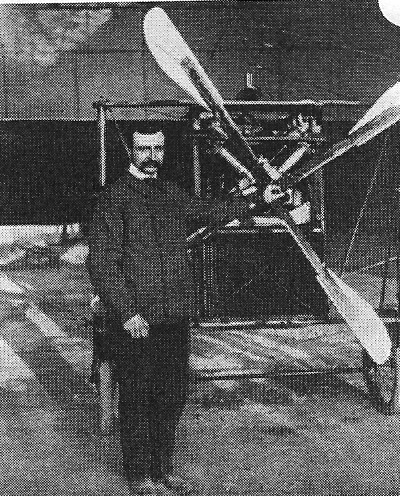
Aircraft of this type, and derivatives served with the French forces, the RFC and RNAS at the beginning of the First World War, as well as with other air arms.
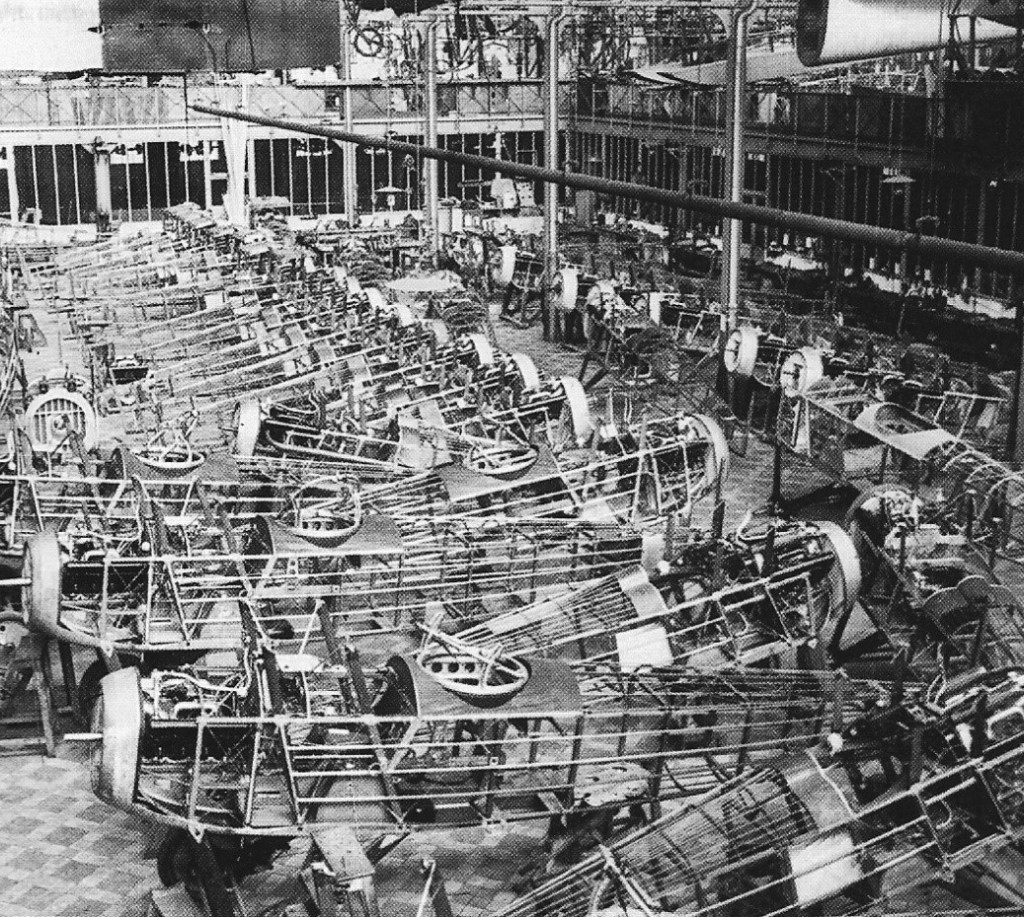
In post-war years Bleriot took over SPAD. The SPAD (Societe pour l’Aviation et ses Derives) concern, although headed by Louis Bleriot, operated as a separate organisation from the Societe Bleriot-Aeronautique until 1921, when SPAD was absorbed and the subsequent progeny of its design team became officially known by the title of Bleriot SPAD.
In France, the Socialist Government of the so called Popular Front brought all the companies building military aircraft, aero engines and armament under its control in 1936. The immediate result was the socialized oblivion of such established companies as Marcel Bloch, Bleriot, Nieuport, Potex, Dewoitine, Hanriot and Farman within half a dozen nationalized groups or Societies Nationales, named according to their geographical location (Nord, Ouest, Centre, Midi and so on).
After World War II, although four of the nationalized groups continued operating under state control, private companies were allowed to resume the design and manufacture of both civil and military aircraft. Some of the pioneering names of French aviation, such as Breguet and Morane Saulnier, returned to prominence.
In a 1934 visit to Newark Airport in the United States, Louis Bleriot predicted commercial overseas flights by 1938. Unfortunately, he would not see this come to fruition as his death from a heart attack took his life on August 2nd, 1936 in Paris, France – bring an end to this French hero’s legacy. The Louis Bleriot Medal, established in 1936, was aptly named in his honor and would be awarded to individuals involved in record-setting flights thereafter. The award is still handed out to this day.
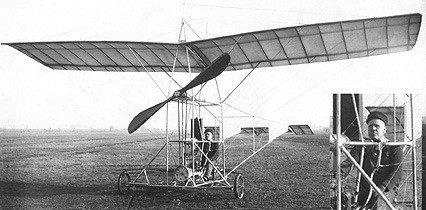
The Jethro. D. Blaney monoplane was a design with a high, frail-looking, cantilever wing attached to a pylon above the box-like undercarriage and engine. The Kirkham engine drove a chain-driven prop that was mounted midway between the undercarriage and engine, which gave it a low center of gravity. It was designed by Blaney with the mechanical engineering done by Chance Vought, who thought it was “two years behind the times.” It was tested at Cicero Flying Field in July 1911, but never left the ground. After it was given a few more failed trial runs, like a number of other unsuccessful experimental aeroplanes at Cicero Field, the Blaney Monoplane remained there and was later abandoned.
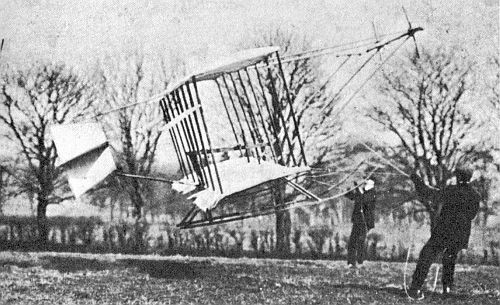
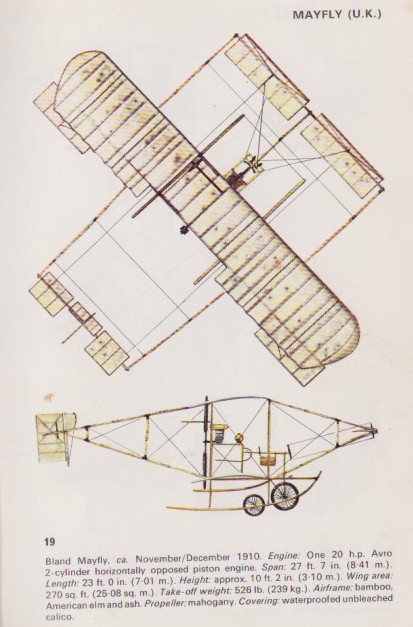
In the summer of 1910 A. V. Roe and Company declared its willingness to build aeroplanes to other people’s designs. Bolts, fittings and bracing wires were supplied to Miss Lilian Bland who built and flew the Mayfly biplane of her own design at Carnamony, Belfast. The first “Mayfly” of Lilian Bland was tested as a glider, probably during February 1910. It was built after the 1909 Blackpool meet and was an amalgam of the Farman and Wright types seen there. Its span was 8.40 m and constructed in less than three months.
Likely the first woman to build as well as fly her own aeroplane, Bland and S.Givvvany developed it empirically, testing and modifying it as a kite and glider before putting a 20 hp engine in it. This aircraft was fitted with one of the few examples of the 20 h.p. two cylinder, horizontally opposed, air cooled Avro engines. It was never given an Avro designation.
Lilian Bland couldn’t sell her constantly modified “Mayfly” and gave it to the Aero Club of Dublin before marrying and leaving for Canada.
Span: 27’7″
Length: 23′
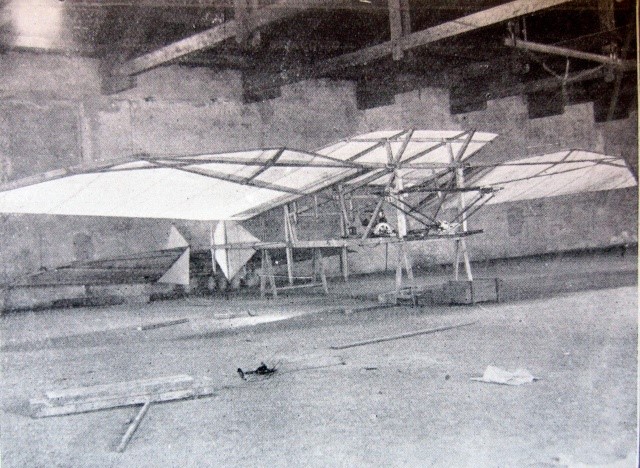
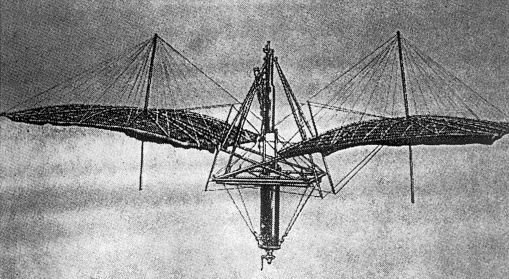
In 1906, Blanc and Barlatier conceived, without success, the first single-seater monoplane with wings inspired by the bat. The kite was pulled by two propellers driven by a central engine of 14 hp Buchet.
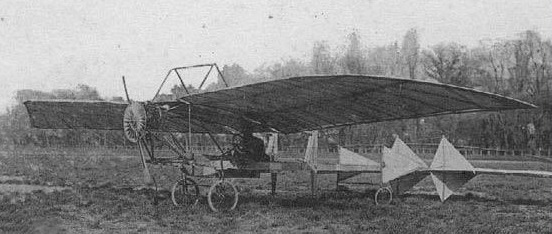
Designed and built by Barlatier and Blanc in 1907-8, only one was built, tested at the camp Le Rouet near Marseille, France.
Engine: 1 REP, 30 hp
Span: 46′ / 14.00 m
Length: 31’2″ / 9.50 m
Wing area: 45.00 sq.m
Weight: 530 lb / 240 kg
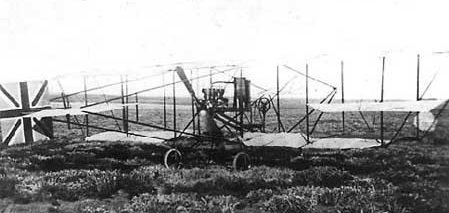
In the early days of aviation flying enthusiasts like Tom Blakely and Frank Ellis, in 1913-1914, built their own biplanes from scratch, or like these two, from broken pieces of another plane they purchased.
Frank H. Ellis, OC (October 13, 1893 – July 4, 1979) was an early Canadian aviator and member of the Early Birds of Aviation. He was born in Nottingham, England in 1893 and immigrated to Calgary, Alberta with his family in 1912. With Tom Blakely, he constructed and flew a biplane designed after a Curtiss model in 1914. He was the first Canadian to make a parachute jump from an airplane in Canada, July 5, 1919 at Crystal Beach, Fort Erie, Ontario. Beside his day job as bus driver, Ellis wrote extensively on the history of aviation, and was an avid aircraft model builder. He located several historic Canadian aviation artifacts and arranged for their donation to museums. In 1954 he published “Canada’s Flying Heritage”, the first major study of the History of aviation in Canada. In 1972, he was awarded the Medal of Service of the Order of Canada. He died July 4, 1979 at the age of 85, in North Vancouver, BC.
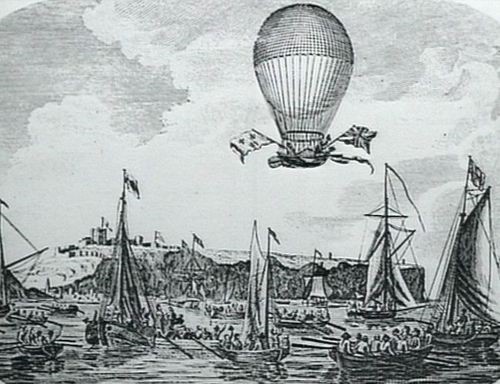
The first flight over the English Channel was on the 7th January 1785, between Dover and Guînes, in 2h25 carrying J.P.Blanchard and John Jeffries.
Aeronaut Jean-Pierre Blanchard had made 66 flights in several countries, when he died in 1809 after having been hardly injured in an accident in 1808.
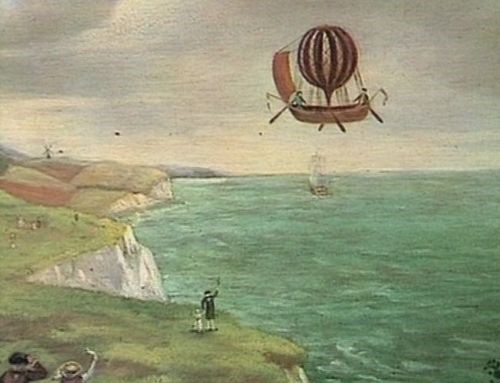
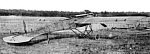
The circa 1913 Blanc monoplane was designed and built by Maurice Blanc in France.
Span: 32’10”
Length: 26’3″
Weight: 772 lbs
Speed: 74 mph
 All Aero