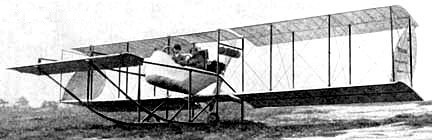
The 1912 Boland tailless pusher biplane was designed by F and J.Boland and built by the Boland Aeroplanes Co.
Span: 35’6″
Length: 21’2″
The 1912 Boland tailless pusher biplane was designed by F and J.Boland and built by the Boland Aeroplanes Co.
Span: 35’6″
Length: 21’2″

Frank and Joesph Boland built and tested several aircraft that featured canard layouts. The 1913 flying boat appeared with a raised plane wing which tied into spanwise braces that also served as outriggers for the stabalising floats. A single fin and rudder were mounted between the wing and float on the port side. The forward canard, rigged as an all flying stabaliser, was large enough to function as a tandem wing. The engine appears to have been a pusher water cooled V-8. The flat bottom hull had two traverse steps approximately at the centre of gravity.

The 1910 Bokor II biplane was designed and built by Mor Bokor in Hungary.
Engine: 30 HP 3 cylinder

As seen at Morris Park, N.Y., winner of the first money prize in America for design and workmanship independent of performance – a $500 prize awarded by the Aeronautic Society of New York in 1909 – even though it failed to fly.

In light of the triplane’s inability to leave the earth, Morris Bokor made changes to his design and took the machine to Arlington, New Jersey, where it won the prize for excellence of construction. There – at the North Arlington Aero Carnival Week of May 25, 1909 which featured Baldwin’s airship, his newest California Arrow, and two aeroplanes, the other that of the Mexican revolutionary Victor Ochoa – the Hungarian Bokor made an attempt at flight but could only manage a top speed of 12 mph while running along an unpaved road. The triplane was subsequently taken to Westbury, Long Island, but it never did get off the ground.
The 1911 Bokor III was powered by two 30 HP 4 cylinder engines in pusher arrangement.
Michał Bohatyrew, Polish-born engineer and officer of the Russian Army built at Modlin an airplane with canard configuration in 1910-12, which crashed during the first flight.
In 1910, Michał Bohatyrew built a canard aircraft in Mońki near Białystok, called “Utka Nadieżda” (“Kaczka-Nadzieja”). Modeled on a Voison canard, but it was a monoplane.
A single-seat monoplane with a wooden structure. Double-girder rectangular lobe stiffened with steel wires. Truss hull with rectangular cross-section in the front and triangular in the rear with ash bars, taffeta cover. The cabin is open. Four-wheeled chassis with anti-cabotage skids.
After initial tests, the aircraft was transported to St. Petersburg, where it was shown at the First Exhibition of New Works in April 1911. Then, at the St. Gatczyno airport. the designer made further tests of the aircraft. During the first take-off the plane was crashed.
Engine: air-cooled, 18 kW (25 HP)
Empty weight: 250-270 kg
Total weight: 350-370 kg.
Speed: 45-50 km / h.
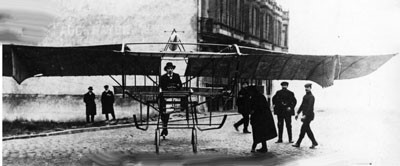
This machine, named after the Blue-footed booby (Sula nebouxii), was built in 1909/1910 in Ostend, Belgium, by Nicolas Boel, together with his brother Louis. It had a wingspan of 9.5 m and was 9 m long. With a turn of the steering wheel the pilot was able to operate the rear rudder, while the forward or backward movement of the steering column caused the elevator to raise and lower. Like on the Voisin, there was no lateral control. Some members of the Aero Club expressed their doubts as to whether that rickety thing could ever fly. Nicolas recognized the merits of their criticism, but instead of, as his brother quietly hoped, losing his heart, he immediately went back to work to improve his first creation, which became the Blauwvoet II.
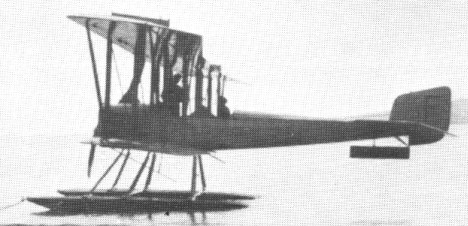
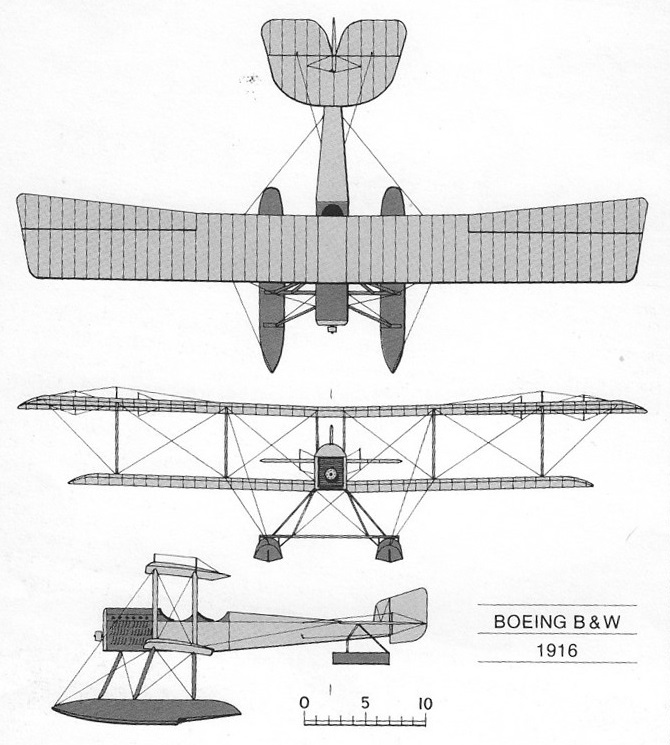
The B & W Model 1 design was the result of a collaboration between William E. Boeing and a friend, Cdr G.C. Westervelt of the US Navy, and the B & W designation recognised this association.
Of wood and fabric construction, extensively strutted and wire-braced, the Model 1 was an unequal-span biplane, with ailerons on the upper wings only. The fuselage, mounted directly on the lower wing, had two open cockpits in tandem, and carried at the rear a tail unit that was a typical braced structure of its period. Power was provided by a Hall-Scott engine mounted in the nose of the fuselage to drive a tractor propeller. Floatplane landing gear included two single-step floats, strut-mounted and braced beneath the fuselage, plus a small float under the tail to prevent disaster in a tail-down landing.
The first of two Model 1s was flown initially on 29 June 1916, by which time Cdr Westervelt had been posted to the other side of the American continent. William Boeing decided, therefore, to establish a company to build these aircraft, and his Pacific Aero Products Company was founded on 15 July 1916 in a rented boathouse on Seattle’s Lake Union. The first company to incorporate the Boeing name, the Boeing Airplane Company, was formed on 26 April 1917.
The two Model 1s, construction numbers 1 and 2, were sold to the New Zealand government.
Later, Boeing staff created a replica of the B&W1.
Engine: 1 x Hall-Scott A-5, 125 hp / 93kW
Take-off weight: 1270 kg / 2800 lb
Empty weight: 953 kg / 2101 lb
Wingspan: 15.85 m / 52 ft 0 in
Length: 9.5 m / 31 ft 2 in
Wing area: 53.88 sq.m / 579.96 sq ft
Max. speed: 121 km/h / 75 mph
Cruise speed: 108 km/h / 67 mph
Range: 515 km / 320 miles
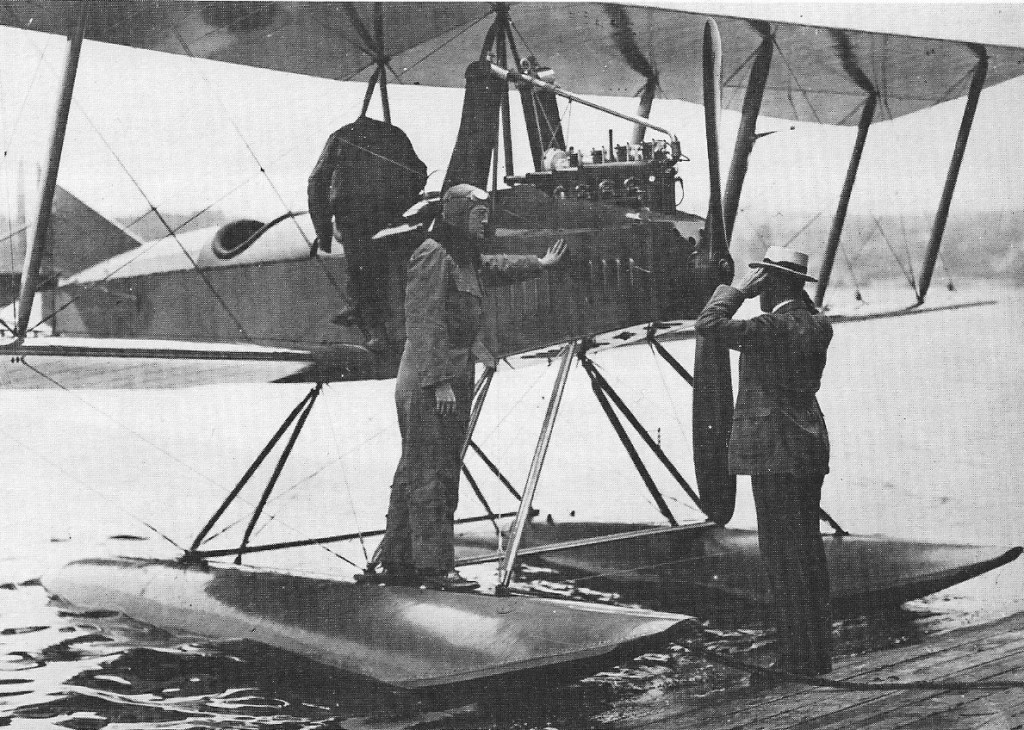
The Boeing C-700 was a development of the Model 5. Boeing (on the float) and Edward Hubbard put this aircraft to work in 1919 carrying mail between Seattle and Victoria B.C. and to ships at sea.
The first internation airmail flight was made from Vancouver to Seattle on 3 May 1919 by Eddie Hubbard and Bill Boeing. A pouch of 60 letters was carried in the C-700.
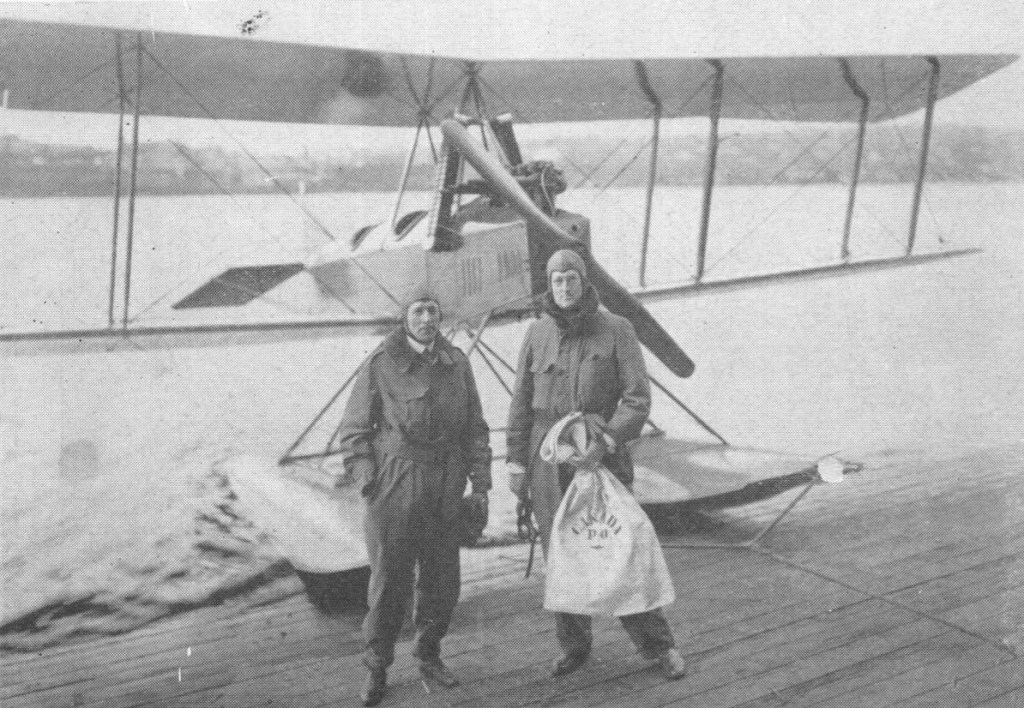
Powered by a Hall-Scott water-cooled four-cylinder of 100 hp, the cruise was 60 mph.
Designed and built by Bobenreith in France circa 1909.
 All Aero