Botts 1903 Flying Machine

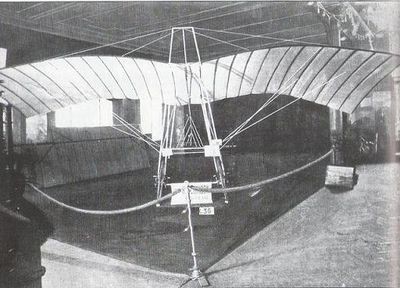
A motor-driven aeroplane designed by R. H. Botts. The machine was a combination of a circular aeroplane with two sets of two propellers, the screws of each set working in opposite directions. The aeroplane itself is circular, 20ft diam., and attached to two hoops, the outer of steel tubing and the inner, 6ft diam., of wood. In the centre a bamboo framework supported the boiler, engines, and the car. One set of screws (upper 5ft 1in. and lower 6ft 2in diam.) was placed above the car, and these ran on a vertical axis, the thrust upward in both, though rotating oppositely. Fore and aft of the aeroplane the other propellers, of the fan-wheel type, and 6ft 2in diam., worked on a horizontal axis. There were two engines. A cloth-covered rudder was so pivoted as to be able to be set at any angle either vertical or horizontal.

The airship was intended for the St. Louis competition. Total weight of engines 33 lbs.; of complete apparatus with operator (of weight not stated, 214 lbs).
Bossi Dai-Dai

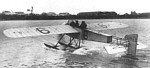
Signor Enea Bossi was the Italian representative of the Curtiss Co. and had arranged with the Zari Bros. of Bovisia, Italy, to build the Curtiss type boat from plans sent from Hammondsport. On September 22, 1914, Lanny made a demonstration flight in the first Italian built flying boat on Lake Como before naval officials. The Dai-Dai boat was purchased and an order placed for several more. The Italians were convinced that naval aviation was an excellent way to patrol their long and exposed coastlines.

Bossi, Enea

Signor Enea Bossi was the Italian representative of the Curtiss Co. and had arranged with the Zari Bros. of Bovisia, Italy, to build the Curtiss type boat from plans sent from Hammondsport. On September 22, 1914, Lanny made a demonstration flight in the first Italian built flying boat on Lake Como before naval officials. The boat was purchased and an order placed for several more. The Italians were convinced that naval aviation was an excellent way to patrol their long and exposed coastlines.

Borucki

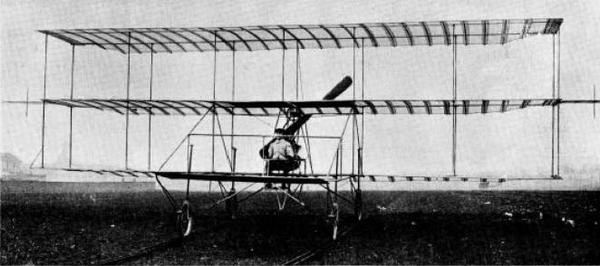
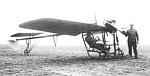
Borucki, an engineer from Kielce built in 1912 two aircraft, one modelled after Bleriot and another after Farman airplane. Because of his wife’s serious illness he didn’t made any flight attempts on these but the “Farman” plane was purchased my Russian military, thereby suggesting that flights on it were made;

Borgnis-Desbordes et de Savignon Triplane / Borgnis de Savignon et de Desbordes

First version

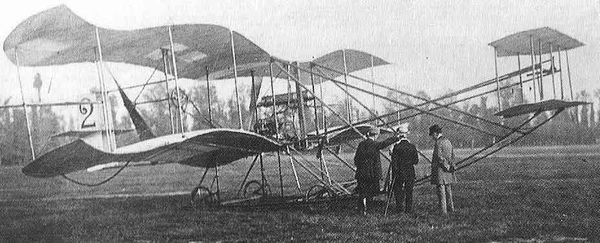
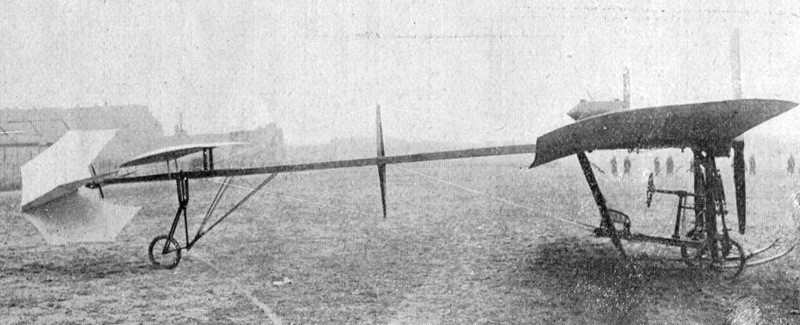
The Borgnis-Desbordes et de Savignon Triplane, also known as the Borgnis de Savignon et de Desbordes, was named after its designers/financier, Achille and Paul Borgnis, and Desbordes de Savignon. A development of the second Bousson-Borgnis, it was of all-metal construction, built at Gennevilliers. There were no rear tail surfaces: steering was done with ailerons set on forward outriggers, and a forward elevator was set low ahead of the 4-wheel undercarriage.

The first version of the Borgnis et Desbordes de Savignon, 12 March 1909

According to reports this triplane actually left the ground several times in Gennevilliers on January 31, 1909.
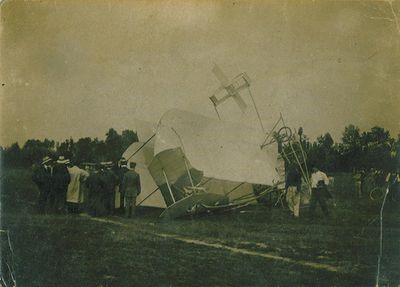
The first version was later modified. In the modification the elevator was brought to the rear of the machine and with new undercarriage, it was driven to Yffiniac on the northern coast of Brittany, where it flew and made a “memorable crash”. Repaired, this machine was destroyed in a collision at the end of 1910, ending the aviation related careers of the Borgnis brothers.

Engine: 6-cylinder, 28 hp
Span: 14.5 m / 47′ 7″
Wing area: 80 sq.m
Gross weight: 570 kg / 1250 lb