E.H. Wiseman and R.C. Burgess of Cleveland, Ohio, USA, circa 1911.
Pioneers
Burgess D
The 1910 Burgess D pusher biplane was designed and built by W.Burgess.
Span: 36′
Length: 41′
Burgess B
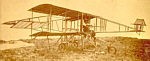
The 1910 Burgess B pusher biplane was designed and built by W.Burgess.
Span: 27′
Length: 26′
Burgess A / Herring-Burgess
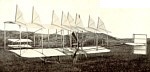
The 1910 Burgess A pusher biplane, also know as Herring-Burgess, was designed and built by W.Burgess (fuselage, wings, gear) and A.Herring (controls, engine and props). It suffered many changes.
Span: 26’9″ or 27′ or 33’4″
Length: 33′ or 26′ or 28’9″
Burga Monoplane / Avro Burga
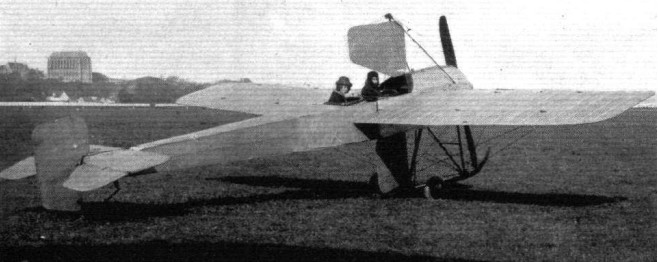
Lieut. R.F. Burga of the Peruvian Navy made the radical suggestion that it might be better to effect lateral control with two rudder-like surfaces, mounted near the centre of gravity and at right angles to the wings. A roll would be initiated by turning these surfaces, one below and one above the fuselage, in opposite directions. Burga applied for a patent in 1910 and it was published on 2 November 1911. He approached A.V Roe & Co., who would build other people’s designs for them, and in 1912 a single engined shoulder winged monoplane was produced with the novel control surfaces. It has been suggested that this aircraft may have been the Avro 502.
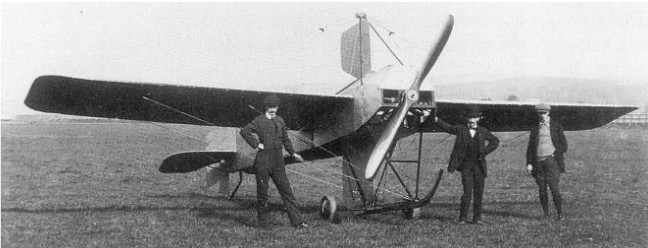
The Burga monoplane was built at Avro’s Manchester factory at the same time as the prototype Avro Type E biplane, and it used the same tail unit and undercarriage. Control surfaces apart, it differed primarily in being a monoplane, but also in having a more slender fuselage, though still a two seater, and in using a less powerful but lighter engine, a 50 hp (37 kW) Gnome rotary. The wings were braced from below to strong points on the undercarriage and from above to a pylon just ahead of the front cockpit. A vertical shaft attached to this pylon appears also to have carried the leading edges of the lateral control surfaces; the one below the fuselage was almost rectangular but the upper one was shaped to avoid the passenger’s head. There was no wing warping.
Though Avro aircraft had always been built in Manchester, they had never flown from there but rather from the Avro School’s base at Brooklands; in August 1912, however the school had moved to Shoreham on the south coast, which is where the Burga machine was test flown. The first flight was on 20 November 1912, piloted by H.R. Simms, one of the School’s pilots. The monoplane had been designed to take wings of different camber and incidence, and those chosen for the early testing were expected to give the highest speed. Simm’s reported hat the aircraft was fast and had a good rate of climb, but no reports on handling with the new surfaces seems to have survived. Further taxying trials were made by H. S. Powell in the following month, and in January 1913 the Burga monoplane returned to the Avro works at Manchester for modification. After more flying, the aircraft was reported as back at the Avro factory for modification but was not seen again.
Engine: 1 × Gnome et Rhône 7-cylinder rotary, 50 hp (37 kW)
Length: 29 ft 0 in (8.84 m)
Crew: 1
Passenger capacity: 1
Burchardt 1909 Gleitflieger
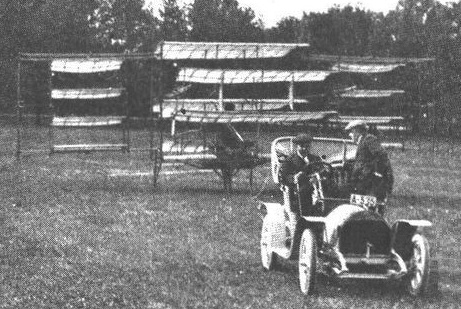
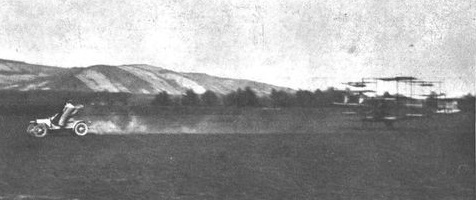
A dreidecker glider built by Wilhelm Burchardt of Klosterneuburg, Austria; the Gleitflieger was seen as a full scale test machine for his design with the intention to fit an engine with pusher propeller later.
Burchardt had connections to the Austro-Hungarian military who were interested in his machine and after validation of his design by Professor Budau (Technical University Vienna) facilities to build it were provided.
Bünzli Glider
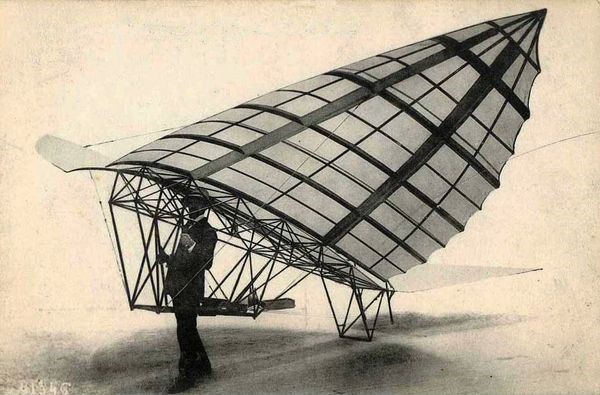
Built by the “Société de Construction d’Appareils Aériens” in Levallois, based on the design of M. Bünzli during 1908-09. The firm’s specialty, the production of wooden parts, destined the framework to be made entirely of wood. The glider consisted of a pair of V-shaped wings set at an angle of 14 degrees, held into place by elastic cords attached to the top and the bottom of the frame. The underside of the frame had an ingenious slide construction that made it possible to move the pilot seat forwards and backwards. Cords were fixed at levers mounted on the elevator, which were then fastened to the moveable pilot chair, which in turn controlled the elevator at the back of the glider. When the pilot slid forward in his seat, the elevator turned down, lowering the nose of the glider. When sliding backwards the opposite happened as the elevator went up assisted by a spring device. Its wing area, the surfaces covered with balloon fabric, totalled 20 square meters; and weighing only about 36 kg, the length of the machine was 5.60 meters, its span 7 meters. It is said that better flights were made with this glider than with the machine of Chanute.
Bulot 1911 biplane
The 1911 Bulot tractor biplane was designed and built by Walter Bulot.
Bulot 1909 Triplane
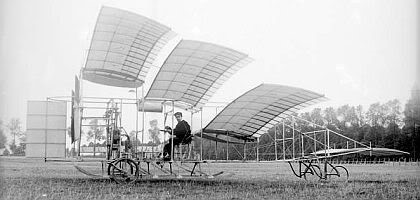
Machine designed by Belgian Walther Bulot and entered the at the “Semaine de l’Aviation” in Tournai (Sept. 5-14, 1909), but pictures only show it on the ground.
Buffalo-Pitts Olmstead 1912 biplane
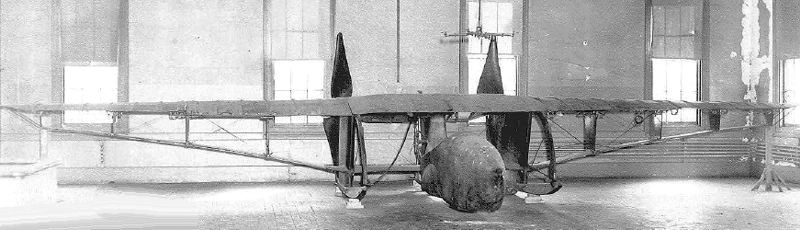
Charles Morgan Olmsted grew up in Buffalo, New York and became interested in aviation at a very early age. In 1895, when he was only fourteen, he built a glider of his own design. After attending college and getting his degree in astrophysics in Germany, he began work on a radical new propeller design (Glenn Curtiss proclaimed it to be “The finest and most efficient I have ever seen). In 1910 he joined the Buffalo-Pitts Company and began work on a biplane that featured a “monocoque” fuselage built of moulded, laminated birch, chrome-vanadium steel, and aluminium sheet. The motor and the two propellers were mounted behind the wings, pusher style. Unfortunately, in 1912, before the plane could be completely finished, the Buffalo Pitts Company went bankrupt. The nearly finished biplane went into storage and was eventually (after the wings had been sawed off to get it out of storage) donated to the Smithsonian Institution where it has remained awaiting restoration.
 All Aero