Georges Cailler, born in Vevey, Switzerland as the eldest son of Alexandre Cailler, founder of the well-known chocolate factory in Broc. He built four aeroplanes and flew them between Broc and Epagny. The parts of flying machines of Cailler were built by workers of the the chocolate factory. At the age of 18, he began construction of a biplane with the help of his friend Henri Magnenat from Lausanne, but their machine did not bring expected satisfaction. The trials with the new monoplane took eight days in spring 1910.
Pioneers
Bylinkin, Iordan and Sikorsky BIS No. 2 biplane
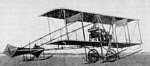
The 1910 BIS No. 2 biplane was designed and built by Bylinkin, Iordan and Sikorsky in Russia.
Span: 26’3″
Length: 26’3″
Weight loaded: 473 lb
Bylinkin 1910 monoplane
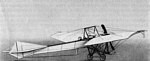
The 1910 Bylinkin monoplane was designed and built by F.I.Bylinkin, in Russia.
Span: 27’11”
Length: 21’4″
Weight loaded: 530 lb
Butusov Albatross
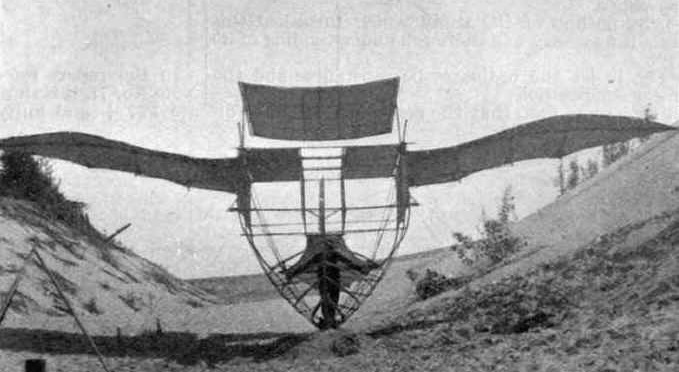
Chanute and his four assistants pitched their tents on a spot within the present city limits of Gary, Indiana, on June 22, 1896. Augustus Herring, the most experienced member of the group, had brought a glider based on the standard Lilienthal monoplane design. William Avery, a Chicago carpenter, had constructed a multi-wing glider designed by Chanute, while William Butusov would attempt to launch his own glider, the Albatross, down a wooden ramp. Dr. James Ricketts, a Chicago physician with “a slack practice and a taste for aeronautics,” would cook for the group and provide emergency medical service as required. Chanute’s dogs, Rags and Tatters, rounded out the party.
The Albatros was the invention of Butusov, who claimed that he had already attained success in soaring flight with it, and as this closely resembled the machine of Captain Le Bris, who was said to have sailed with such a machine in France, in 1867, it was determined to give the design a trial.
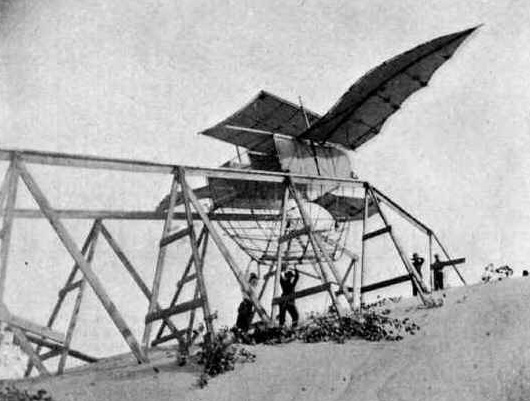
It was a complicated apparatus. Over the top was an aeroplane, below which two great wings extended, 40 feet across, and beneath which again there was a boat-like frame which could be transformed into a skiff by enclosing it with oiled canvas. The whole spread of supporting surface was 266 square feet and it weighed 190 pounds. As this could not, like the other machines, be carried about on a man’s shoulders, special appliances were required to launch it.
This appliance consisted of trestle work built down the slope of the hill. It involved the great disadvantage that it could only be used when the wind blew straight up the trestle, a rare occurrence. Nevertheless two launches were made, but in ballast, as there was no absolute certainty about the equilibrium. On the first occasion, with 130 pounds of ballast, it went off very well indeed, but did not sail very far. In alighting, some of the ribs of the boat-frame were cracked but were replaced in an hour. On the second trial, with 90 pounds of ballast, but in a quartering, unfavorable wind, the latter swung the machine around, after it left the ways, and upon one of the wings striking a tree, the apparatus fell and was broken. On neither occasion would the operator have been hurt had he been in the machine, but it was evidently much too heavy and too cumbrous to be successfully used in experiments designed solely to work out the problem of equilibrium.
Bussard 1910 monoplane
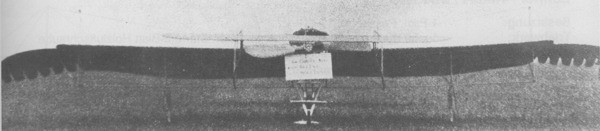
Produced by Lohner but designed by Oberoffizial Hugo L. Nikel, Hauptmann Eugen von Stephaits and Doro Stein in Austria, this monoplane was delivered by Lohner on 10 September 1910. It was destroyed several weeks afterwards when flown by von Stephaits. It had a characteristic wing construction with a “feather” look at the wing tips, which could have been ailerons, and front elevator. An Argus 50 hp engine drove a two-bladed tractor propeller. Contemporary journals identified the machine as the Bussard designed by Stephaits, Nikel and Stein.
Bush, Eldon and Gilbert Motorplane No.8 / No.9
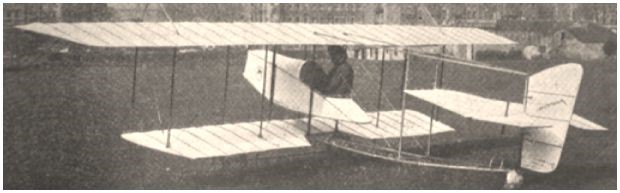
The Motorplane was built at Bath, Somerset, UK, in 1912 by Eldon and Gilbert Bush following the proficiency which they gained with their own gliders and upon professionally-built aircraft. In its original form, as the Bush No. 8, the nacelle was of small cross-section and it was intended to fit an in-line engine. When it proved impossible to obtain an engine of this type at a reasonable price the Bush brothers accepted the loan of a 50 h.p. Gnome rotary, the nacelle being widened accordingly to accommodate it. The machine was then re-designated the Bush No. 9, and it was planned that Eldon Bush should demonstrate it at Hendon. However, while on test at Keynsham the propeller shaft broke and it was not possible to secure a replacement engine before he had to go to Canada on business.
Burlingame 1909 Monoplane
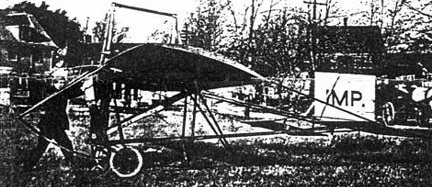
The 1909 Monoplane designed and built by Elmer A.Burlingame in the USA was one of the first monoplanes.
Burghart Doppeldecker
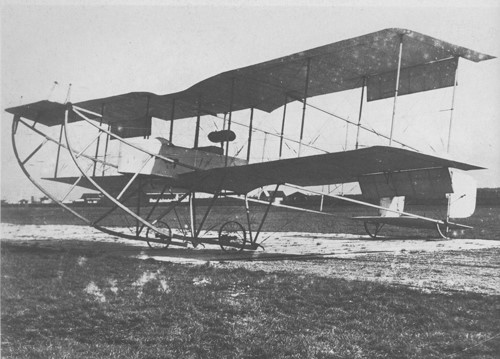
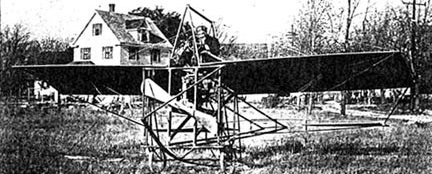
A biplane pusher with a closed nacelle and ailerons at upper and lower wings, built in München, Germany, during 1911-1912. A big rounded tube construction holds the elevator in front. Double rudder at the back.
Burgess-Curtiss Model D

A hybrid of Farman and Wright machines, it was completed after the Harvard-Boston Aero Meet in 1910, first tried at the end of 1910, and flown into 1911. Passenger flights were undertaken until it crashed in April 1911. Its power plant was a 60 hp Hendee V-8, while a proposed 50 hp Gnôme was never fitted.
Burgess-Wiseman 1911 Monoplane
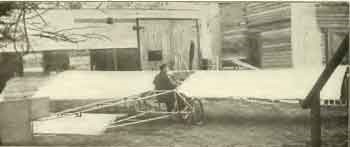
The people behind this design were E.H. Wiseman and R.C. Burgess of Cleveland, Ohio, USA. Wiseman himself designed and built the monoplane, including the flat four-cylinder engine which was to have provided 25hp.
 All Aero