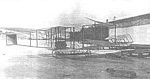
The 1909 Baddeck II was designed and built by McCurdy and Baldwin with the Canadian Aerodrome Company.
Baddeck No. 2 Engine: 1 × Kirkham air-cooled piston engine, 40 hp (30 kW) Wingspan: 33 ft 11 in (10.34 m) Wing area: 220 sq ft (20 sq.m) Length: 32 ft (9.8 m) Height: 7 ft 6 in (2.29 m) Max takeoff weight: 1,000 lb (454 kg) Crew: one
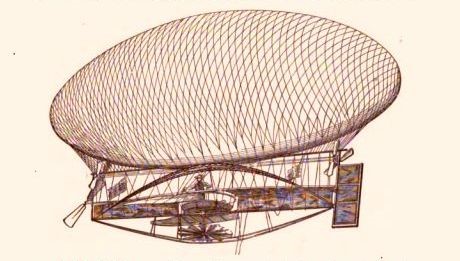
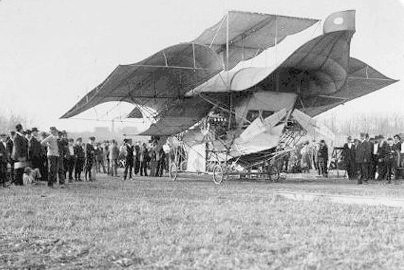
Powered by an Edison electric motor, its 18,000 cu. ft. envelope supplied by Carl E. Meyers, and built a cost of $2500 by the Novelty Air Ship Company of Brooklyn, N.Y., for Professor Peter C. Campbell; the first flight of which was made December 8, 1888 from Coney Island to Sheepshead Bay, piloted by Carlotta the aeronaut – the wife of Carl Meyers. At this time the motive of power is reported to have been bicycle pedals and multiplying gears. The Campbell Air Ship was lost at sea July 16, 1889 while being flown by Professor E. D. Hogan, a Canadian professional aerobat/parachutist, during an exhibition flight originating from the Nassau Gas Works. Intending to make a trip around New York, then to pass over to New Jersey and into the country, five minutes into the flight the 8 foot diameter lower propeller, with which Hogan was to raise and lower the Air Ship gave way and fell to the ground. To make matters worse, it was observed that the steering propellers did not seem to work as no revolutions were discernible, leaving Hogan at the complete mercy of the wind.
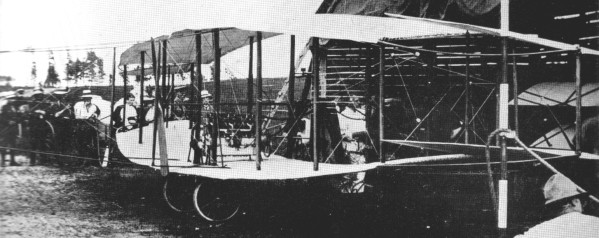
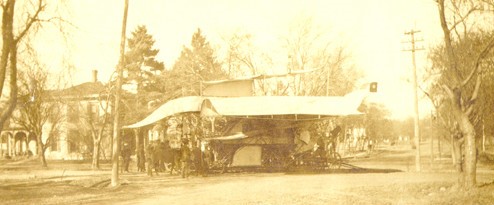
Henry Laurens Call was a writer, a member of the American Association for the Advancement of Science and the designer of this huge, complicated craft, which was powered by two 20hp Curtiss engines, spanned 41 feet and weighed 3,000lbs. It was intended to transport several passengers in the air, on water and on roads, with hot food and all kinds of comfort. However, Call stated that there were too many trees in Girard, Kansas where it was built, and the roads were not very good, so he was never been able to get up a speed of more than 18 miles per hour, rather than the thirty miles an hour he claimed was necessary for the ship to rise in the air.
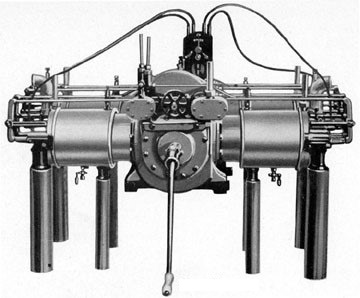
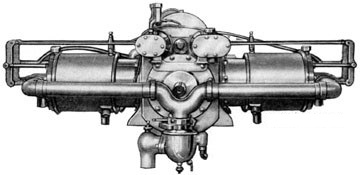
The 1911 Call 2 monoplane was created by the “Aerial Navigation Company of America” of Henry Laurens Call in 1911. It was powered by a 50 hp, horizontally opposed two-cylinder, four-stroke, Call Aviation Engine.
It made several flights before being destroyed by a tornado.
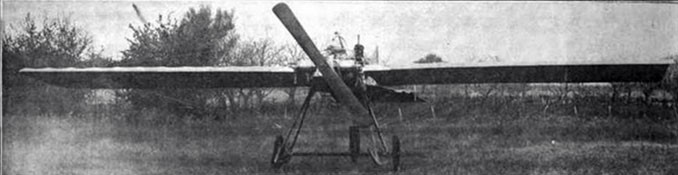
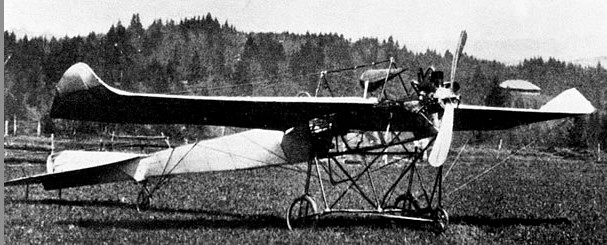
Georges Cailler, born in Vevey, Switzerland as the eldest son of Alexandre Cailler, founder of the well-known chocolate factory in Broc. He built four aeroplanes and flew them between Broc and Epagny. The parts of flying machines of Cailler were built by workers of the the chocolate factory. At the age of 18, he began construction of a biplane with the help of his friend Henri Magnenat from Lausanne, but their machine did not bring expected satisfaction. The trials with the new monoplane took eight days in spring 1910. The boys flew several hundred meters to a height of about 8 meters. They are believed to be the first Swiss aviators to fly a monoplane built entirely in Switzerland by Swiss. The machine is often attributed to Cailler alone.
 All Aero