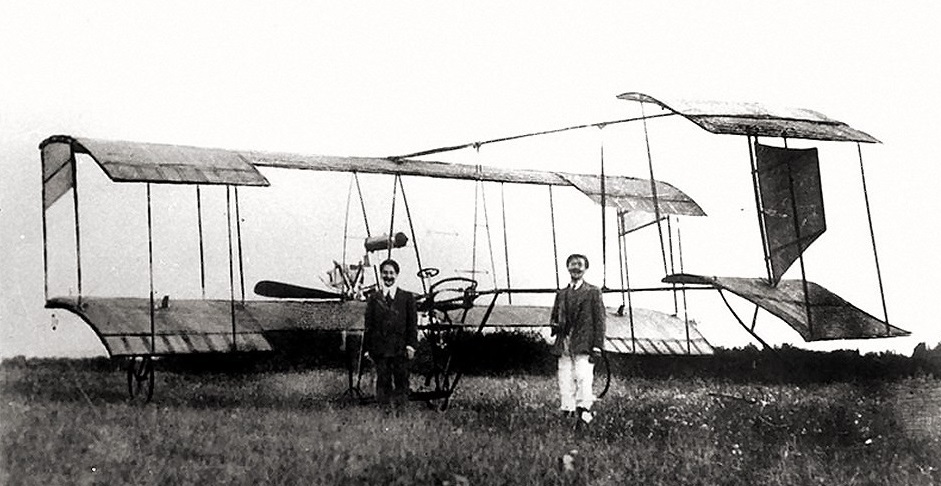
The 1911 Caproni Ca.4, designed and built by Gianni Caproni, was powered by a 25 hp engine.
Span: 44’5″
Length: 30’6″
Weight empty: 530 lb
The 1911 Caproni Ca.4, designed and built by Gianni Caproni, was powered by a 25 hp engine.
Span: 44’5″
Length: 30’6″
Weight empty: 530 lb
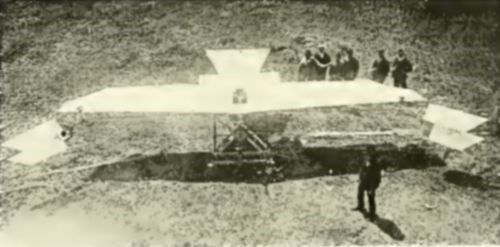
Federico Capone’s machine was called l’Aérogyroplane because of the way it was powered. A small motorcycle engine of 4.5 hp drove double pairs of swinging blades symmetrically disposed at the end of wings. The blades worked like rotors in the initial stage of flight and then their position could be changed from horizontal to vertical. The latter was to give horizontal action to the machine. Built by Ceccarelli in Naples, testing was not very successful, as the machine was partially wrecked by a gale on April 30, 1905. The repaired machine was later sent off from a high launching position and managed to fly a certain distance.
In 1911 Capon designed and built a monoplane in France.

The 1910 Canton et Unne push-pull monoplane was designed and built by Canton and Unne in France.
Span: 34’6″
Length: 26’3″
Weight: 926 lb empty
The Flying Training School at Sockburn, operated by the Canterbury Aviation Company, was formed in 1917. The company had applied to the New Zealand Government for assistance and had been refused, and it had entered into an agreement with the British Government. Training started in June with one aircraft, a Caudron II with a sixty-horsepower Anzani engine.
The Canterbury (NZ) Aviation Co imported six Caudron GIII one and two-seat trainers, built up three locally made copies – #3 #5 and #9, aand built an own design biplane in 1919.
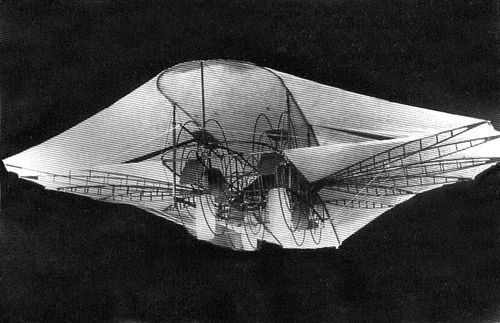
The airship of the Baptist Reverend Burrell Canon from Pittsburg, TX was named “Ezekiel” because Canon get the idea to build it while he read in the book of Ezekiel. The ship had large fabric-covered wings powered by an engine that turned four sets of paddles. It was built in a nearby machine shop and was reported as briefly airborne in 1902. En route to the St.Louis world’s fair in 1904, the airship was destroyed by a storm. In 1913 a second model crashed, and the Rev. Cannon gave up the project. A replica is currently housed in the Northeast Texas Rural Heritage Museum in Pittsburg, Texas.
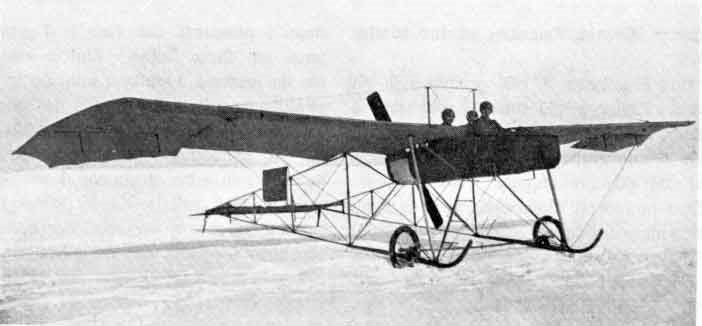
Italian pusher monoplane designed by Italian engineer Canova. Characteristic and beautiful looking machine accommodating three people in the short central fuselage. Ailerons on the wing. Single rudder on the tail-boom construction.
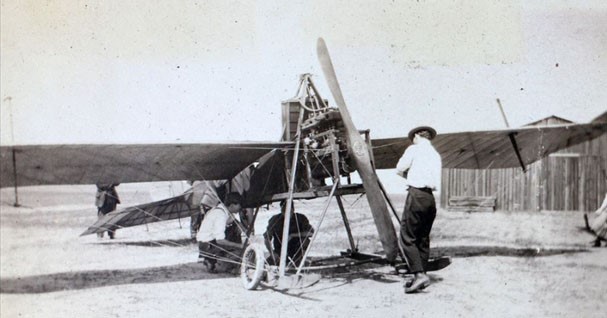
Californian brothers Walter Bissell Cannon and John Arthur Cannon built two machines in 1911. The second, a monoplane, was tested on Eaton Field in June 1911, powered by a Ford engine.
Californian brothers Walter Bissell Cannon and John Arthur Cannon built two machines in 1911. The first was a biplane that was flown very successfully as a towed glider and later with a Ford automobile engine. The second, a monoplane, was tested on Eaton Field in June 1911.

The Canadian Aerodrome Company Hubbard Monoplane “Mike” (Hubbard II) designed and built in Canada in 1910.
J. A. D. McCurdy set up the Canadian Aerodrome Company after the AEA was dissolved. Gardiner Hubbard was a cousin of Bell’s wife, Mabel Gardiner Hubbard.
The Hubbard Monoplane, also nicknamed “Mike”, was designed by John McCurdy and built by the Canadian Aerodrome Company. It was commissioned by Gardiner Greene Hubbard II of Boston. The monoplane was constructed at the Beinn Bhreagh estate of Alexander Graham Bell in Baddeck, Nova Scotia, by John McCurdy and F. W. “Casey” Baldwin. The aircraft was the third to be built by the Canadian Aerodrome Company, and the first to represent an indigenous design, although loosely based on the Blériot XI. The aircraft made two brief flights on 3 March 1910, flown by McCurdy.
After it was shipped to Montreal for the 1910 Montreal Air Meet, Hubbard was unsuccessful in flying the aircraft, it possibly being too low-powered to do more than taxiing. Shortly after, Hubbard had the aircraft dismantled and shipped to Boston, making it the first Canadian aircraft sold and built for export. The intent was to enter the aircraft at the Harvard-Boston Aero Meet in Boston. The aircraft was displayed at the aero meet, and was included in the photographs of the flight line, but it did not leave the ground.
Baddeck No. 2
Engine: 1 × Kirkham air-cooled piston engine, 40 hp (30 kW)
 All Aero