Built in 1914. One delivered to Uruguay.
Pioneers
Castaibert IV
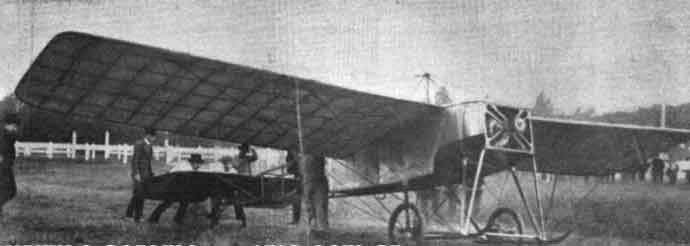
Built in 1913. Four were delivered to the Escuela Militar de Aeronáutica in Uruguay.

Castaibert 1912 Bleriot type
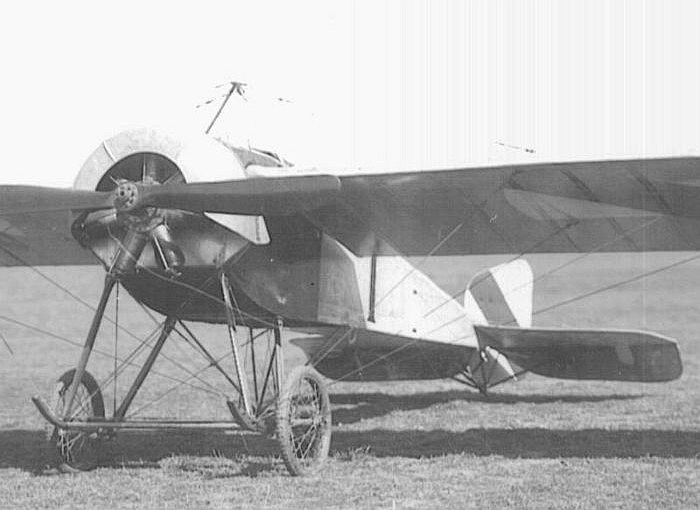
Built by Pablo Castaibert, the 1912 Castaibert Bleriot type monoplane reportedly flew well.
Engine: Gnome, 50 hp
Span: 30 feet (9.35 m.)
Area: 194 sq. ft. (18 m².)
Length: 28 feet (8.47 m.)
Total weight: 617 lbs. (280 kgs.)
Speed: 50 mph / 80 kph
Castaibert 1911 Bleriot-Hanriot type
The Castaibert II was Pablo Castaibert’s second aircraft, powered by a 25 hp (19 kW) Anzani 24.5hp 3-cyl fan engine and reached 46.5 miles per hour (75 km/h). Built by Pablo Castaibert, the 1911 Castaibert Bleriot-Hanriot type monoplane reportedly flew well.
Engine: Anzani, 25 hp / 19 kW
Span: 29 feet (8.80 m.)
Area: 206 sq. ft. (19-20 m².)
Length: 26½ feet (8.15 m.)
Total weight: 705 lbs. (320 kgs.)
Speed: 75 km/h (47 mph, 40 kn)
Castaibert Monoplano 1910-I
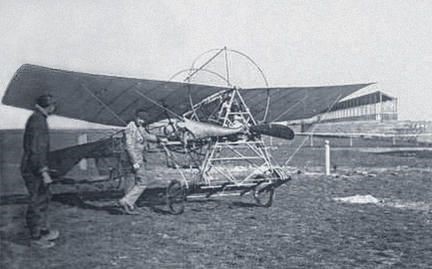
Pablo Castaibert’s monoplane 1910-I was modelled on the Santos-Dumont Demoiselle. Fitted with a 35 hp Anzani, it was not able to fly. It is claimed that the machine would not fly because of a balance problem that could not be resolved after several modifications although it was probably also due to the absence of flight experience by Castaibert himself. At the end of 1910 Castaibert saw a Blériot flying which prompted him to switch designs resulting in his rather more successful series of monoplanes.
Castaibert, Pablo
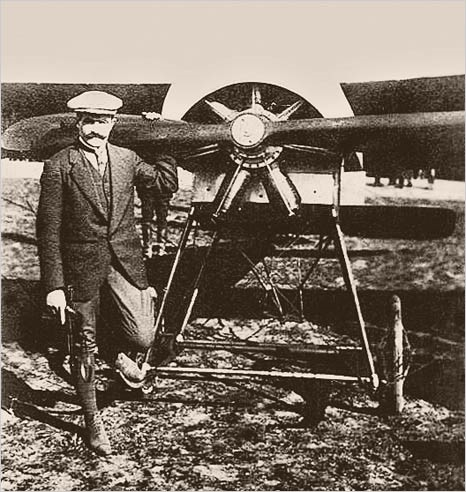
The Castaibert series of monoplane aeroplanes were designed and built by Pablo (Paul) Castaibert, a Frenchman living in Argentina, in the years before and during World War I. His designs were inspired by aircraft he had seen in France.
Castaibert built about 20 machines of several types between 1910 and 1916 when he gave up the business.
Carter 1911 biplane
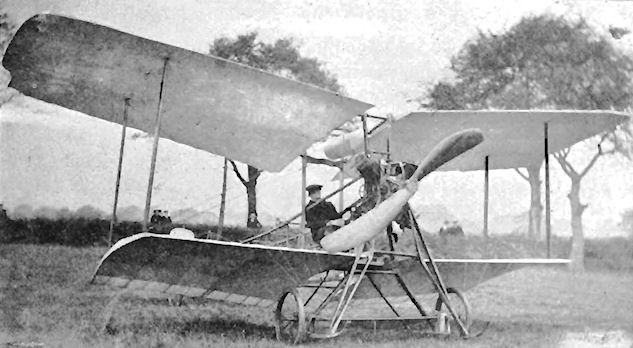
In the UK in 1911 Mr. Carter was out on the new machine and with the engine running fairly well, the machine made a few hops. The machine is of the biplane type of very short span, with the upper planes of slightly greater span than the lower ones. There is no elevator in front, but that position is occupied by the engine and propeller. The engine is an 8-cyl. made by the Nonpareil Motor Fitting Co. at Birmingham. At present it gives about 60-hp, but when properly tuned up it is expected to reach about 80-hp Mr.Carter succeeded in getting the biplane off the ground for short distances.
Mr. Carter was also out with his biplane after having made a few alterations to the tail. The machine rises very rapidly, in one case getting off the ground in 15 ft. but no extended flights were made owing to the fact that the engine was not running up to form.
Carlier 1911 biplane
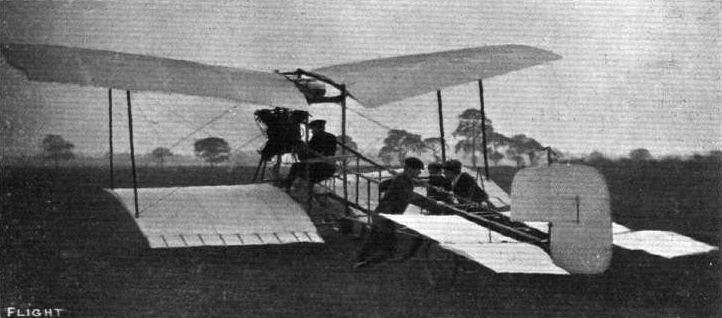
In 1911 Rene Carlier designed and built a biplane in France with a 26’3″ wingspan and 23′ in length.
Carlingford Aërial Chariot / Aerhedon
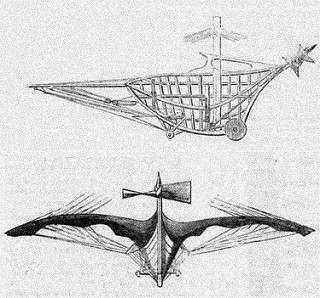
In 1856 Godwin Swift of Kilkenny, Ireland, aka Viscount Carlingford patented an aeroplane both in England and France, resembling in outline a falcon gliding downward with partially closed wings, described by the inventor as follows: “The aerial chariot in form is something in the shape of a boat, extremely light, with one wheel in front and two behind, having two wings, slightly concave, fixed to its sides”. “A tail can be raised and lowered at pleasure by means of a cord. The chariot is drawn forward by an ‘aerial screw’ in front thereof, which screws into the air at an elevation of 45°, turned by means of a winch acting on three multiplying wheels.” The machine was built and tested by swinging it from a rope. The propeller and a wheel are preserved at the Rothe House Museum of Kilkenny.
Carl Belz Doppeldecker
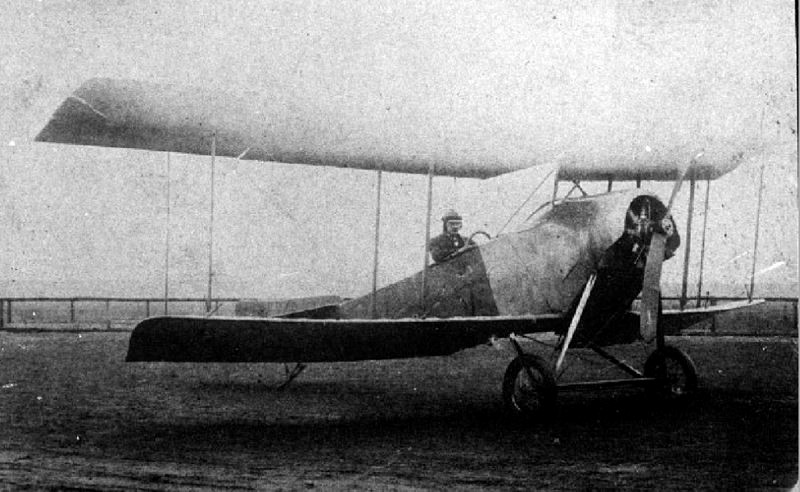
This little biplane with a 50 hp Gnôme rotary was built by Carl Belz Flugzeugbau und Fliegerschule in Berlin-Treptow, Germany, in 1913.
 All Aero