The Collyer-Lang “Otasel” single-seater monoplane tested at Brooklands between November 1910 and February 1911, only achieving brief hops. It was a pusher with twin rear booms, with the pilot seated ahead of the wings between the two front skids. Inset single acting ailerons provided lateral control, and twin rudders within the booms and a tail mounted elevator comprised the other control surfaces. The engine was a 30hp WLA (Adams) motor.
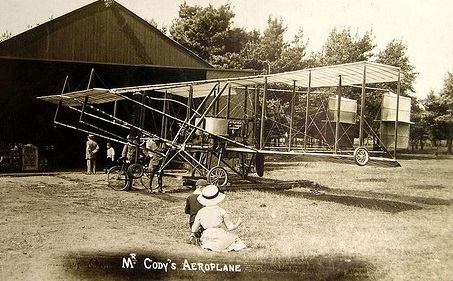
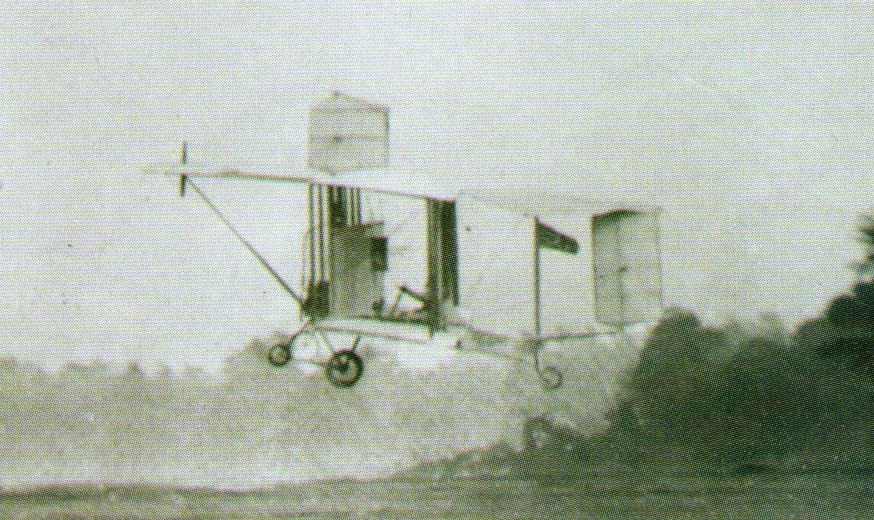
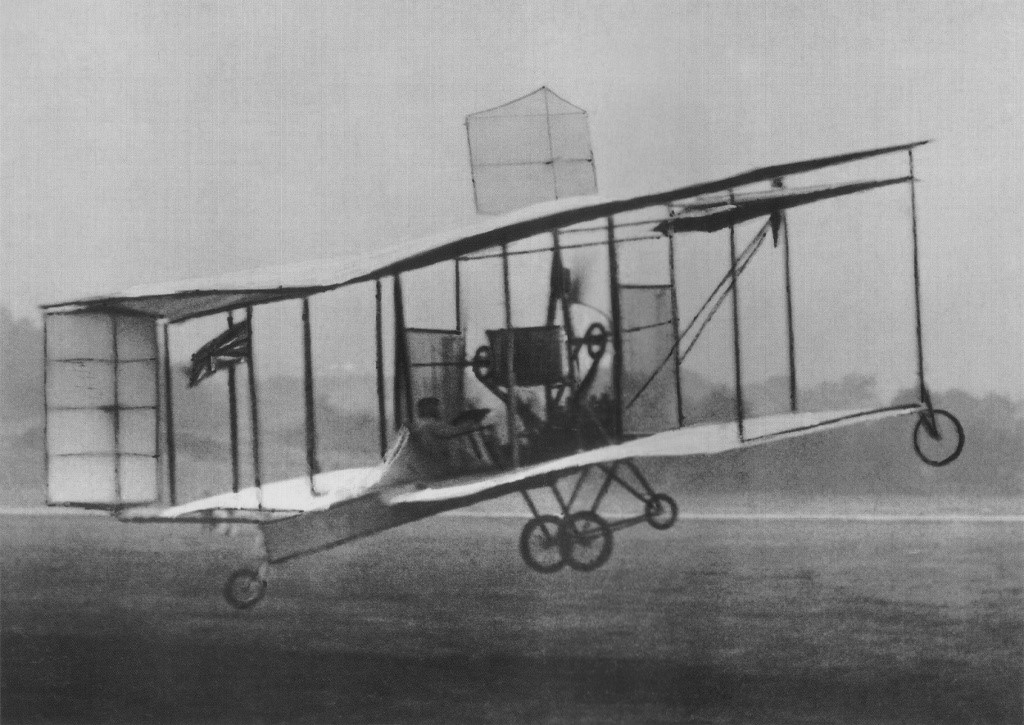
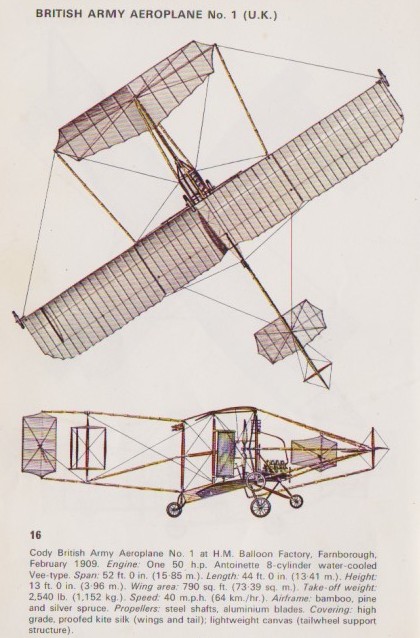
Using personal funds and a borrowed airship shed, Cody built a huge sturdy pusher biplane of 52 foot span, weighing 1,200 pounds. Size and strength were Cody trademarks; he was observed tying knots in bracing wires with his bare hands and was the only one able to spin the biplane’s 50 hp V8 to life. A reporter took one look and dubbed it “the Flying Cathedral.” The nickname stuck. While he had seen pictures of American and French machines, Cody saw no reason to alter his kite with an engine concept, which, by the way, he carried entirely in his head. There were no blueprints or lists of materials because Cody had never learned to read and write. (He eventually mastered a huge “S.F. Cody” for official paperwork, holding the pen like a trowel.) The finished product included a shock-mounted landing gear with steerable tailwheel, ground adjustable wing camber and propeller pitch plus ailerons, this being the first aircraft to use separate surfaces for banking. Cody did not invent ailerons, but he was the first to make practical use of them. Oddly enough, he abandoned them later in favor of wing warping. In the summer of 1908, Cody’s aircraft was towed to Laffan’s Plain, a rough, rolling pasture surrounded by trees. One up¬hill run to test the controls left a 234 foot gap in the tire tracks, a greater distance than the Wright’s first hop, but Cody dismissed it as “just a jump.” On October 16, with reporters watching, he gave it full throttle, rose quickly to 40 feet and flew 1,390 feet, crashing when he dragged a wingtip in an attempt to avoid some trees. The big man emerged from the pile of bamboo and linen bruised but smiling. The illiterate genius had become the first man to fly an airplane in England.
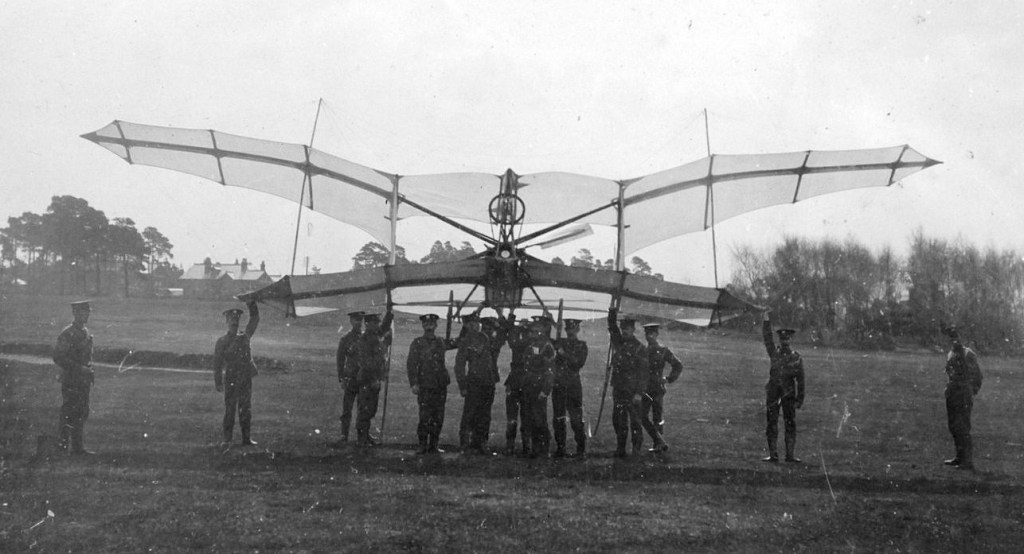
Winner of the 1912 War Office military trials at Salisbury Plain was Cody’s Cathedral, which collected a total of £5,000 prize money, but was clearly of no use to the newly formed Royal Flying Corps and was not put into production.
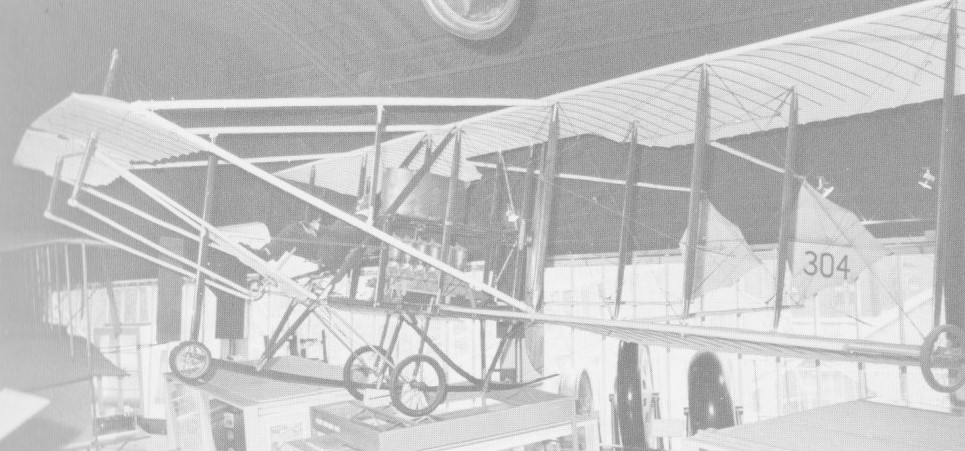
One example, built in 1912 at Farnbough, was similar in configuration to the 1911 Biplane and was again evaluated for military application. It was evaluated by the Army at Cambridge in September 192 and subsequently purchased. The Army number 304 was allocated.
304 at Science Museum, South Kensington
It was little flown and passed to the Science Museum in 1913.
Engine: Austro-Daimler, 120 hp. Span 43 ft Length 34 ft. 4 in Wing chord 5 ft. 6 in Wing area 430 sq. ft Weight, empty about 1,900 lb Weight loaded 2,680 lb Max. speed 73 mph. Stalling speed 48.5 mph Take off run 960 ft Range 336 miles.
Army 304 Engine: Austro-Daimler, 120 hp. Span 52 ft Length 44 ft Weight loaded 2,900 lb Max. speed 65 mph.
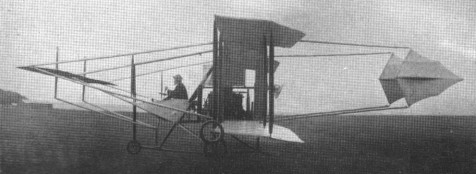
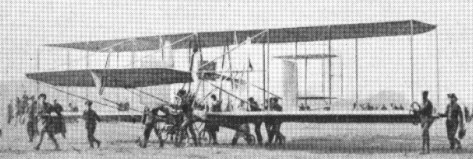
The next step was to build a full size piloted version of the glider. In December 1907, Cody began to build his first biplane at Farnborough, and since Nulli Secundus was rebuilding (to emerge as Nulli Secundus II the following summer) he was allowed to use her 50 h.p. Antoinette engine to power the machine of bamboo and wire. He arranged it to drive two pusher propellers; the result looked something like the Wright biplane.
It was in this aircraft that Cody made his first hops in May, 1908, on Laffan’s Plain. On October 5 or 16th 1908 he made the first official flight in a piloted aeroplane in Great Britain a measured distance of 496 yards at a height of 50-60 ft over Laffan’s Plain (it lasted 37 seconds), Farnborough, and this was the first powered aeroplane flight in Britain; but Cody was American at the time, and did not take out naturalisation papers until 1909.
Cody Army Aeroplane No.1A
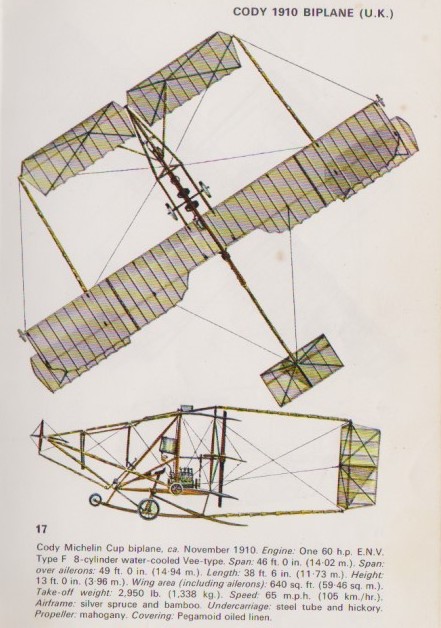
Cody 1 – Initial Prototype; fitted with Antoinette 50 hp. Later, with ailerons Cody 2 – Revised Cody 1 airframe Cody 3 – Cody 2 prototype fitted with ENV Type F engine of 60 horsepower.
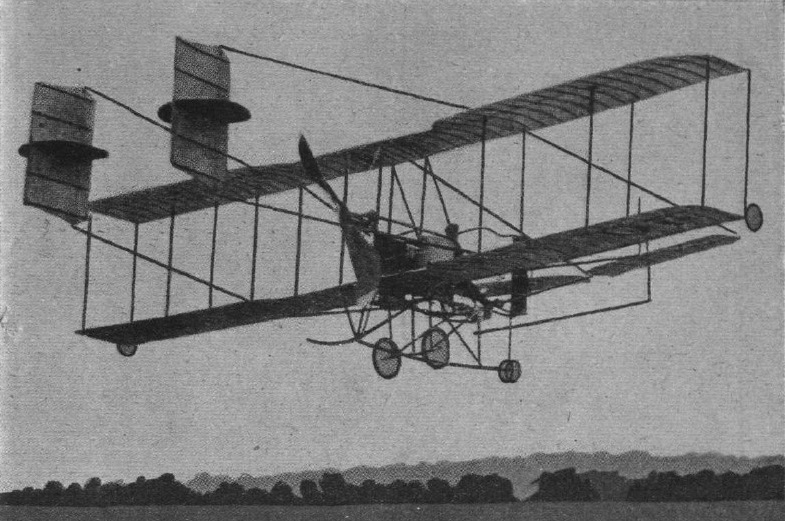
The Cody II was a Michelin Cup machine in which he flew 4 3/4 hours on December 31, 1910 to win the trophy. Clear differences to the earlier machine were the one large propeller installed at the rear in place of the two forward propellers and a 60 hp Green engine fitted in place of the ENV.
Cody II
The Michelin Cup machine in which he flew 4 3/4 hours on December 31, 1910 to win the trophy. Clear differences to the earlier machine were the one large propeller installed at the rear in place of the two forward propellers and a 60 hp Green engine fitted in place of the ENV.
Engine: 1 x Antoinette, 50 hp Length: 38.48ft (11.73m) Wingspan: 52.00 ft (15.85m) Height: 13 ft (3.96m) Maximum Take-Off Weight: 2,950lbs (1,338kg) Maximum Speed: 65mph (105kmh; 57kts) Accommodation: 1
Turning his back on a 15 year stage career, Cody closed the road show and spent months on kite and airship matters. He built gliders in his spare time, but Cody was more interested in aeroplanes and before long had fitted a 12 h.p. Buchet engine to one of his kites.
The motor kite was constructed at Farnborough in 1907, though possibly started in 1906. It was a pilotless biplane, similar to a Cody kite but with additional control surfaces and a three-cylinder 12 hp Buchet engine powering a propeller situated behind the wings. The span of the upper wing is estimated to 35 feet. The undercarriage was fitted beneath the central box section and two long skids were mounted beneath the twin tail rudders. The machine had a horizontal tailplane and at one stage biplane elevators/balancing planes were fitted on the front.
It was tested both on the ground and suspended from a cable rigged between two 100 ft masts, but there is no evidence that it ever made a free flight. Cody said, when presenting slides of the machine to a meeting of the Aeronautical Society, “This is a kite; I am just starting the engine and I try to get out of the way to let it run. It was supposed to be let loose, but the authorities were afraid I might do some damage by letting it go up in the sky.”
Born in Iowa, USA, in 1867 as Samuel Franklin Cowdery, he took on the name Cody to take advantage of the success of William Frederick ‘Buffalo Bill’ Cody of’Wild West’ fame. S F. Cody arrived in the UK in 1889 and set up a touring show. Part of the many ‘acts’ within this travelling ‘circus’ was the flying of substantial kites. Cody became fascinated by flight and developed his own cellular (or box) kites and in November 1902 patented his man-lifting design. The UK military became very interested in these devices as an observation system that was than cheaper and more efficient than balloons.
From 1906, Cody was appointed Chief Kite Instructor to the Balloon Factory at Farnborough, Hampshire. As well as kites, he assisted in the construction of the airship Nulli Secundus (Second to None) which first flew in September 1907, powered by a 50hp (37kW) Antoinette V8. In 1908, Cody turned his attention to building a heavier-than-air flying machine inspired by the Wright Brothers’ designs. Fitted with the same Antoinette that had powered the airship, his British Army Aeroplane No.1 took to the air for the first time on October 16,1908, and put Cody into the history books. He became a British subject in October 1909. He built another biplane in 1910 in which he took the Michelin Prize with a flight of 185 miles (297km) in a closed-circuit. He gained Royal Aero Club Aviator’s Certificate No.9 on June 7,1910. Cody developed his Circuit of Britain Biplane in 1911, entering it for the Daily Mail 1,010-mile contest of the same name. He came fourth in that and won two Michelin Cups for close-circuit flying, becoming well known for flying passengers. In 1912, he flew a short-lived tractor monoplane, which was destroyed in a collision with a cow that July. The same year saw the birth of the Military Trials Biplanes, which resulted in a pair being ordered for service with the Royal Flying Corps. (The second of these biplanes, No.304, was presented to the Science Museum in November 1913 and is today displayed at South Kensington, London.) His final design was the large (even by Cody’s standards) Hydro-Biplane designed to enter the coastal Daily Mail Circuit of Britain of 1913. Cody and his passenger W H B Evans were killed in this machine, in landplane form, on August 7,1913. Pioneer Cody had become the 32nd British pilot fatality.
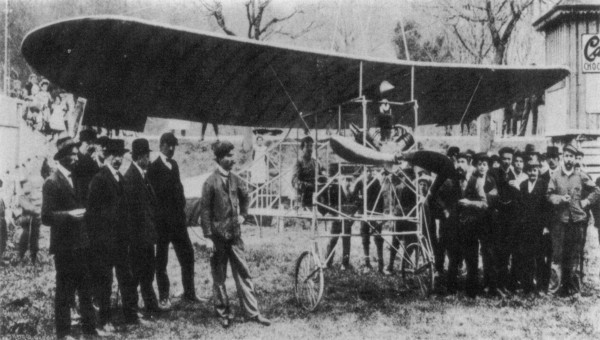
Henri Cobioni quit motorcycle racing in September 1909 and built this little monoplane at his home in Moutier/Münster, Switzerland. He had to collect money for the engine, which was installed in about March 1910. Flight testing took place at the “Allmend” of Thun, where Cobioni could make a few hops, but finally crashed the machine in June 1910. After that he entered the Caproni school and qualified for the Swiss FAI-brevet No.15 in August 1911. The construction of this first monoplane is credited to Eng. Emilio Lazzaroni from Milano, who together with Cobioni patented the machine and founded the company “La Société Jurassiene d’Aviation”, which was quickly dissolved after the Cobioni’s crash.

 All Aero