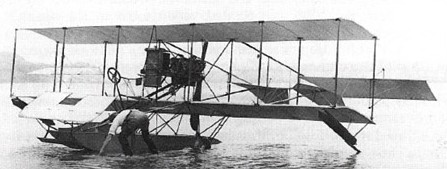
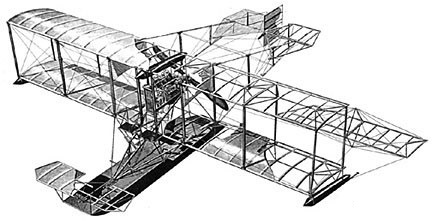
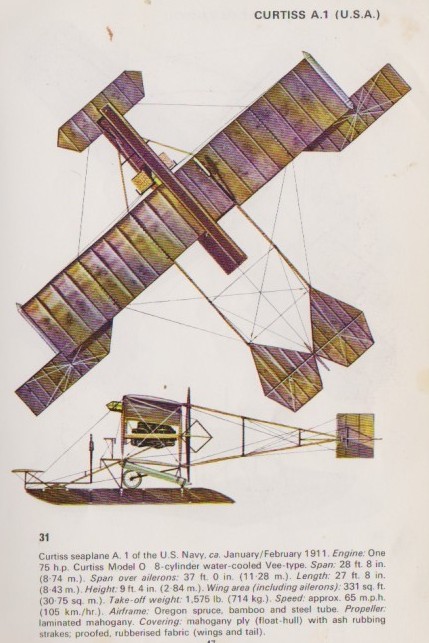
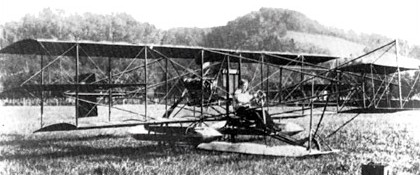
In February 1911, Curtiss introduced the Triad seaplane, which had both wheels and floats.
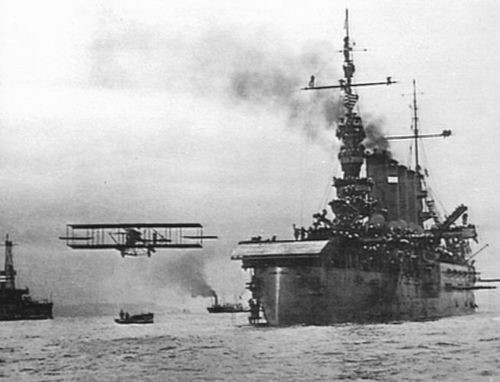
The Triad A-1 first flew on July 1, 1911, piloted by Curtiss, for a five minute flight at 25′ AGL, and was the US Navy’s first airplane (later being designated AH-1) for $4,400.
The A-1 was used in a variety of aerial “firsts”—first cross-country flight, 112 miles in 122 minutes; first (albeit unsuccessful) catapult launch (On 31 April 1912); first night landing on water without lights. It also set a world seaplane altitude record of 900′, and completed 285 flights.
Curtiss A-1 USN Lt T S Ellyson
The Triad was sold to the British, Russian, German and Japanese navies in 1912. The Japanese naval aviation was founded with the purchase of three Curtiss Triads. In 1912, Curtiss won the Robert Collier Trophy for his development of the seaplane.
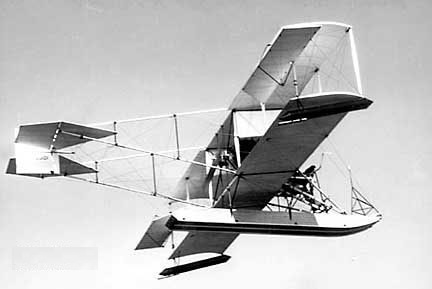
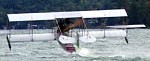
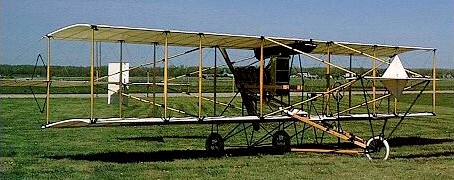
A faithful replica was built by a group of fans in San Diego c.1956.
Curtiss A-1 Replica
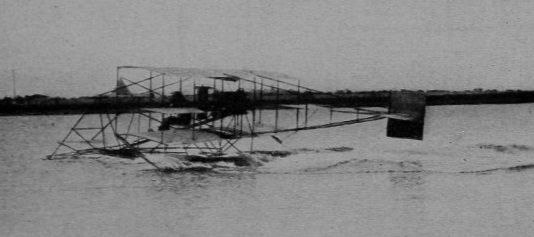
Reconstruction during take off
A-1 Engine: 1 x 75 hp Curtiss V-8 Max Take-off weight: 715 kg / 1576 lb Empty weight: 420 kg / 926 lb Wingspan: 11.28 m / 37 ft 0 in Length: 8.71 m / 28 ft 7 in Height: 2.69 m / 8 ft 10 in Wing area: 26.57 sq.m / 286.00 sq ft Max speed: 97 km/h / 60 mph Cruise: 40 mph Range: 112 mi Seats: 2
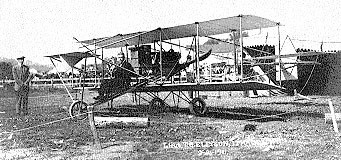
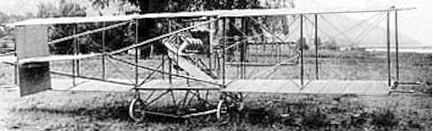
The USN’s second plane, the 1912 patrol amphibian Curtiss A-2, or OWL, was converted from the 1911 Model E landplane. Ordered by the Navy in May 1911 as a standard model E pusher landplane and taken into service as the A-2. With two seats and 50hp Curtiss pusher engine, later replaced by 60hp V-8, it was unofficially dubbed OWL for “Over Water and Land” when experimental wheels were added.
With a modified with cabin enclosure, it was re-designated E-1 in Sept 1913, then AX-1 in March 1914.
The sole example crashed on 27 November 1915 after 91 flights and was scrapped.
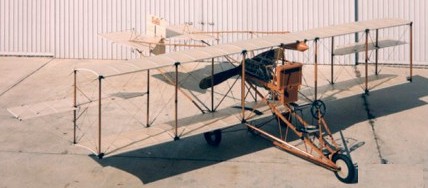
OWL-1
Work was begun by Curtiss in late 1913 on the OWL II, while utilising the same model E components, featured a more pointed V-bottom hull and improved housings for the tricycle wheels. The OWL II was reportedly in 1914.
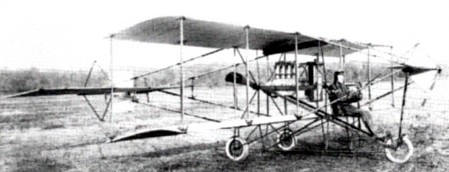
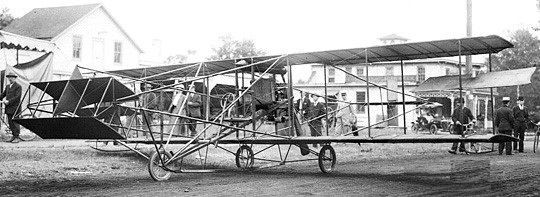
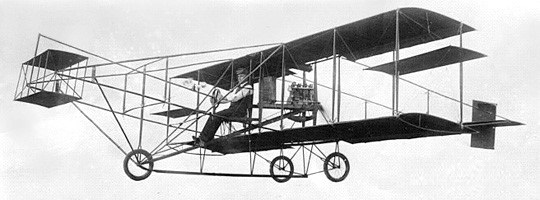
Replica: Coolbaugh Curtiss-Ely 1911
Curtiss E First flight: 1912 Wing span: 12.3m / 40 ft Length: 7.9m / 26 ft Weight: 677 kg / 1490 lb
Model E-4 Engine: 1 x 40hp 4-cylinder water-cooled Curtiss Take-off weight: 272 kg / 600 lb Wingspan: 10.77 m / 35 ft 4 in Length: 7.85 m / 25 ft 9 in Height: 2.44 m / 8 ft 0 in Max. Speed: 64 km/h / 40 mph
In 1909, Glenn Curtiss decided to try for the $10,000 prize posted by the New York World newspaper for the first flight between Albany, the capital city of New York State, and New York City. After many delays due to weather, the record 251km flight was made on 29 May, 1910. The start was at Albany, with a refuelling stop at Poughkeepsie and a precautionary stop within the northern city limits of New York before the final landing on Governor’s Island. The Hudson Flyer was a stock model Curtiss or the period, modified for the flight. As the entire route was over the Hudson, emergency flotation gear was added. To preclude nosing over on alighting on water, a hydrovane was installed ahead of the nosewheel at the suggestion of Charles Willard, who had made two unintentional alightings in the Golden Flyer. To carry the weight or the extra equipment and fuel, the area of the upper wing was increased by adding strut-braced extensions to the tips.
At the urging of the Aeronautical Society of New York to represent it in the 1909 Gordon Bennett Cup Race in France, Curtiss built a larger version of the D / Golden Flyer and installed a new 60hp V-8 engine, which was a carefully-guarded secret until the racer was set up in France in August.
The Curtiss No. 2, often known as the Reims Racer, was a modified Golden Flyer (also known as the Curtiss No. 1), and was an open-framework biplane with two-bay unstaggered wings of equal span. It had a monoplane tail that controlled the rudder but the elevators were carried forward of the pilot as a biplane canard unit. The landing gear was wheeled and tricycle in configuration, with each unit carrying a single wheel. Large ailerons were carried in the interplane gap.
Curtiss modified the Golden Flyer into the Reims Racer by adding a covered stabilizer unit at the canard, increasing the wing size, modifying the interplane elevators and replacing the 25 hp four cylinder inline Curtiss OX engine by a 63 hp Curtiss OX V8 that had been stripped down and specially lightened for the race. A new, lighter fuel tank was exchanged for the older, heavier one.
A transverse-rocking, metal framework “shoulder cradle”, hinged longitudinally on either side of the pilot’s seat, achieved the connection between the pilot and aileron control cabling. This apparatus required the pilot to “lean-into” the turn to operate the ailerons and bring the plane in the same direction. This system was later used again in the Curtiss Model D.
Reims Air Show August 1909
Flying against the clock rather than other aeroplanes, Curtiss completed the 20km closed course at a world’s record 69.76km/h to win the Gordon Bennett Cup. Curtiss’ participation in the race was sponsored by the Aero Club of America, which had offered to back him after a similar offer was turned down by the Wright brothers. While not as fast as its European competitors, the Reims Racer was more maneuverable, and Curtiss, who piloted the machine himself, was able to take advantage of this by paying special attention to his turns. The first competitor to fly, Curtiss recorded a time of 15 minutes 50.4 seconds for the two 10 km circuits required. When Louis Bleriot made the final flight of the competition, he recorded a time 5.8 seconds longer, leaving Curtiss to claim the FF 25,000 prize. Curtiss’s flight, at an average speed of 47.06 mph (75.48 km/h) was also a new airspeed record for the distance.
Curtiss at the controls of the Reims Racer
After Reims, Curtiss took the aircraft to Italy, where he won events at a competition at the Air Show in Brescia in September. There, he won the overall grand prize by flying the required five 10 km circuits in 49 minutes 24 seconds. He also won the quick starting prize, starting his engine in 8.2 seconds, and took second place to Henri Rougier in the altitude prize, climbing to 165 ft (51 m). While at Brescia, Curtiss gave Italian poet Gabriele d’Annunzio a short joyride, but declined a similar request by Princess Laetitia on the grounds that the seat would be unsuitable.
The Reims Racer was later used by Curtiss who set a speed record of 55 mph at the first US air meet, 10-20 Jan 1910, at Dominguez Hills in Los Angeles, and his pilots for exhibition work and other record flights in the United States.
It was sold to Charles K Hamilton, who flew exhibitions in it until crashing at Seattle on 3 Dec 1910.
The book “How to Fly” – or The Conquest of the Air – published in 1910 by Thomas Nelson & Sons has a description of how to fly this aircraft (pp 157 to 162) as follows: “There is a diversity of design in the arrangement of the means of control. We shall describe that of the Curtiss biplane, as largely typical of them all. In general, the biplane consists of two large sustaining planes, one above the other. Between the planes is the motor which operates a propeller located in the rear of the planes. Projecting behind the planes, and held by a framework of bamboo rods, is a small horizontal plane, called the tail. The rudder which guides the aeroplane to the right or the left is partially bisected by the tail. This rudder is worked by wires which run to a steering wheel located in front of the pilot’s seat. This wheel is similar in size and appearance to the steering wheel of an automobile, and is used in the same way for guiding the aeroplane to the right or left. In front of the planes, supported on a shorter projecting framework, is the altitude rudder, a pair of planes hinged horizontally, so that their front edges may tip up or down. When they tilt up, the air through which the machine is passing catches on the under sides and lifts them up, thus elevating the front of the whole aeroplane and causing it to glide upward. The opposite action takes place when these altitude planes are tilted downward. This altitude rudder is controlled by a long rod which runs to the steering wheel. By pushing on the wheel the rod is shoved forward and turns the altitude planes downward. Pulling the wheel turns the rudder planes upward. This rod has a backward and forward thrust of over two feet, but the usual movement in ordinary wind currents is rarely more than an inch. In climbing to high levels or swooping down rapidly the extreme play of the rod is about four or five inches. Thus the steering wheel controls both the horizontal and vertical movements of the aeroplane. More than this, it is a feeler to the aviator, warning him of the condition of the air currents, and for this reason must not be grasped too firmly. It is to be held steady, yet loosely enough to transmit any wavering force in the air to the sensitive touch of the pilot, enabling him instinctively to rise or dip as the current compels. The preserving of an even keel is accomplished in the Curtiss machine by small planes hinged between the main planes at the outer ends. They serve to prevent the machine from tipping over sideways. They are operated by arms, projecting from the back of the aviator’s seat, which embrace his shoulders on each side, and are moved by the swaying of his body. In a measure, they are automatic in action, for when the aeroplane sags downward on one side, the pilot naturally leans the other way to preserve his balance, and that motion swings the ailerons (as these small stabilizing planes are called) in such a way that the pressure of the wind restores the aeroplane to an even keel. The wires which connect them with the back of the seat are so arranged that when one aileron is being pulled down at its rear edge the rear of the other one is being raised, thus doubling the effect. As the machine is righted the aviator comes back to an upright position, and the ailerons become level once more. There are other controls which the pilot must operate consciously. In the Curtiss machine these are levers moved by the feet. With a pressure of the right foot he short-circuits the magneto, thus cutting off the spark in the engine cylinders and stopping the motor. This lever also puts a brake on the forward landing wheels, and checks the speed of the machine as it touches the ground. The right foot also controls the pump which forces the lubricating oil faster or slower to the points where it is needed. The left foot operates the lever which controls the throttle by which the aviator can regulate the flow of gas to the engine cylinders. The average speed of the 7-foot propeller is 1,100 revolutions per minute. With the throttle it may be cut down to 100 revolutions per minute, which is not fast enough to keep afloat, but will help along when gliding.”
Curtiss also worked on developing the seaplane, basically a land plane with floats instead of wheeled landing gear. His first seaplane, based on the Model D was manoeuvrable, light, and relatively fast, and was the most widely built type of plane in the United States before World War I.
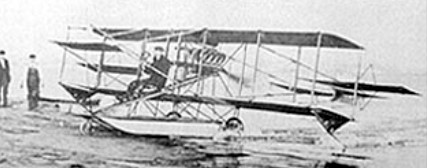
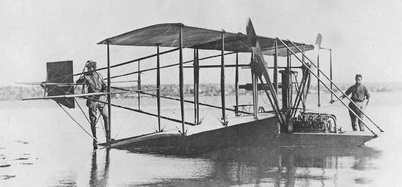
The D Hydro was a standard, Curtiss-designed 60 hp Type D pusher landplane fitted with a single, flat- bottomed spruce hull built locally by Baker Machine Co. Built and flown by Glenn Curtiss from San Diego Bay on 26 January, 1911, the first practical seaplane.
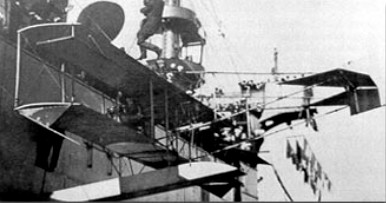
Curtiss and his hydroplane being hoisted aboard the USS Pennsylvania in San Diego harbour, 1911.
In 1910, Curtiss set up shop in San Diego and taught the first naval aviators to fly, and in that year, he introduced the Model D biplane. In 1911, Curtiss began to concentrate on the military market, selling three airplanes to the U.S. Navy. The Model D was the second military airplane purchased by the U.S. Army Signal Corps. It was known as Signal Corps Airplane No. 2. Curtiss continued the evolution of the pusher design with the development of the D-II (the Golden Flyer was considered the Model D) and the D-III, to which a second set of elevators were added to the rear in place of the fixed horizontal stabilizer formerly used on the D and D-II models. The two-seater aircraft was built in sections so it was easy to disassemble and transport. The elevons were operated by the pilot’s shoulders.
The Curtiss D-III Headless Pusher resulted from an accident incurred by exhibition pilot, Lincoln Beachey. While flying in a competition with a standard Curtiss D-III, Beachey hit a fence upon landing and destroyed the front elevator. Rather than drop out, Beachey continued to fly without the front elevator control and found that the aircraft performed better than before. Navy pilots had independently realized that stability was enhanced without the forward elevator and they removed them from their airplanes. Curtiss concurred with the results and began producing the 1912 Model D Headless Pusher as a new offering.
Curtiss D Headless Pusher
Glenn Curtiss persuaded the US Navy to fit a wooden platform over the deck of the US cruiser Birmingham, and on 14 November 1910, a Model D Curtiss plane, piloted by Eugene Ely made a successful flight from this platform in a standard Curtiss biplane at Hampton Roads, Virginia. On January 18, 1911, Ely landed on the deck of the USS Pennsylvania.
In 1909 Arthur P Warner of Beloit WI., USA, purchased and assembled Curtiss pusher components and taught himself to successfully fly his own creation at Turtle Ridge.
Warner-Curtiss
Curtiss’ first flying boat attempt was the Model D. A combination of hull shape, insufficient power and wing area prevented it from flying.
Undetered, Curtss left San Diego in the spring of 1912 to return to Hammonsport, where he commenced work on Flying Boat No.2.
Curtiss D-III Headless Pusher Engine: Curtiss V-8, 50 hp Wingspan: 11.6 m (38 ft 1 in) Length: 7.8 m (25 ft 6 in) Height: 2.7 m (9 ft) Weight: 632 kg (1,390 lb) Airframe: Wood Covering: Fabric
Curtiss Model D Engine IV Pusher Engine: Curtiss V-8, 59 hp Length: 31.463 ft / 9.59 m Height: 8.366 ft / 2.55 m Wingspan: 41.142 ft / 12.54 m Max take off weight: 1301.0 lb / 590.0 kg Weight empty: 701.2 lb / 318.0 kg Max. speed: 43 kt / 80 km/h Endurance: 3 hr
Developed from the earlier AEA June Bug, the 1909 Golden Flyer represented an important com¬promise between stability and controllability. It started the main rival biplane tradition to the Wright Flyer in the United States.
Relatively easy to fly, this aircraft became popular as a safe, sporting machine. It won the prize for the longest distance flown during the great airshow at Rheims in 1909, which was attended by a quarter of a million people.
A single-seat model ordered by the Aeronautical Society of New York on 2 March, 1909, the purchase price of $5,000 included instruction for two Society members. With no designation, No.1 was initially called Gold Bug because of the golden tint of the varnished fabric but later officially became the Golden Flyer.
Curtiss delivered the Curtiss No. 1 on May 29, 1909. Several copies were made for the Aeronautic Society of New York as their Model D.
Engine: One 50 hp Curtiss. Length 28 ft (8.5m) Wing span 29 ft (8.8m) Weight empty 550 lb (250 kg) Seats: 1. Speed: 45 mph (72 kph).
Curtiss, who was a motorcycle fiend and engine genius, had actually asked the Wright Brothers if they wanted one of his 50 hp engines when he went to discuss some aviation data, but they said no, unaware that Curtiss and the AEA would soon be a major competitor.
As a member of Alexander Graham Bell’s Aerial Experiment Association (AEA), Glenn Curtiss built the engines for the Red Wing and the White Wing early in 1908, piloted his first plane, and built and flew the June Bug that June.
The AEA disbanded in 1909, and Curtiss formed the Herring-Curtiss Company on 20 March 1909 with Augustus Herring. Its first customer was the Aeronautic Society of New York. Curtiss delivered his first plane to them, the Curtiss No. 1, built to their specifications, on May 29, 1909.
When the Herring partnership split up, Curtiss founded the Curtiss Exhibition Company, the Curtiss Aeroplane Company in December 1911 in Hammondsport, New York, and the Curtiss Motor Company.
As business expanded, the Hammondsport factory became unable to fill all the orders. Curtiss extended its operation to Buffalo, where it rented the site of the company that had supplied Curtiss with his first bicycle engine years before. Curtiss also opened a new plant in Toronto. The quarters in Buffalo quickly became inadequate, and a new 120,000-square-foot (1,115-square-meter) building was constructed that became the company headquarters. Soon after, a new plant that sprawled over 72 more acres was added.
1909-early 1911 – While A, B, and C models are known (or thought) to have existed during this historically important period for Curtiss, where they were applied is not. Numerical assignments, as well, were guesses—Model 2 has appeared for both Rheims Racer and Charles Willard’s Banshee Express but not verified (Willard unjustifiably claimed authorship of that design). By 1910, Model D had been established, in some references tied to Curtiss-Herring, which was actually built after the partners’ dissolution. But there were at least 9 aircraft known to have been produced in this period, the “official” Model D, in one of its many forms, formally appeared in the first company catalog on mid-1911 along with its companion Model E. Production of concurrent Curtiss-Aero Society Model Ds unknown but the design quickly evolved into the Curtiss D (Standard). A Herring-Curtiss, for which plans were published for home-builders of the time, differed from Curtiss D with its ailerons on the front wing struts instead of the rear wing struts. Herring’s contribution, besides that as a temporary partner, was his alleged invention of a gyroscopic stabilization device (claimed, but unsubstantiated, 1909 US patent #12,256), which would circumvent the Wright’s aileron patents, but which was never used on any Curtiss machine.
Curtiss designed and built the following planes during 1908 – 4, 1909 – 2, 1910 – 4, 1911 – 5, 1912 – 3, 1913 – 3, total – 21.
In 1916, the Curtiss Aeroplane & Motor Company, Ltd. went public with Curtiss as president. By that time Curtiss had become the world’s largest aviation company, employing as many as 18,000 at Buffalo and 3,000 at Hammondsport.
The Curtiss Aeroplane and Motor Company was created 13 January 1916 from the Curtiss Aeroplane Company of Hammondsport, New York and Curtiss Motor Company of Bath, New York. Burgess Company of Marblehead, Massachusetts, became a subsidiary in February 1916. In 1916 the company moved its headquarters and most manufacturing activities to Buffalo, New York, where there was far greater access to transportation, manpower, manufacturing, and much needed capital. It became the largest aircraft manufacturer in the world during World War I, employing 18,000 in Buffalo and 3,000 in Hammondsport, New York. Curtiss produced 10,000 aircraft during that war, and more than 100 in a single week. A third factory (Garden City, Long Island, NY) became boat hull department for flying-boat production. Burgess Company of Marblehead, Massachusetts, became a subsidiary in February 1916. Aircraft built during First World War included A and AH biplanes for USN, Models D and E for U.S. Army, Model F flying-boats for USN, H-4 Small Americas, H-12 Large Americas and H-16 Large Americas (plus 150 by Naval Aircraft Factory). Best-known were JN-4/JN-6 “Jenny” trainers (5,000 built, plus 1,200 by Canadian Curtiss), HS flying-boats, MF flying-boats, N-9 floatplanes, British S.E.5a fighters, Orenco D fighters, and 5L flying-boats. Total wartime was 4,014 aircraft and 750 aero engines.
After the war, Curtiss, fell on hard times. In August 1920, the company was forced into receivership. Clement Keys, a Canadian financier, obtained funds to manage the company’s debt and led it again to sound financial status. The Buffalo facility became the major facility, and the company remained the largest U.S. aircraft company through the 1920s.
Postwar production, mostly in 1920s, included NC- 1/2/3/4 transatlantic flying-boats (four only); Oriole, Eagle, and Seagull civil types (little success achieved with the few built). Followed by a series of Army (R-6/R-8 etc.) and Navy (CR/R2C/R3C etc.) racers. Twelve B-2 Condor biplane bombers were followed by PW-8 biplane fighters, P-1/P- 6 U.S. Army Hawks, F6C U.S. Navy Hawks, and O-1/11/39 and A-3 Falcons for U.S. Army. The few Carrier Pigeons and Larks were followed by one Tanager biplane, which won 1929 Guggenheim Safe Airplane Competition. Subsequently produced N2C Fledgling, F8C/OC Falcon, and F8C/02C Helldivers for USN.
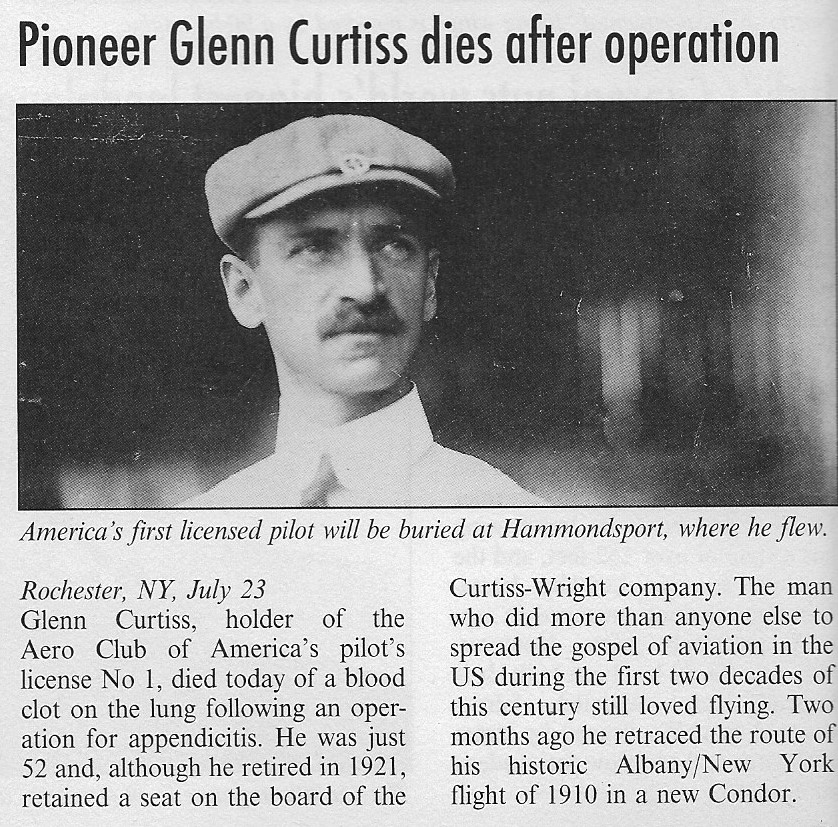
Foundation of Curtiss-Robertson division in 1928 was followed by, on July 5, 1929, Curtiss Aeroplane and Motor Company became part of Curtiss-Wright Corporation, together with 11 other Wright and Curtiss affiliated companies. In 1929, shortly before Curtiss died, the Curtiss Aeroplane & Motor Company, Ltd., merged with the Wright Aeronautical Corporation to form the Curtiss-Wright Corporation.
1930
Neither Curtiss or Wright successfully made the transition to the jet age and substantially all aircraft assets were sold to McDonnell and North American by 1950.
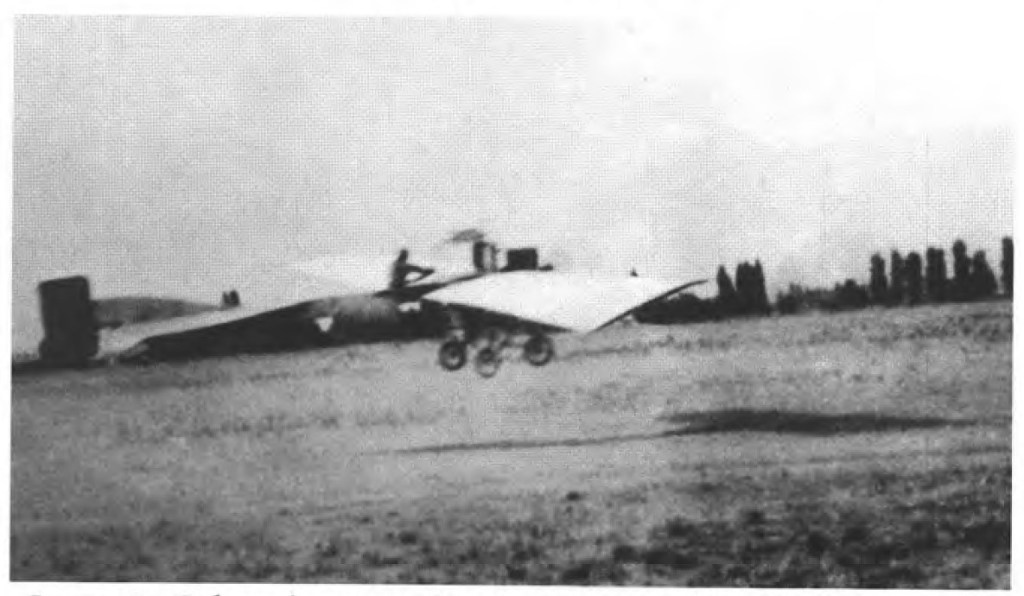
Lagar Culver of Salt Lake City started a monoplane in December 1910. It reportedly flew several times at the Lagoon race track up to August 1911, but wasn’t satisfactory.













 All Aero