The sole 1913 Curtiss A-3 was a two place, open cockpit biplane, becoming a USN patrol land/hydroplane. Powered by a pusher engine, it was later re-designated AH-3.
Pioneers
Curtiss M
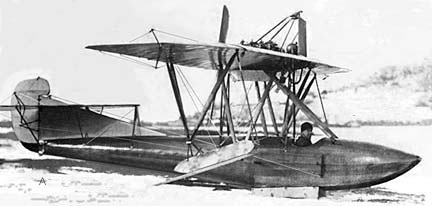
The Curtiss M flying boat was built to order for Raymond V. Morris, a Curtiss employee.
It featured swept-back, birdlike parasol wing and full-length, V-bottom wooden hull.
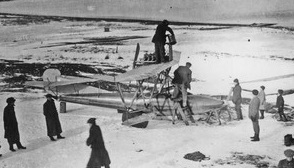
A single seater first flying in January 1914, it was the world’s first monoplane flying boat.
After unsatisfactory tests were performance was marginal, it was converted to a biplane layout at San Diego.
Engine: Curtiss O, 90hp
Wingspan: 34’0″
Length: 25’0″
Seats: 1
Curtiss-Willard Banshee Express
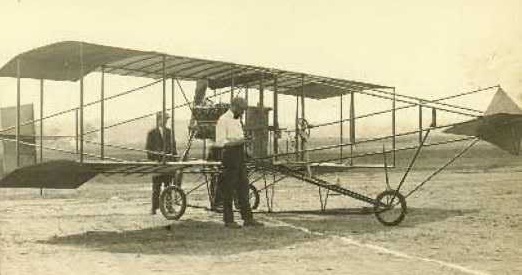
The Curtiss-Willard Banshee Express of 1910 was designed on the specifications of Charles F. Willard and built by Curtiss.
The first flight of the Banshee Express took place at Mineola, N.Y., and established an American record by carrying 3 passengers (1200 lb gross) on August 14, 1910.
Span: 32′
Curtiss B-8
The Curtiss B-8 was an early air-cooled 8-cylinder engine used for a number of aircraft and one motorcycle designed by Glenn Curtiss. It powered the AEA June Bug in 1908, becoming the first Curtiss engine to power a heavier-than-air aircraft in sustained flight.
Applications included:
AEA June Bug
AEA White Wing
AEA Red Wing
Curtiss V-8 motorcycle
Specifications
Weight: 150 pounds (68 kg)
Bore×Stroke: 3.625×3.25 in.
Power: 40 horsepower (30 kW)
Displacement: 268 cubic inches (4,390 cc)
Curtiss A-2 (engine)
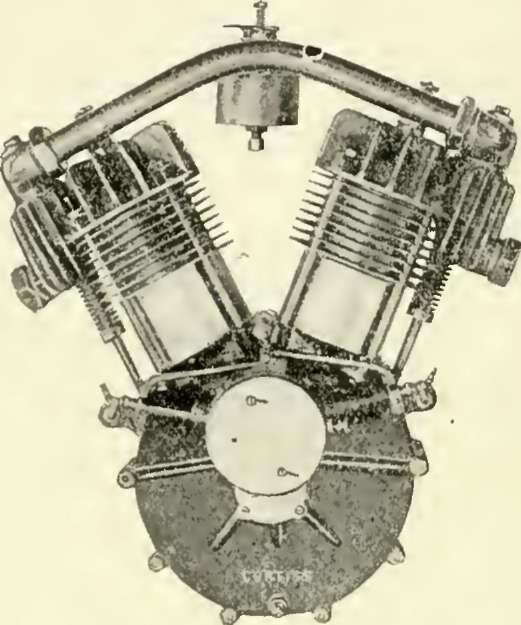
The A-2 was a small 2 cylinder V-type engine built by the Curtiss Aeroplane and Motor Company around the early 1900s. It was developed from an earlier Curtiss motorcycle engine. The first Curtiss aircraft engine, a 5.2 kW (7 hp) air cooled, V-twin, was built T S Baldwin’s dirigible and first flew on 3 August 1904.
A-2
Type: Two-cylinder, V-type, air-cooled
Bore: 3.25in (82.55mm)
Stroke: 3.625in (92.08mm)
Displacement: 60.14 cuin (986cc)
Dry weight: 50lb (22.7kg)
Cooling system: Air cooled
Power output: 7 hp (5.2 kW) at 1,500 rpm
Curtiss Autoplane

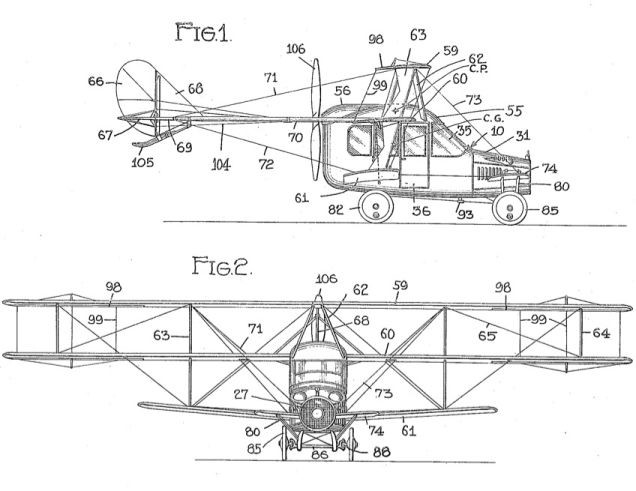
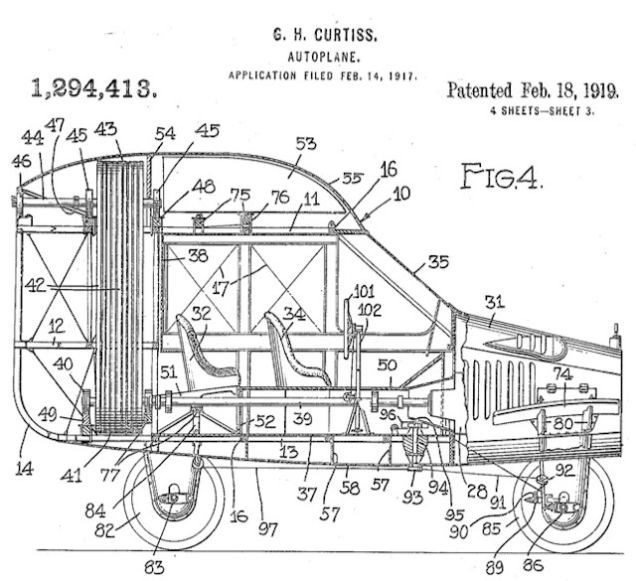
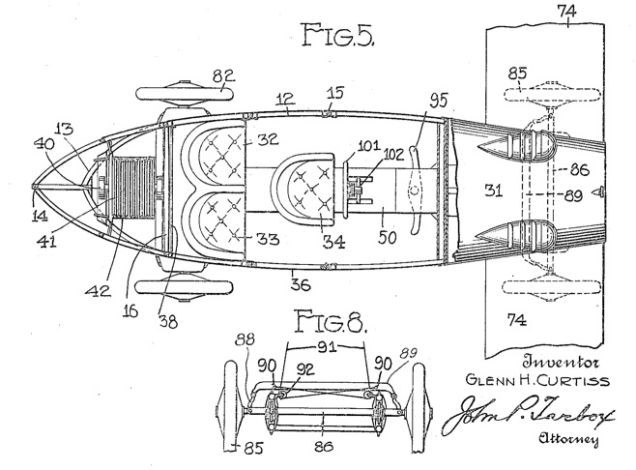
The Curtiss Autoplane offered limousine luxury in its aluminium bodied ‘car’: comfortable leather seats for an aerial chauffeur and two passengers, tasteful trimming in plush brocade, tapestries, even velvet drapes for the celluloid windows. Exactly how its triplane wings and outrigger mounted tail unit detached for road use is not clear, but with a mass of rigging wires needing careful adjustment it can scarcely have been an easy or quick process. The 100 hp Curtiss OXX engine drove a four blade pusher propeller by means of a shaft and chain mechanism. A clutch took care of power transmission to the road wheels.
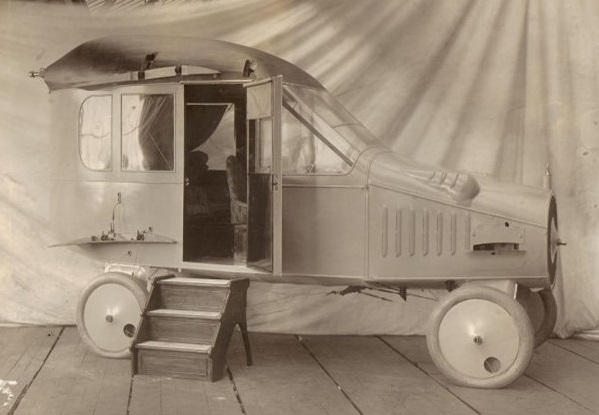
The Curtiss Autoplane was ceremonially unveiled at the New York Pan American Aeronautical Exposition in Grand Central Palace, New York, on 8 February 1917.The machine only flew once or twice from the Atlantic Coast Aeronautical Station at Newport, Rhode Island, before America’s entry into World War I intervened and curtailed further development in favour of weapons of war.
Curtiss F / Alexandria 10
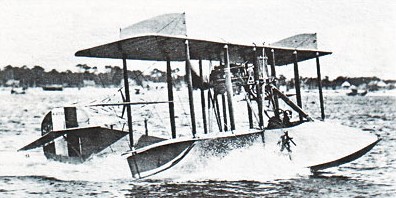
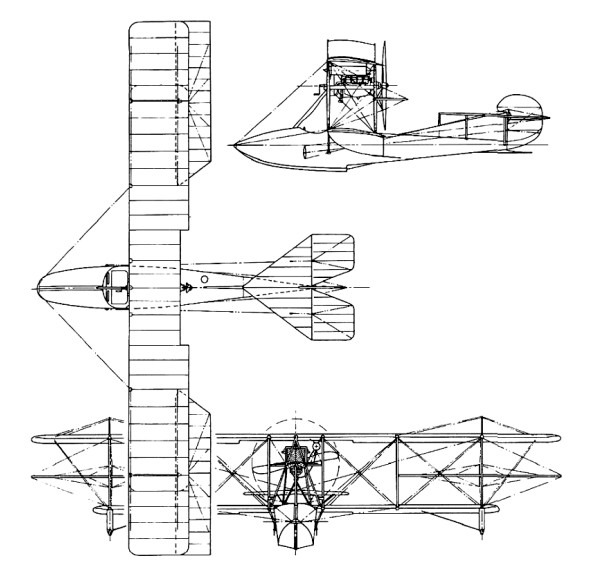
The definitive 1913 Model F was of wooden construction, the two-bay biplane had inter-plane ailerons on each side, fabric-covered wings and tail unit, and a carefully contoured single-step plywood-covered hull which accommodated two side-by-side in a cockpit location just forward of the wings. Power was a 56kW Curtiss O engine driving a pusher propeller. The engine being mounted on struts just below the upper wing centre-section.
The Curtiss F two-seat biplane flying boat became the Army’s first flying boat. This basic design was ordered by the US Navy, and after the United States entered World War I on 6 April 1917 it was adapted as the service’s standard primary training flying-boat, 144 more being ordered. During the war, Curtiss received so many orders for flying boats that he hired Boeing and Loughead (later renamed “Lockheed”) to build them to his specifications.
Alexandria was contracted Curtiss F-boats for USN, as the Alexandria 10, circa 1917. Thirteen were built; A2651 to 2653, A5024, and A5247 to 5256
The F was also sold to several civil owners.
The 1914 version of the Model F had rounded wingtips, a tougher hull and increased strut support for the engine to prevent it collapsing on the crew in the event of a crash.
The 1917-18 version of the Model F eliminated the original shoulder-yoke type aileron control in favour of a more conventional arrangement; and some aircraft had the ailerons transferred to the upper wing from the interplane position, span of the upper wing being extended. Several ambulance conversions flew with provision for a stretcher patient to be carried above the hull behind the cockpit. The more powerful Curtiss OXX-3 engine was fitted from 1917 onwards.
The Model F, particularly in its earlier versions, was sold to a number of foreign navies. Russia obtained a considerable number for operation in the Baltic and Black Seas. The Italians also flew the Model F and eight examples were licence-built by the Zari company at Bovisio.
Engine: 1 x 75kW Curtiss OXX-3 inline piston
Take-off weight: 1116 kg / 2460 lb
Empty weight: 844 kg / 1861 lb
Wingspan: 13.75 m / 45 ft 1 in
Length: 8.48 m / 27 ft 10 in
Height: 3.42 m / 11 ft 3 in
Wing area: 35.95 sq.m / 386.96 sq ft
Max. speed: 110 km/h / 68 mph
Range: 1370 km / 851 miles
Curtiss Hydroaeroplane / C-1 / AB-1
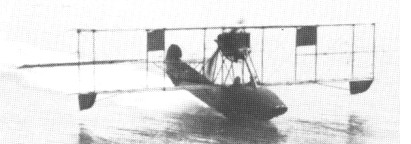
The Curtiss Flying Boat was an early “hydro-aeroplane” or seaplane that was first concept tested by well-known aviator Glenn Curtiss in January 1912 in San Diego. By the end of the same year, Curtiss had built his first successful flying boat at Hammondsport, NY and succeeded in selling the aircraft to the Navy. The Navy first acquired five Curtiss Flying Boats, then an additional 144 for training before the original F type model was supplanted by the MF in 1918.
The C-1, the Navy’s first flying boat, was tested at Hammondsport, N.Y., by Lieutenant T. G. Ellyson on 30 November 1912. Its performance, as informally reported by Ellyson, was: “Circular climb, only one complete circle, 1,575 feet in 14 minutes 30 seconds fully loaded. On glide approximately 5.3 to 1. Speed, eight runs over measured mile, 59.4 miles per hour fully loaded. The endurance test was not made, owing to the fact that the weather has not been favorable, and I did not like to delay any longer.”
The Curtiss C-1 (changed to AB-1 in 1914) made the first catapult launch by a flying boat in December 1912.
On 27 March 1914 the original designations of aircraft were changed to two letters and a number of which the first letter denoted class, the second type within a class, and the number the order in which aircraft within class were acquired. Four classes were set up; A for all heavier-than-air craft, D for airships or dirigibles, B for balloons and K for Kites. Within the A Class, the letters L, H, B, X and C represented land machines, hydroaeroplanes, flying boats, combination land and water machines, and convertibles respectively. Thus the third hydroaeroplane, formerly A-3, became AH-3, and the first flying boat, formerly C-1, became AB-1.
The first Curtiss Flying Boat acquired by the Navy was designated C-1, before it was changed to AB-1 (A for Curtiss and B for flying boat) as the Navy began to procure aircraft from other corporations. The C-1 was based at the Navy Yard in Washington, D.C. in 1912 before moving to Guantanamo Bay, Cuba.

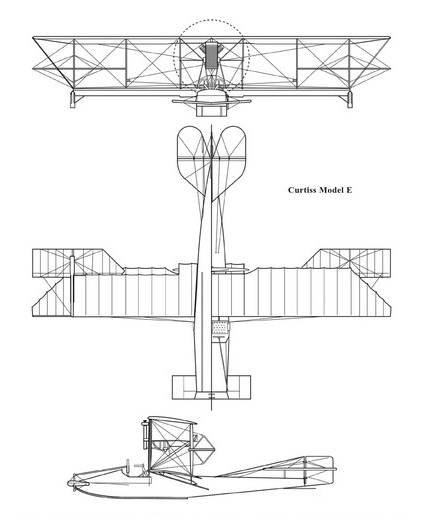
Curtiss Flying Boat Nr.2 / E / Flying Fish
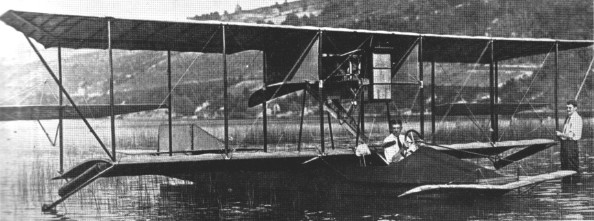
Curtiss left San Diego in the spring of 1912 to return to Hammondsport, where he commenced work on Flying Boat No.2 during the spring of 1912, which, in its original configuration, utilised standard components of the 1911 model E land and hydro (float) plane, including twenty-eight foot, eight inch single surface, equal span wings and a pusher mounted 75 hp Curtiss O V-8 engine. Its flat-bottomed, scow-type hull, unlike Boat No.1, extended all the way aft to support an empennage consisting of a long-chord fin and rudder with cruciform horizontal surfaces. To reduce the danger of sinking after hard landings, the hull was constructed with six watertight compartments.
Initial trials were not successful, as Flying Boat No.2 could not be made to unstick from the water at takeoff speed. After observing numerous attempts, Curtiss modified the hull to incorporate a step just behind the centre of gravity. The step produced a reduction in hydrodynamic drag by lifting almost half of the hull free of the water and increased lift by permitting the nose of the aircraft to be rotated up to a positive angle of attack.
Other changes made included standpipes that bled air into the cavity behind the step, a secondary canard elevator on the nose (later removed due to control problems), and triangular extensions to the upper wing to increase lift.
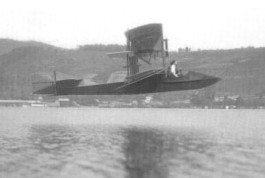
Flown by Glenn Curtiss on 26 January, 1911, the first practical seaplane. By the fall of 1912 Curtiss had made sufficient progress with the design to sell the Navy its first boat-hulled aircraft, entering service in late November as the C-1 (changed to AB-1 in 1914). This aircraft made the first catapult launch by a flying boat in December 1912.

The first seaplane was maneuverable, light, and relatively fast, and was the most widely built type of plane in the United States before World War I.
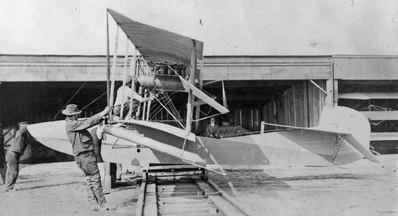
Later model E flying boats featured deepened, V-bottom hulls with a more pronounced step, as well as more powerful engines, a larger rudder, and a diagonal strut in front of the motor mount to prevent the engine from leavin its mounts in hard landings. Besides the Navy’s C-1, a number of E boats were built for the Army and the Curtiss Flying School, plus two or three more to civilian purchasers, one of which was used by Lawrence Sperry during 1944 to conduct the first experiments of an airborne gyroscope.
Lawrence Sperry flew his Curtiss over Paris in 1914 with his hands off the controls and his passenger standing on the wing to prove the efficiency of its automatic pilot.
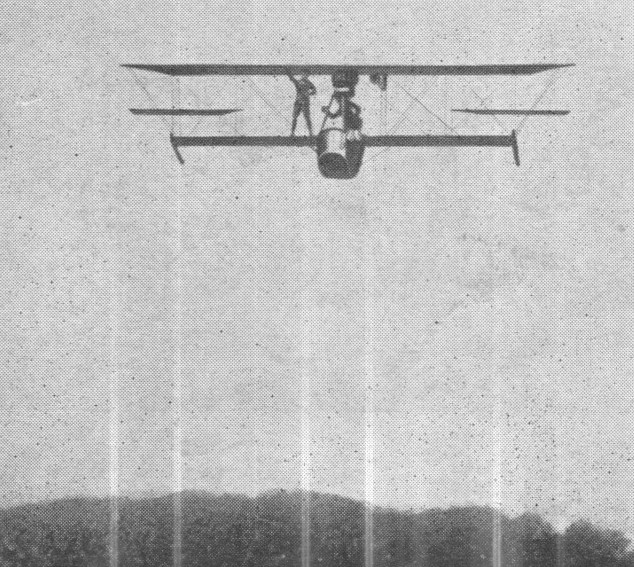
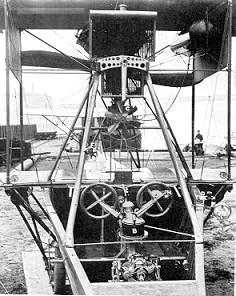
Model E
Engine: 1 x 75-100 hp Curtiss OX
Prop: 2 blade fixed pitch wood
Empty weight: 1490 lb
Take-off weight: 2500 lb
Wingspan: 37 ft 9 in or 40 ft 0 in
Length: 27 ft 2 in
Wing area: 350 sq.ft
Curtiss Flying Boat Nr.1
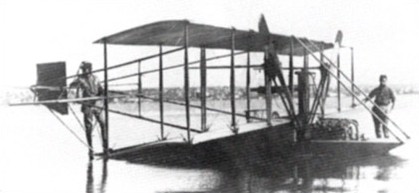
The first Curtiss flying-boat, tried at San Diego on 10 January, 1912, was more a hydro than a true boat. A wide flat-bottomed hull, only slightly longer than the standard Curtiss pontoon, was attached under the lower wing of the de-engined airframe of the tractor seaplane with Type D wings and tailplane. A single 60hp engine was mounted in the hull and drove two tractor propellers through chains in Curtiss’s only deliberate adaptation of a Wright brothers’ feature. There were two side-by-side seats in a cockpit behind the wing. Although No.1 was unable to take off, the experiment did indicate that the flying-boat concept was practicable. Subsequent developments were made at Hammondsport.
 All Aero