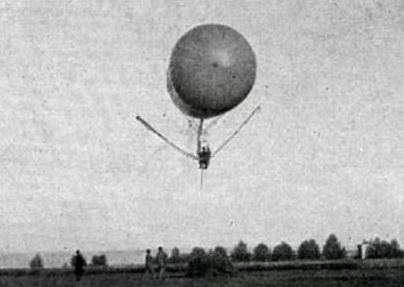
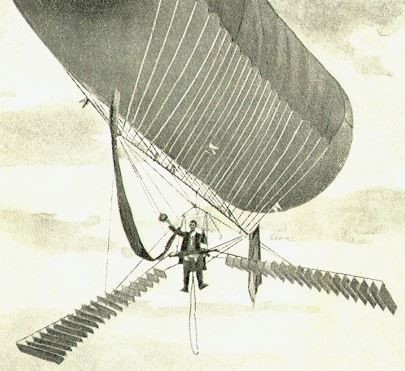
The second man-powered airship constructed by Dr. Konstantin I. Danilewsky of Charkov, Russia (now Ukraine). Supported by industrialist A. A. Pilstrem, and flown by the 20-year old engineer-aeronaut Peter Koziakov it made its first ascent on 18 June 1898. It was controlled by fans, or wings, up to 16′ 4″ long, which could be opened over an arc of 90 degrees. It was trial-flown with some success, making several ascents in alternate configurations, and demonstrated before a Russian board of inspection on 15 August 1898.
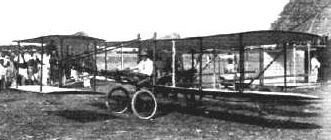
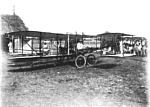
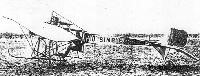
Giacomo D’Angelis, a confectioner from Messina, Italy, arrived in Madras in 1880. He ran a flourishing confectionery business, and in due course of time established Hotel D’Angelis, Madras’s finest hotel of the time, in Mount Road. Inspired by Frenchman Louise Bleriot’s flight across the English Channel in 1909, D’Angelis built a biplane, with the help of Simpson’s, entirely from his own designs. The airplane was powered by a small 12 horse-power engine. He tested his aeroplane at Pallavaram, and then arranged for a public viewing, for a fee, in March 1910. D’Angelis made the first public flight on March 26, 1910 from Island Grounds. Clearly, Madras pioneered the first flight in India, and may be in Asia as well. Subramania Bharati wrote in 1910 about the plane that was built by Tamil workers in the workshop of Simpson’s. Then, in 1914, J W Madley, the civil engineer who built Madras’s water supply system, assembled an aeroplane and flew from Island Grounds over the Red Hills water reservoir to make an aerial assessment with photographs.
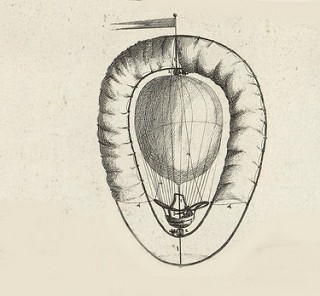
This balloon was most often called the Ballon de Franconville, and was credited to the Comte d’Albon. It was 24 feet high and 16 feet in diameter and had an annular sail that followed the profile of the balloon and was used for steering. This arrangement was used on the balloon when it took off on 16 January 1784 from the gardens of Madame Countesse d’Albon. It was found the 21st of the same month at Montmorency.
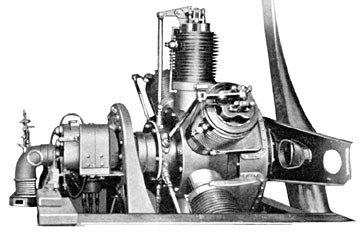
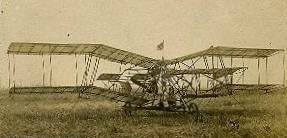
The 1909 Daimler Lutskoy No. 1 monoplane was the largest aircraft built and flown in 1909. Designed by B. G. Lutskoy (Russian) and built by Daimler (Germany) it featured one nose propeller driven by one engine and two wing-mounted propellers driven by another engine.
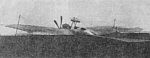
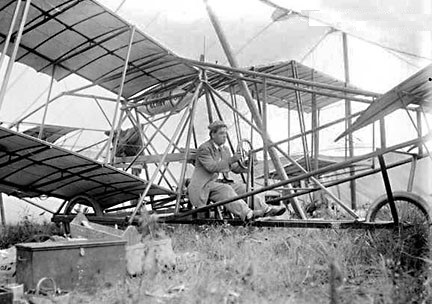
The Daily ‘Old Glory’ built in 1910 in Chicago, Illinois, was an early “gull-wing” aircraft built for entry in one of the popular local air meets. The ship was motorless at the time of the photo.
The machine had the name “Old Glory” painted on the petrol tank that was mounted under the center of the drop in the upper wing. Although apparently built to completion, it is doubtful the machine was ever flown.
 All Aero