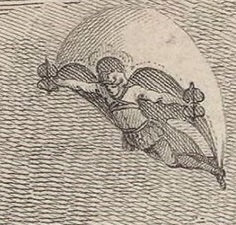
de Saint-André Aerostatic Cloak

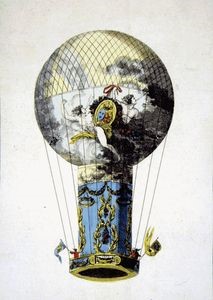
The 1784 “Aerostatic Cloak” of Thibaut de Saint-André (France) parachute-like cloak, was aerodynamic rather than aerostatic, was invented only one year after the first successful balloon flight. It was intended for flying from balloons or other flying ships. The brave pilots would have worn life vests (invented only in 1775) for landing in water and been equipped with a compass and with paddle-like hand-held wings for control. Tickets were sold to a test of the devices, but nothing is known of the results.

de Rozier Rozière

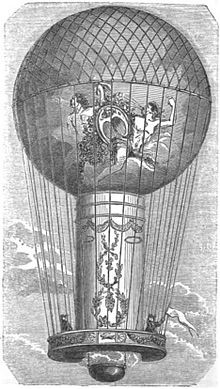
Pilátre de Rozier considered it unthinkable that a criminal should gain the honour of being the first airman, volunteered to make the ascent himself; and on 15 October 1783 he rose to about 80 feet in a captive balloon with a capacity of 60,000 cu.ft.

On 21 November he completed the first aerial voyage in history, with the Marquis d’Arlandes, by flying 5.5 miles across Paris at a height of 3,000 feet, from the Cháteau de la Muette. The 25 minute flight was not without hazard, for the balloon kept inflated by means of a brazier slung underneath its neck, and the airmen had a hectic time putting out fires on the fabric with a sponge and water they had taken with them.

De Rozier’s plan was an attempt to cross the English Channel from France to England. A Montgolfier balloon would not be up to the task, requiring large stocks of fuel for the hot air, so his balloon, the Rozière balloon, was a combination hydrogen and hot air balloon. It was prepared in the autumn of 1784, but the attempt was not launched until after another Frenchman, Jean-Pierre Blanchard, and American companion, Dr John Jeffries, flew across the English Channel in a hydrogen gas balloon on 7 January 1785, from England to France.

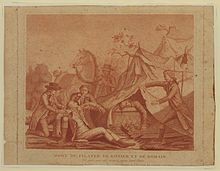
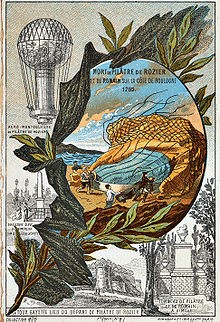
Despite several attempts, De Rozier and his companion, Pierre Romain, were not able to set off from Boulogne-sur-Mer until 15 June 1785. After making some progress, a change of wind direction pushed them back over land some 5 km from their starting point. According to contemporary accounts, the balloon caught fire in midair before suddenly deflating and crashing near Wimereux in the Pas-de-Calais, from an estimated height of 450 m (1,500 feet). Both occupants were killed.

Fatal accident at Wimereux, 15 June 1785.

Eight days later his former fiancée died, possibly having committed suicide. A commemorative obelisk was later erected at the site of the crash. The King had a medal struck, and gave his family a pension.

The modern hybrid gas and hot air balloon is named the Rozière balloon after his pioneering design.

Deaths of Rozier and Romain.

de Rozier, Jean-François Pilâtre

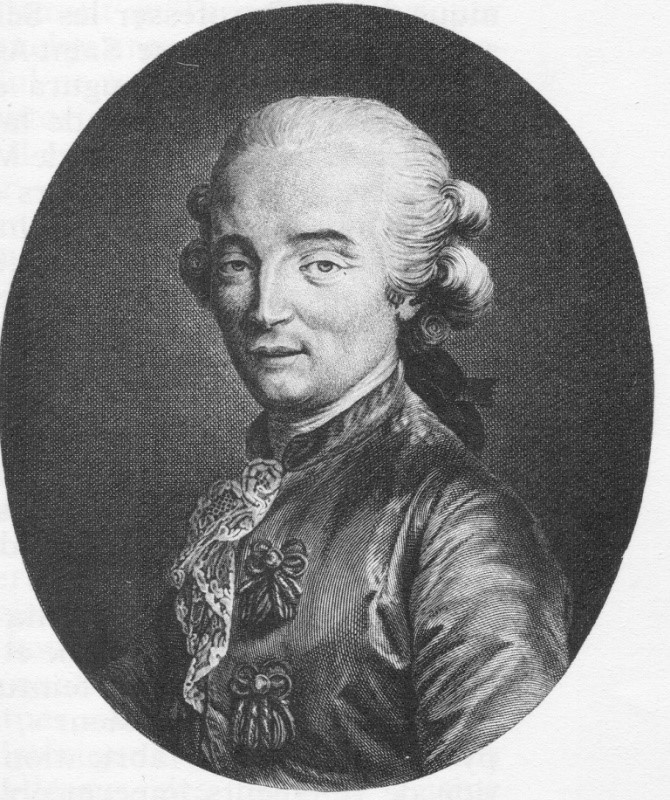
Jean-François Pilâtre de Rozier was born in Metz, Lorraine on March 30th, 1754, the third son of Magdeleine Wilmard and Mathurin Pilastre.

His interests in the chemistry of drugs had been awakened in the military hospital of Metz, an important garrison town on the border of France. He made his way to Paris at the age of 18, then taught physics and chemistry at the Academy in Reims, which brought him to the attention of the Comte de Provence, brother of King Louis XVI.

He returned to Paris, where he was put in charge of Monsieur’s cabinet of natural history and made a valet de chambre to Monsieur’s wife, Madame, which brought him his ennobled name, Pilâtre de Rozier. He opened his own museum in the Marais quarter of Paris on 11 December 1781, where he undertook experiments in physics, and provided demonstrations to nobles. He researched the new field of gases, and invented a respirator.

In June 1783, he witnessed the first public demonstration of a balloon by the Montgolfier brothers. On 19 September, he assisted with the untethered flight of a sheep, a cockerel and a duck from the front courtyard of the Palace of Versailles.

He is the first man who had the courage to fly in the airs on board an astonishing machine, manufactured only a couple of months prior by Etienne and Joseph Montgolfier (two brothers from Annonay – Ardeche). After the first test without basket and passengers and then the complementary flight with animals, the King Louis XVI didn’t want to kill one of his subjects and wished to send convicts instead.

Along with Joseph Montgolfier, he was one of six passengers on a second flight on 19 January 1784, with a huge Montgolfier balloon Le Flesselles launched from Lyon. Four French nobles paid for the trip, including a prince.

Pilâtre de Rozier, a freemason, friend of Benjamin Franklin, Lafayette and other decision makers, had just created a Sciences Museum in Paris. Surprised and interested, the King’s court accepted Jean-François’ project and gave him the possibility to be the first to fly. During several weeks, he modified and tested the balloon, then flew with the “Marquis d’ Arlandes” on November 21st, 1783. He carried out the first world record of distance, altitude and duration. His fame soon exceeded France and extended to the whole world. The Man achieved his dream: to fly in the air. Pilâtre de Rozier invented the first gas mask, the matches and many other inventions, but he continued his experiments in ballooning. He manufactured “La Rozière”, combination between a hot air balloon and a gas balloon (hydrogen) which had just been set up by the physicist Charles. He also risked himself while researching the flammability of hydrogen: in “A Short History of Nearly Everything”, Bill Bryson writes “In France, a chemist named Pilatre de Rozier tested the flammability of hydrogen by gulping a mouthful and blowing across an open flame, proving at a stroke that hydrogen is indeed explosively combustible and that eyebrows are not necessarily a permanent feature of one’s face.”

His 3rd flight would kill him. He intended to fly from France to England on June 15th, 1785, but the machine wasn’t ready. He died at Wimille, on the French coast, aged 31, with his unfortunate flight companion Pierre Ange Romain, crushed on the ground after a vertiginous fall. Physicist chemist, he was also the creator of a new museum (a kind of “Conservatory of Arts and Crafts). He was also the first air victim and the spiritual father of generations which have succeeded him on board hot air balloons, gas balloons and “Rozières”. It’s with a “rozière” that Bertrand Piccard and Brian Jones accomplished a round the world tour in March 1999, so did Steve Fossett a few years later.
d’Equevilley-Montjustin 1908 Multiplane

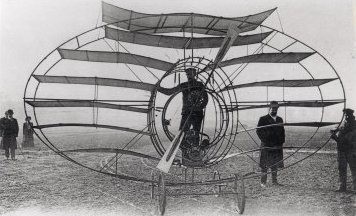
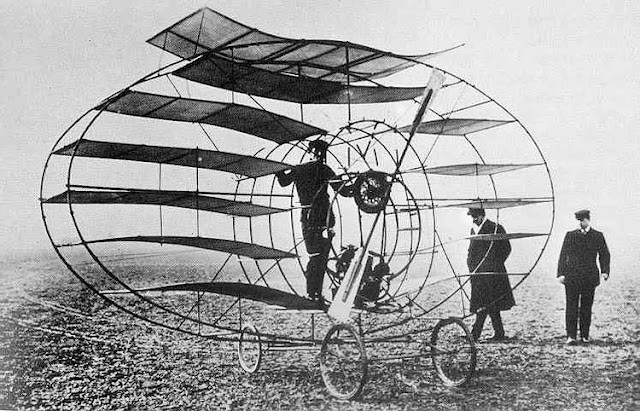
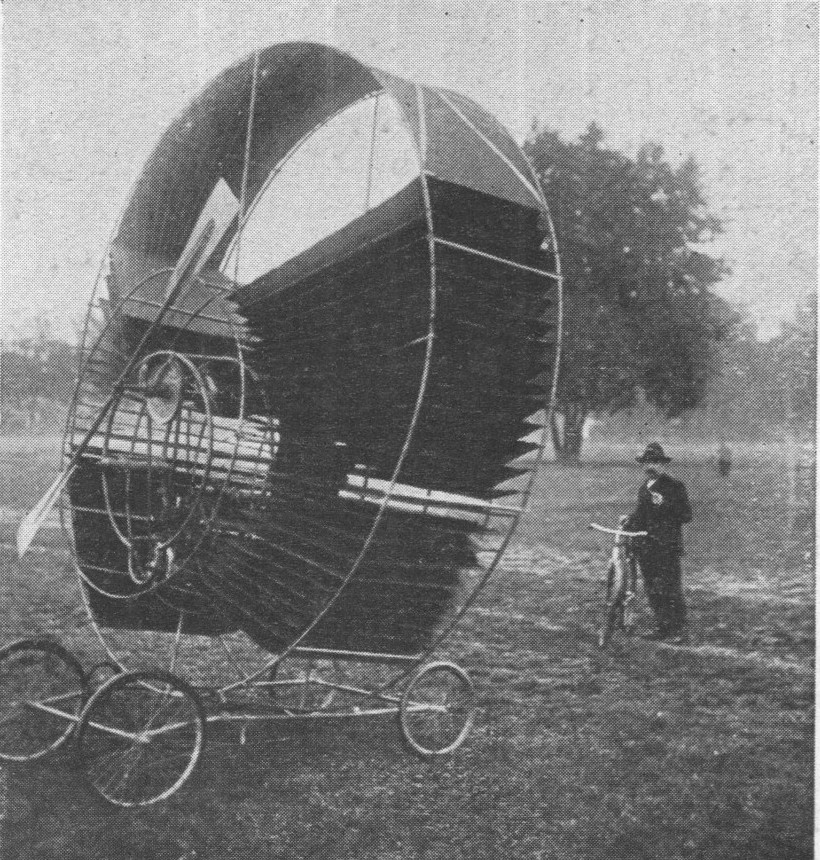
A 1908 patented multi-wing machine design by Raymond d’Equevilley-Montjustin – otherwise known as the Marquis d’Equevilley – very characteristic in its circular hoop construction and several levels of planes. The pilot was to stand in flight and direct the machine by leaning his body to the left or right, and although the machine was continuously developed adding or diminishing the number of “wings”, it failed to ever leave the ground. D’Equevilley, a quite capable engineer and designer, had nearly fifty patents to his name, and is often credited as the person who perfected the snorkel that is used on submarines.

1908
Marquis d’Equevilley’s 12hp flying machine

de Puiseux Aéro-Cycle No. 5 La Mouche

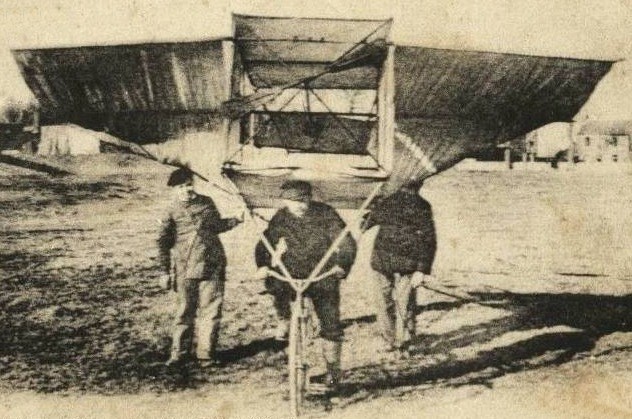
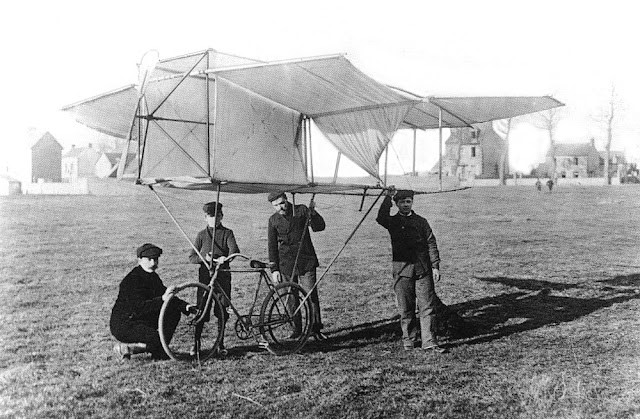
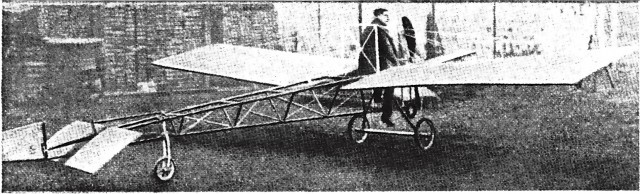
This was the ultimate development of Comte Gustave de Puiseux’s ambitions of 1911/1912 to create a successful human-powered airplane. At least one source quoted that it flew 16 meters. The machine, which had a wing span of some 6,5 m and a length of 5.5 m had a tractor propeller driven by the human cyclist, pedalling via chains. It is unlikely that a powered version was ever made, since this was more work than just installing an engine and the Count had no experience with engines.