Deutsche Flugzeubu-Werke GmbH / DFW was formed by Bernard Meyer at Lindenthal, Leipzig, in 1910, it built Maurice Farman biplanes under license and produced its own Mars biplane and a copy of the Jeannin Taube and Etrich Stahl-taube in 1914. During the war the DFW B series (unarmed) and C (armed) two-seaters were well known, the C V in particular being license-built also by Aviatik and Halberstadt. In 1916 DFW produced the R.I. and R.ll giant bombers, very clean designs with engines in the fuselage. Planned civil development of these after the war had to be abandoned and they were scrapped, but civil conversions of C types were built. The company built no aircraft after 1920, amalgamating with Allegemeine Transportanlagen Gesellschaft Maschinenbau (ATG).
ATG joined Siebel in 1945 to become Siebel ATG (SIAT).
Pioneers
Detroit Aeroplane Co Airmotor
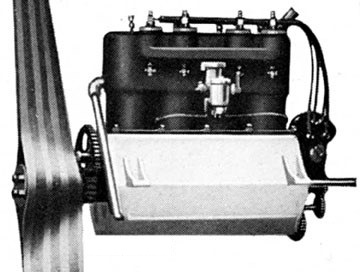
The 1910 Aeromotor aero engine was in two versions. A four-cylinder inline water cooled producing 60-75hp. And a six-cylinder experimental 6-cyliner liquid-cooled.
Detroit Aeroplane Co Aero / O-240
The 1910 Detroit Aeroplane Co Aero / O-240 was a two cylinder, horizontally opposed, air cooled aero engine. Designed by Fred Weinberg, it produced 20-30hp@1500rpm from 237.48ci.
Detroit Aeroplane Co 1910 Monoplane / Miss Detroit
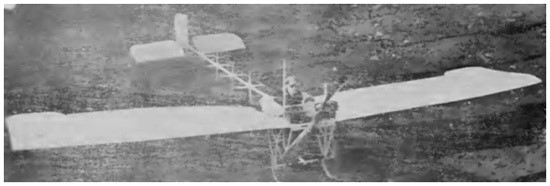
The Detroit Aeroplane Co. displayed a monoplane fitted with the company’s two-cylinder opposed 30 hp engine at the 1910 Philadelphia show, where it was “the hit of the show”. Two of them were sold, one to Atlantic City, where a training school is to be started next summer. It had a main plane with a span of 30 ft and an area 150 sq. ft. Stability was achieved by an arrangement where “the extremities of the wings sections have been cut out and hinged to the rear lateral beam. These float in the air stream in flight, being depressed individually through their attachment to the steering column”, i.e. ailerons… The fuselage was a single seamless steel tube of large diameter, braced with wires over cruciform horizontal and vertical masts.
Detroit Aeroplane Co
74 Crane Ave
Detroit MI
USA
Detroit Mfrs Syndicate.
Desusclade 1910 monoplane
The 1910 Desusclade monoplane was designed and built by Desusclade in France.
Span: 32’2″
de Souza Cruzeiro
In Belém, a city located in northern Brazil, Júlio Cesar Ribeiro de Souza created a workshop to produce hydrogen gas for the machines that he invented. Júlio finally succeeded with his dream of pursuing air navigation with the flight of another dirigible, called Cruzeiro, in 1886 in Paris.
de Souza, Júlio Cesar Ribeiro
In 1875, Júlio Cesar Ribeiro de Souza, born in Belém, a city located in northern Brazil, started some research in aeronautics because he was impressed with the flight of certain native birds of the Amazon rain forest. he moved to Rio de Janeiro, where he published works on air navigation and presented talks on this subject to the Instituto Politécnico, an engineering faculty. he designed a dirigible, which was christened Victória after his wife. after obtaining part of the funding in Brazil, the device was constructed in Paris. attempts to place the device airborne failed both in France and in Brazil.
de Silva 1909 biplane
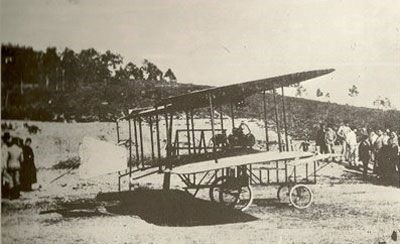
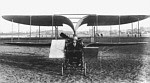
This canard biplane, a creation of inventor Abeillard Gomes da Silva, was tested at Tancos, Portugal in 1910. Several unsuccessful take-off attempts were made, before the craft was damaged and then abandoned. It had a wingspan of 6.75 m, weighed 185 kg and was powered by a 28 hp Anzani.
Descamps
France
Elysee Alfred Descamps designed a machine gun-armed fighter in 1913, but this was not put into production. For a time he worked with Aviatik at Mulhouse, then went to Russia in 1914 to become chief engineer to Anatra. After the revolution he returned to France and built several fighter and bomber prototypes. In 1923-1924 he was carrying out experimental work for the French government.
 All Aero