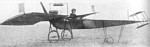
In 1911 H. S. Dixon built a 25 hp canard called the Dixon Nipper. The original Nipper was wrecked, which is hardly surprising, for it had no lateral control and the canard elevator was hinged along its trailing edge, so that any control input would have led to full deflec¬tion of the surface.
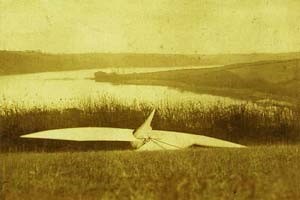
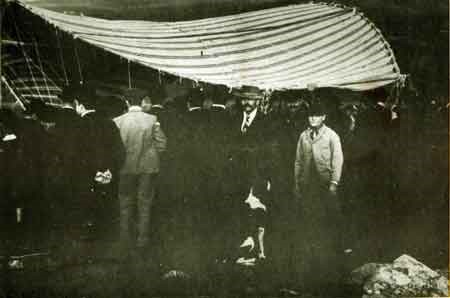
Designed and built by the Swiss engineer Albert Liwentaal while he was living in Devon, England, the Dittisham Aerostat of 1894 glider was tested twice, and crashed twice. The photograph, the image appearing to have been printed backwards, shows the result of the final trial, which took place near Bozomzeal, above Dittisham, Devon, along the River Dart.
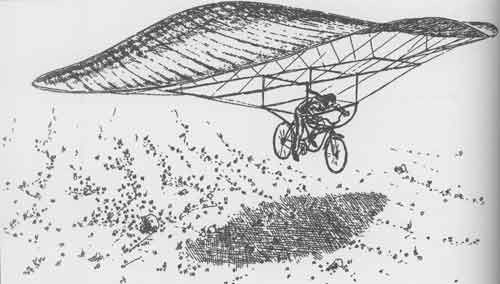
Guido Dinelli, an Italian shoemaker, was the second person in South America who is known to have made a gliding flight, while Pablo Suarez is believed to have been the first to do so. Both gliding flights took place at Tandil, Argentina, from atop Garibaldi Hill. Dinelli’s flight, on May 25, 1904, was made with a glider which he designed in late 1903. The glide was remarkable, covering 590 feet… a considerable distance.
Dinelli and his “Aereoplano apparatus” weighed a combined total of 211 pounds and was controlled by a number of ropes pulled by the operator. The glider, constructed of steam-bent spruce covered with cotton fabric, apparently was attached to a bicycle. Dinelli seems to have garnered some construction advice from Frank Brown, an English clown with the Carlo Brothers Circus. The wing was arranged to tilt (in order to vary the angle of incidence) so Dinelli could choose when to gain lift. He pedaled the bicycle to gain speed and then tilted the wing to lift just as he left the edge of Garibaldi Hill, timed to take advantage of an updraft. Dinelli’s glide, apparently his last, ended with damage to his glider and bruises to himself.
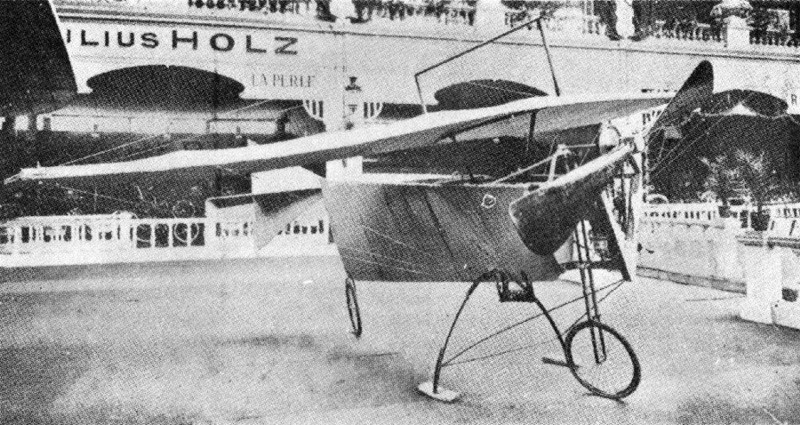
Displayed in the 1910 Brussels salon, the D’Hespel monoplane had a short boat-like fuselage suspended pendulum-like from a one-piece wing. Two-cylinder air-cooled engine, universally-articulated tail.
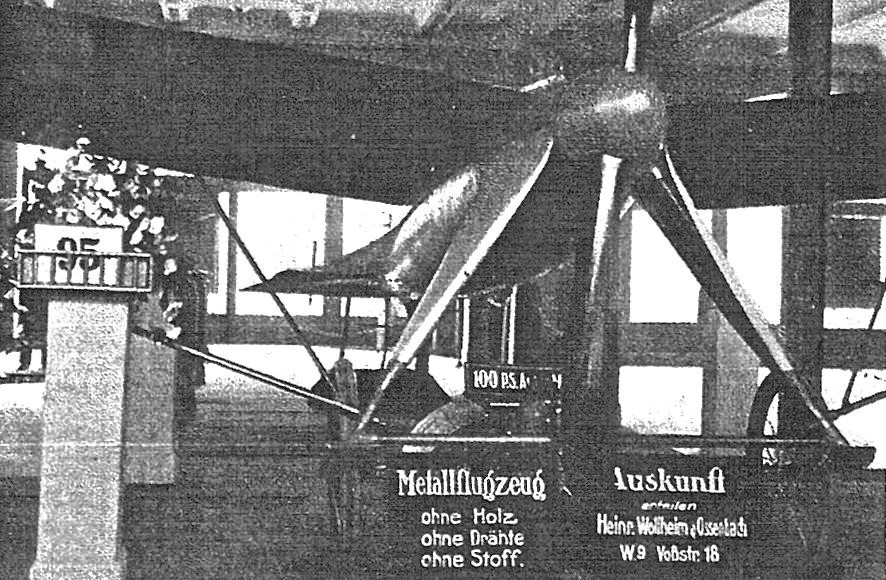
A streamlined monoplane, built of and entirely covered with aluminium by Dr. Fritz Huth’s Deutsche Flugwerft of Johannisthal, Berlin. It was displayed at the 1912 A.L.A. in Berlin, but the displayed machine, powered by an 100 hp Argus, was probably not airworthy and nothing is known about any flights.
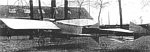
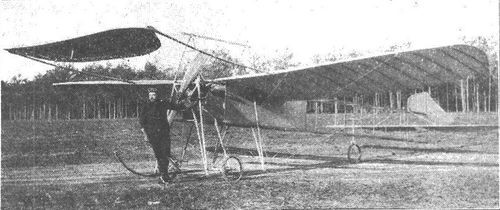
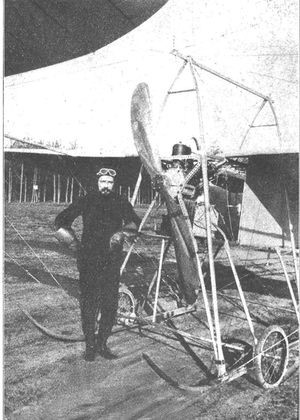
DFG Hintner Eindecker of 1910 was a monoplane drawn up by the Cornelius Hintner – a successful Austrian artist who later became famous as a film director – realized by the German firm of Deutsche-Flugmaschinenbau-GmbH.
The Hintner Eindecker was special in that the elevator was mounted in front of the tractor propeller. Power was supplied by a 25 hp Anzani 3-cylinder radial driving a Chauvière propeller. The wing area was about 30 m², where total weight (inclusive the pilot) was 280 kg.
During the first test flight the machine flew for 500 meters at a height of 25 meters, most likely only in a straight line. The machine lifted after a run of only 25 to 30 meters.
When Hintner flew his Eindecker he had no licence and almost certainly no flying experience whatsoever. He later received German flying licence No.110 on September 9, 1911 flying an Albatros biplane at Berlin.
 All Aero