Stefan Drzewiecki (1844-1938) was a World-renowned scientist and inventor, credited with – among others – designing kilometric counter for cabs (1867), automatic railway coupler (1872), device plotting ship’s course on map (1872), first submarine using a periscope (1877) and first one with electric propulsion (1888). From 1877 Russian Navy built 50 small submarines of Drzewiecki’s design. In 1901 navies of Russia and France introduced torpedo launchers operating on pressurized air designed by Drzewiecki. In 1892 he wrote (in France) theoretical work regarding scientific methods of manufacture of ship (and plane) propellers and in 1920 presented a general theory for screw-propeller thrust (which in turn led to creation of propellers with adjustable blades).
Pioneers
Druiff-Neate Cycloplane
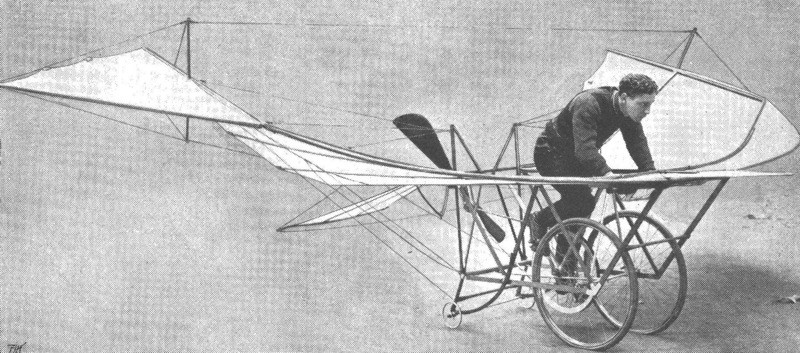
Built by Messrs. C.G. Spencer & Co. of Highbury, N London in 1909, the machine was pedal powered driving a 4ft pusher propeller, although the fitting of a motor was contemplated
Drewet 1909 glider
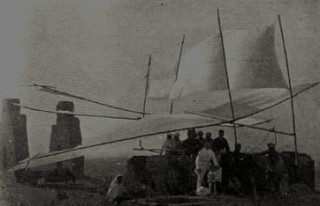
Oliver H. Drewet (or Drewett, but definitely not Drewer) returned to Asansol, India to work as an engineer. It was there that he built his glider, based on a model that he had built before moving to India. A test flight, claimed to be the first in India, was made on 1 March 1909, down an inclined railway, on top of a truck. After 100 yards the machine left the truck with Drewet on board, and flew a distance of 20 yards before crashing.
Drewet, Oliver
Oliver H. Drewet (or Drewett, but definitely not Drewer) was born in Bombay, India in 1880 to European parents, who eventually settled in New Zealand in 1884. He returned to Asansol, India to work as an engineer. It was there that he built his glider.
When war broke out, Drewet joined the army as part of the New Zealand Expeditionary Force and was killed in action on 8 May, 1915 at Gapa Tepe, on the Gallipoli peninsula in Turkey.
du Breuil 1911 monoplanes
During 1911 Marquis Picat du Breuil designed three monoplanes, built by Pouvarel in France.
No.3
Span: 29’4″
Length: 39’4″
Douseler 1909 4-cylinder
Dousler built/convert a 40hp 4-cyl water-cooled aero engine used in his plane by Douseler at the Dominguez Hills air meet.
Douglas Flying Club Glider / Flyer / Bomber
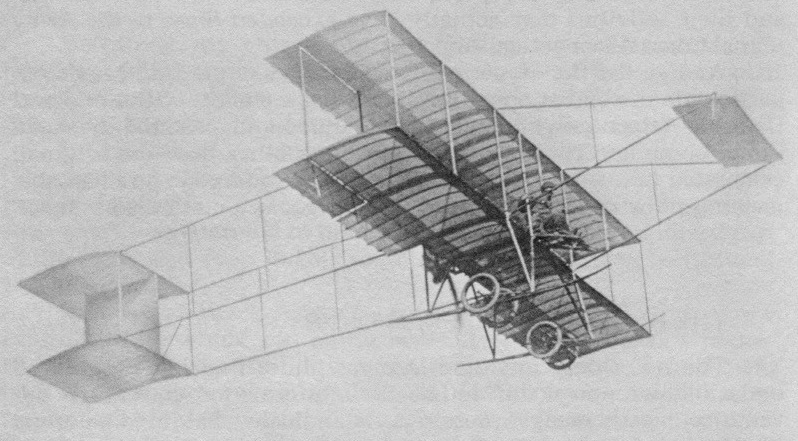
In 1908 there was a group of eight to nine different people in town known as the Douglas flying club, Arizona … and these people built what was known as the Douglas Glider.
The members of the Douglas flying club were A.M. Williams, John C. Wright, Judge Forte, Ben Goodsell, Felipe Mazon, Ted Bowden, Charles M. Ford and Sparks Y. Faucet.
The glider was built in downtown Douglas and flown off of 15th Street between A and Washington Ave. It’s made most of rattan and bamboo, and metal fittings and fabric that covers over the wings.
Initially, to get the glider off the ground, horses would be attached a hitch on the front of the glider that was then attached to harnesses. The horses would then start running and as the glider began to lift off the ground the hitch would come free from the harnesses. It didn’t fly very far but it did get off the ground.
They had people there watching them do this and after they were done they would pass the hat and people would contribute a little money to it and if they had enough money they would make another run.
That evolved into an airplane when they hung a motor on it and put a propeller on the motor and then put wheels on the glider making it an airplane.
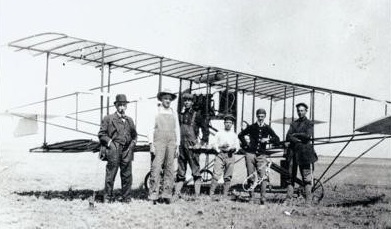
Following 1908 modifications were made to the Douglas Glider, Schultz said. It would later change its name to the Douglas Flyer then The Douglas Bomber and be used in the Border War from 1910-20.
Estimated wing span: 30 feet
Estimated length: 20 feet
Douglas Bearcat
Little is known of the early Douglas Bearcat aero engine that produced 70hp. It was possibly a modified Ford model A engine.
Dottori 1909 biplane
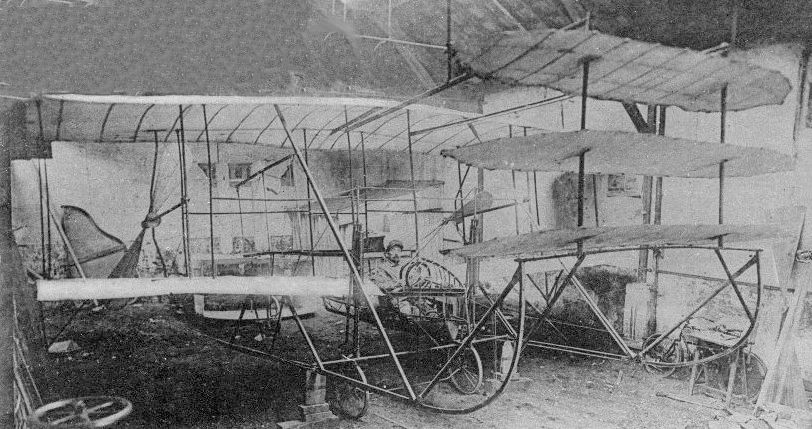
This somewhat complicated twin-propeller pusher with a span of 12 m and a length of 11 m was designed by Charles-Albert Dottori, who was granted a French patent for “Appareil de direction et de stabilisation pour aéroplanes” on April 16th, 1909. The machine was tested on the ground at Port-Aviation by Edmond Jean Eugène Pouvarel, who had built its 50 hp engine. It was destroyed by fire on the night of December 18th, 1909, before making any flights.
Span: 39’4″
Length: 36’1″
Dorner 1911 Eindecker / T.II / T.III
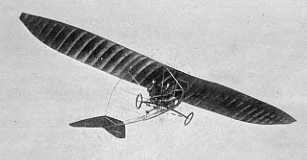
The Dorner monoplane was a well-known sight around Johannistahl. Georg Schendel set a German record for altitude of 2010 meters on 6 June, 1911, and a World Altitude record with passenger, of 1690 meters on 9 June, 1911, in his Dorner.
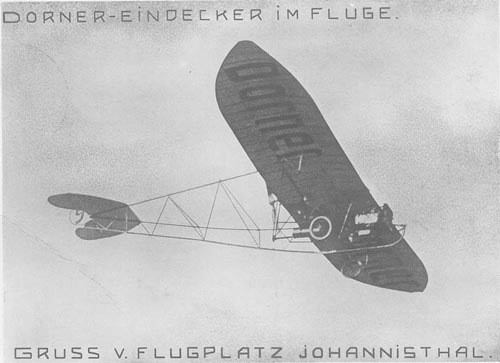
Type II had a 20 hp Dorner-Motor and cost 13,500 Marks.
Type III came with a 40 hp Dorner-Motor at 15,500 Marks, or 50 hp at 16,500 Marks.
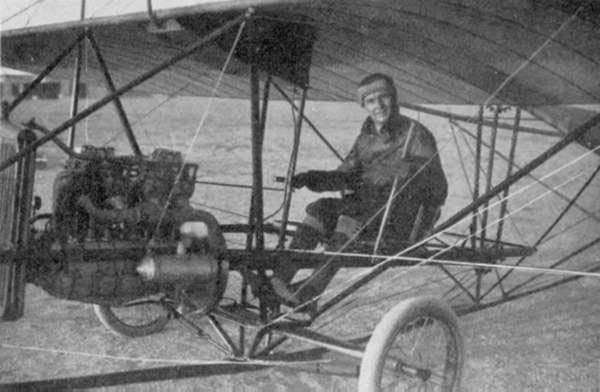
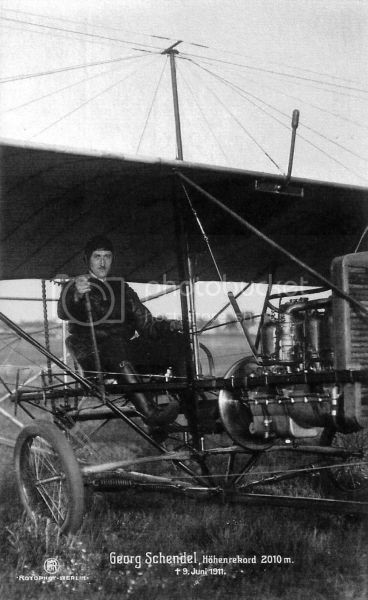
Dorner had entered the T III with 40 hp Körting at the “Zuverlässigkeitsflug am Oberrhein” in April/May 1911, where his light monoplane still was underpowered and could not complete a single stage.
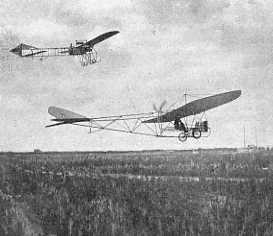
The T. III version had a fatal accident for both passenger and pilot on 9 June, 1911 at Johannistahl.
Variation:
Werntgen Wassereindecker
 All Aero