A two-cylinder horizontally opposed engine, rated 37.5 h.p. at 1000 r.p.m., was built with an unusually long stroke. The bore was 110 mm. (4.33 in.), the stroke 300 mm, (11.81 in.), and the total displacement 349.4 cu. in. The dry weight was stated to be 200 lbs., or 5.9 lbs. per rated h.p.
Pioneers
Duthiel-Chalmers 24 hp
A two-cylinder Duthiel-Chalmers horizontal engine, rated 24 h.p. at 1200 r.p.m., had a 128 mm. (5,04 in.) bore, 130 mm. (5.12 in.) stroke, and a total displacement of 204.28 cu, in. This engine was said to weigh 132 lbs., or 5.5 lbs. per rated h.p.
Cylindrical sleeve valves in the cylinder head were operated mechanically. The cylinders were held by long studs passing through clamps over the cylinder head.
The water outlet and the spark plugs were located on top of the cylinder and the water inlet underneath. The crankshaft was fitted with a wire spoked flywheel, and the pistons were lubricated by special oil feeds run to the cylinder.
Duthiel-Chalmers
The Duthiel-Chalmers engines were early French designs, in which the cylinders were all arranged horizontally.
Except for the first 20-h.p. air-cooled two-cylinder model used in Santos-Dumont’s Demoiselle, all of the later engines were water-cooled.
A series of Duthiel-Chalmers horizontal engines of two, four, and six cylinders and rated at 20, 40 and 60 h.p., respectively, were built with 125 mm. (4.92 in.) bore and 120 mm. (4.72 in.) stroke. The 20-h.p. engine, of 179.52 cu. in. total displacement, was said to weigh 165 lbs., or 8.25 lbs. per rated h.p. The four-cylinder 40-h.p. model had 359.04 cu. in. total displacement and weighed 264 lbs., or 6.6 lbs. per rated h.p. The six-cylinder engine of 538.56 cu. in. total displacement weighed 374 lbs., or 6.23 lbs. per rated h.p.
An interesting feature of these engines was the two spark plugs located in a valve. Either of the spark plugs could be removed while the engine was running by turning the internal tapered plug.
du Temple 1874 Monoplane / du Temple Canot planeur

The du Temple Monoplane “Canot planeur” of 1874 might have been realized by Félix du Temple de la Croix (1823-1890) from his 1857 patent. The du Temple Monoplane was a steam-powered aircraft made of aluminium, built in Brest, France, by naval officer Félix du Temple.
The aircraft used a very compact, high-speed circulation steam engine for which Félix du Temple applied for a patent on 28 April 1876. The engine used very small pipes packed together to obtain the highest possible contact surface for the smallest possible volume.
When he began with the aid of his brother, M. Louis du Temple, to experiment on a large scale, the inadequacy of all motors then known became apparent. They first tried steam at very high pressures, then a hot-air engine, and finally built and patented, in 1876 a very light steam boiler weighing from 39 to 44 lb. to the horse power, which appears to have been the prototype of some of the light boilers which have since been constructed. It consisted in a series of very thin tubes less than 1/8 in. in internal diameter, through which water circulated very rapidly, and was flashed into steam by the surrounding flame.
This type of boiler, which boils the water instantly, has come to be known as a flash boiler. The engine design was later adopted by the French Navy for the propulsion of the first French torpedo boats.
Variously reported as steam powered or powered by a hot-air engine; fitted with a propeller of 12 blades or 6 blades or even 8 blades; and the undercarriage sometimes claimed as “retracting”.
A flight of the full-scale machine was attempted in 1874 in Brest, where it was launched from a ramp. Several trials were made with the aircraft, and it is generally recognized that it achieved lift-off – described by Dollfus as “short hop or leap” and in Flight International as “staggered briefly into the air” – (from a combination of its own power and running down an inclined ramp), glided for a short time and returned safely to the ground, making it the first successful powered flight in history though not the first self-powered one. Flight was not attained as the machine swiftly hit the ground and rolled over. Reports on who was in the pilot’s seat is given that du Temple at the controls – or, in other reports – a “young sailor” was the pilot.
Félix du Temple had been the first to build a heavier-than-air model (weight 700 g), which flew and landed safely in 1857.
It had a wingspan of 13 m (43 ft) and weighed 80 kg (180 lb) without the pilot.
Duryea-Turnbull OL-185
The 1905 Duryea-Turnbull OL-185 was a two-cylinder, horizontally opposed, air-cooled aero engine. Producing 16hp from 184.8ci and a dry weight of 120 lb, it was built for Canadian pioneer aviator W Rupert Turnbull.
Duryea-Turnbull
(Charles E) Duryea Power Co
Reading PA.
USA
In 1905 Duryea-Turnbull built the OL-185 for W Rupert Turnbull.
du Réau 1908 Monoplane
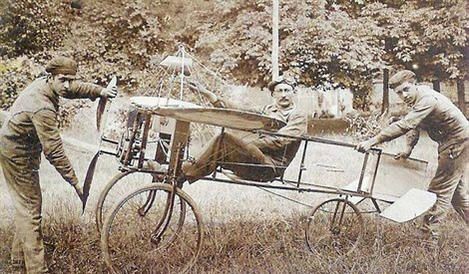
The du Réau Monoplane of 1908 was designed and built using bicycle tubing by du Réau near Angers, France and tested unsuccessfully by Ernest Clairouin.
de Lome 1872 dirigible
In 1872 Frenchman Henri Dupuy de Lome built a dirigible that relied on human muscle power to spin the propeller.
Dunne-Huntington 1910 triplane
The Dunne Huntington is variously described as a monoplane, biplane or triplane. The basic design was by Dunne in 1907-1908. The drawings were completed by Professor Huntington. The design was built by Short brothers. The machine was a good flyer as it continued flying till at least April 1913. During its time it was modified several times.
Span: 59′
Length: 50′
Dunne D.8
Unfortunately, by that time the War Office decided that it had spent far too much on experiments with aeroplanes a total of about £2,500, at a time when Germany was devoting £400.000 a year to military flying and Dunne lost his official support.
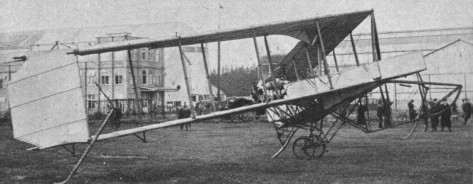
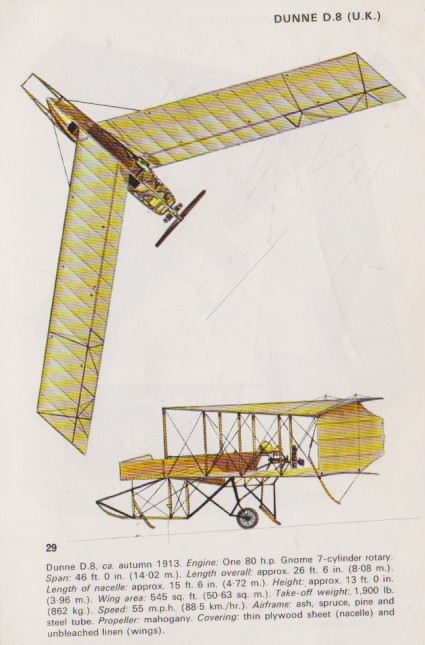
Dunne’s final designs were built during 1911 1912. When the Dunne D.5 crashed in 1911 it was rebuilt as the D.8. Reverting to the biplane con¬figuration he rebuilt the D.5 with a 4-cylinder, 60 hp Green engine and dual controls. It was a tailless four bay unstaggered biplane with its wings swept at 32°. The washout on tips well behind the centre of gravity provided longitudinal stability in the same way as a conventional tailplane. Wing tip elevons were used for control, operated by a pair of levers, one either side of the pilot. It was powered by a 4-cylinder, 60 hp Green engine that directly drove a single pusher propeller. The Green engine was later replaced by an 80 hp Gnome. The D.8 first flew in June 1912 at Eastchurch.
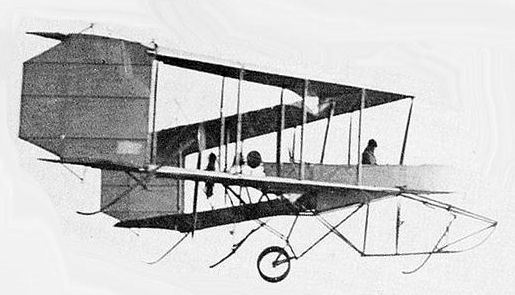
Captain Carden, who had but one hand, used this machine to gain his Royal Aero Club Aviator’s Certificate in June 1912. In August 1913 the aircraft was flown from Eastchurch in Kent to Paris, France for tests by the French Aeronautic Corps, during which Commandant Felix of the Nieuport company astonished crowds at a Deauville flying meeting by stepping from the cockpit and walking along the aircraft’s lower wing in flight.
Three Dunne tailless biplanes were built by the Burgess Company of Marblehead, Massachusetts in 1916 and evaluated by the US Army, but by then Dunne had been advised by his doctors to give up aviation, which he did.
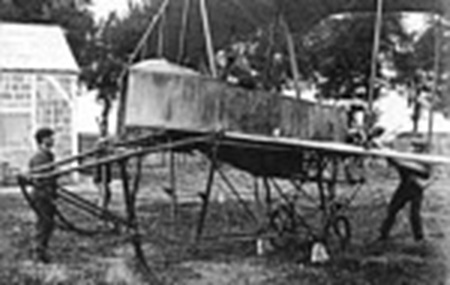
Engine: 60 hp, Green.
Span 46 ft
Length 30 ft. 4 in
Wing chord 6 ft
Weight empty about 1,400 lb
Weight loaded 1,900 lb
Max. speed 55 mph.
 All Aero