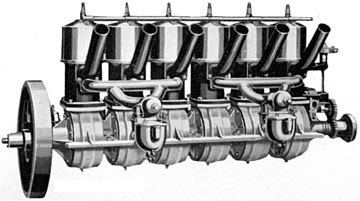
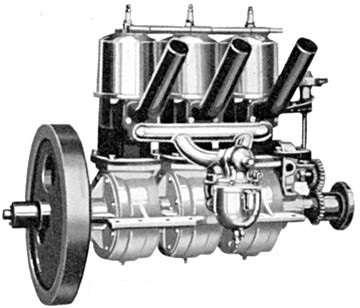
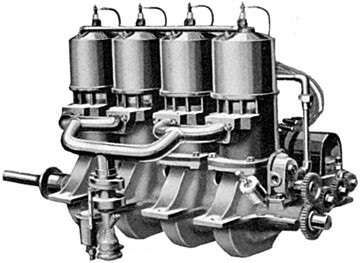
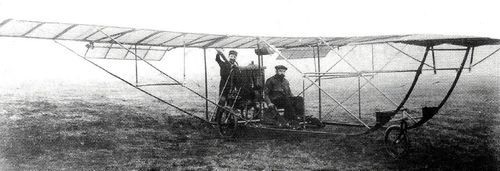
Jacob Christian Ellehammer was first apprenticed as a watchmaker, he then qualified as an electrical engineer; he made one of the earliest motor-cycles built in Denmark, and also designed his own internal combustion engines. His 3-cylinder piston engine of 1903 was perhaps the world’s first radial engine, and his experiments in aviation, started two years later, embraced monoplanes, biplanes, triplanes, flying boats and helicopters.
After the 1912 helicopter, Ellehammer then put aside his helicopter experiments until about 1930, when he began to evolve some new projects. One of these was, in effect, a parasol monoplane in whose wings was a huge circular cut-out with two contra-rotating rotors turning inside it. Even more novel was a proposal in the mid-1930s for a helicopter driven by compressed air. As with the previous project, only a working model was built, powered by a vacuum cleaner motor. In the full-sized aircraft Ellehammer proposed to have a radial engine driving a powerful air compressor. A substantial pylon over the fuselage was topped by a metal disc, made to rotate by the reaction from expelling compressed air through slots in its underside. The centrifugal force of the rotating disc was sufficient to unsheath four spring-loaded rotor blades; when take-off had been accomplished, these were retracted back into the disc and the compressed air stream diverted to an efflux at the rear of the aircraft to give it forward movement.
 All Aero