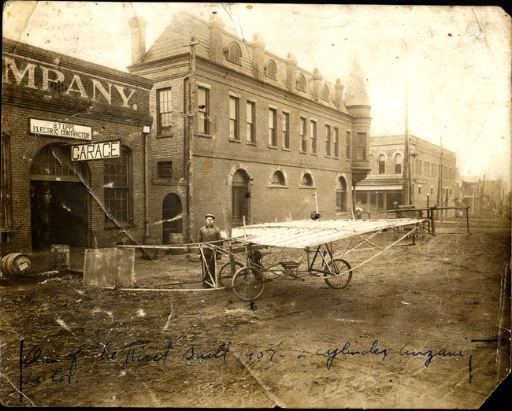
The early American Ben Epps Monoplane of 1907 was designed and built by Benjamin Thomas Epps in Athens, Georgia. This machine is quoted as being the first heavier-than-air aeroplane in history that flew south of the Mason-Dixon Line. Machine can be identified by its high wing monoplane construction, pilot seat construction under the wing, tricycle undercarriage, pusher construction.
Mr. Epps taught his growing family of children to fly, and Ben, Jr., the oldest son, soloed at age 13 in 1929. Eight of his nine children are or have been aviators and his six sons are all engaged in various phases of aviation. Ben Epps was critically injured in a crash at Athens in 1935 and in 1937 he was fatally injured in a take-off crash at the Athens airport, which is now named in his honor.
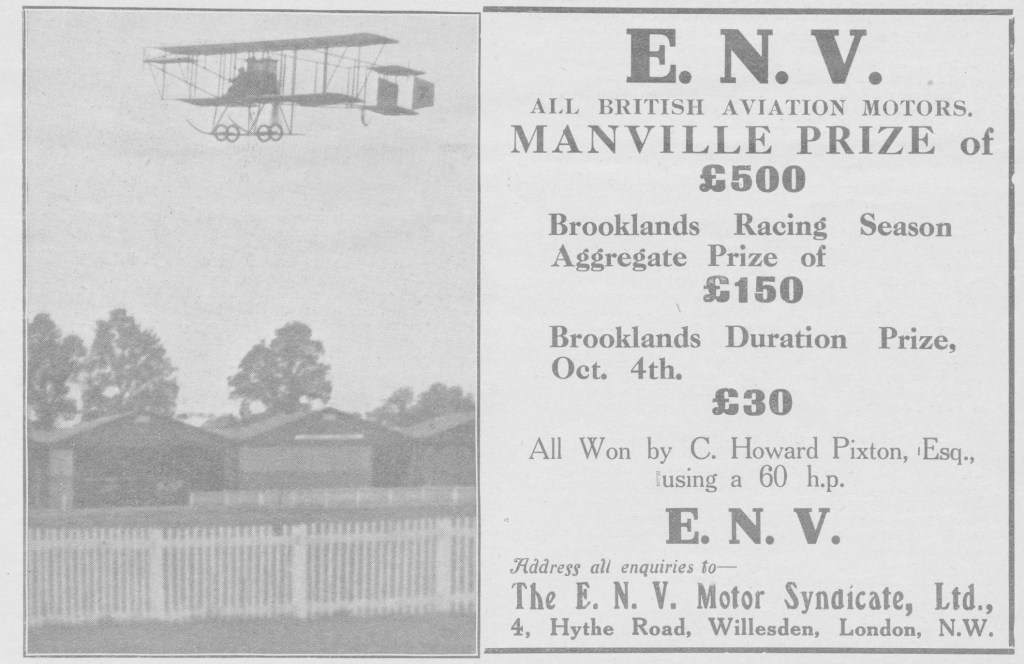
The three horizontally opposed, four-cylinder, overhead-valve engines that appeared at aircraft shows between October 1909-10 were E.N.V.’s only departure from their standard 90° V8 layout. Technical details are rather sparse, but the 1909 engine had steel cylinders and combined inlet/exhaust valves. The 30 hp 1910 engine had separate steel cylinder heads and barrels, screwed and brazed together. Inlet and exhaust valves were also separated, placed respectively below and above the cylinders and worked by push/pull rods and rockers. Only one of these horizontal engines flew, powering the Neale monoplane of 1909-10 at Brooklands for a short time.
25/30 hp Year: 1909 Power: 24 hp @ 1,200 rpm Capacity: 4,100cc Bore×Stroke: 109×110mm Weight: 30kg Manufactured in France
H Year: 1910 Power: 30 hp @ 1,200 rpm Capacity: 2,300cc Bore×Stroke: 90×90mm Weight: 40 kg bare
30 hp Year: 1910 Power: 30 hp Capacity: 3,050cc Bore×Stroke: 80×120mm Weight: 60kg
ENV engine installation in the Cody Mark IC Cathedral
E.N.V.’s V-8 engines appeared in six different models. Most of these were identified by a letter, though contemporary sources often refer to them by power. The assignment of the letters C, D, F and T is known from contemporary sources. The one type known to have pre-dated the C has been assigned the letter A by a later historian, a notation followed here. The last engine is usually known as the 1914 100 hp E.N.V.
The physical details of all the engines, such as bore and stroke etc. are known from both contemporary records and surviving examples. There were also variations within types, as development proceeded. Nonetheless, all the V-8s had much in common. They all had their cylinder banks separated by 90°, leaving space within the V for inlet manifolds and valvegear. All were water-cooled; each cylinder was enclosed with an electrolytically formed copper jacket. Initially these were produced with a variant of the lost wax process. The cylinders were coated with wax, which was then coated with black lead to make it electrically conductive and copper plated. Afterwards the wax was removed by heating. Later, the insulating wax was replaced with electrically conducting, low melting point white metal, simplifying the process. Pistons were made of steel, with cast iron rings, and the crankcases were cast aluminium. There was one plug per cylinder, supplied by a gear-driven magneto alone or with an additional battery-driven ignition coil and distributor for dual ignition.
The types A, C, D and F were all side-valve engines, with valves operated by push rods running exposed and parallel to the cylinder axes, driven within the V from a central, gear-driven camshaft above the crankshaft. All camshafts were hollow for lubrication. The cylinder cooling jackets surrounded the cylinders, then turned inward with flattened faces for inlet and exhaust manifolds and push rods. The exhaust stubs were vertical, each bank of cylinders feeding its own horizontal pipe. The inlet stubs entered the cylinder head at right angles. The earliest type A engines had a pair of inlet tubes, one for each bank and fed from a carburettor at the front.
Slightly later model As and types C and F placed the carburettor between the cylinder banks, halfway along the engine axis. Fuel and air was passed to a spherical copper mixing chamber above the carburettor, then via four radial copper tubes which finally branched into pairs the feed the inlet ports symmetrically. The smaller type D retained the end positioned carburettor. These engines all had cast iron cylinders. The types A and C were very similar in construction as well as capacity, but a major change in crankshaft design was introduced with the smaller type D and inherited by the F. The A and C types had a crankshaft supported by only three plain bearings and the width of the central one required a greater space between the second and third cylinder of each bank, visibly dividing each into blocks of two. The crankshafts of the D and F types had five ball race bearings, one between each cylinder and two end bearings; the output thrust bearing was a double race to allow for pusher or tractor configurations. The new bearing arrangement permitted an equal cylinder spacing. The type FA was a type F with an extended crankshaft, mounted in a very prominent, conical crankcase extension. The type T, discussed below, had a similar extension, which in that case at least allowed a larger diameter thrust bearing to be used.
Though heavy, the E.N.V. models A and C provided some of the earliest European fliers with a relatively powerful engine. Some Voisin biplanes used them between 1908 and 1910 and S.F. Cody fitted his first pusher biplane with a type C in the second half of 1909. His second aircraft also used that engine in the autumn of 1910. The types D and F had significantly better power-to-weight ratios than the first two models and become E.N.V.’s most popular products, being widely used in 1910 and 1911. After that they were eclipsed by the new, light rotary engines.
November 1911
The last two V8’s, the T and the 100 hp were not successful. Though tested, they never flew. The type T introduced steel cylinders and was an overhead-valve engine with vertically mounted valves operated from a central camshaft by thin pull rods and rockers. The carburettor was mounted centrally at the front, feeding a central tube which ran to the back of the engine, divided and ran back along each cylinder bank. Dual magneto/coil and battery ignition was provided. The 100 hp engine was also an overhead-valve engine in the sense that the port opened directly into the cylinder head, though the valves were mounted horizontally. This arrangement required an unusual shape of combustion chamber but enabled the valves to be operated directly from a central crankshaft raised on pillars to cylinder head height. Vibrations of this crankshaft and weakness of a new cylinder head restraint system dogged the engine, the last E.N.V. made.
A Type: 90° V-8 Year: 1908 Power: 50 hp @ 1,000 rpm Maximum Power: 60 hp Valve configuration: side Capacity: 8,171cc Bore×Stroke: 100×130mm Weight: 200kg Manufactured in France
C Type: 90° V-8 Year: 1908-9 Power: 65 hp @ 1,180 rpm Maximum Power: 90 hp for 15 min claimed Valve configuration: side Capacity: 8,171cc Bore×Stroke: 100×130mm Weight: 170kg Manufactured in France
D Type: 90° V-8 Year: 1909-10 Power: 30 hp @ 1,000 rpm Maximum Power: 40 hp @ 1,400 rpm Valve configuration: side Capacity: 4,087cc Bore×Stroke: 85×90mm Weight: 70kg Manufactured in France & UK
F Type: 90° V-8 Year: 1909-11 Power: 59 hp @ 1,000 rpm Maximum Power: 88 hp @ 1,500 rpm Valve configuration: side Capacity: 7,623cc Bore×Stroke: 105×110mm Weight: kg Manufactured in France & UK
FA Type: 90° V-8 Year: 1909-11 Power: 59 hp @ 1,000 rpm Maximum Power: 88 hp @ 1,500 rpm Valve configuration: side Capacity: 7,623cc Bore×Stroke: 105×110mm Weight: kg Manufactured in France
E.N.V. was an early manufacturer of aircraft engines, originally called the London and Parisian Motor Company their first model appearing in 1908. E.N.V. engines were used by several pioneer aircraft builders and were produced in both France and the UK until about 1914.
The London and Parisian Motor Co. was an Anglo-French venture registered in London in 1908 and largely backed with British capital and expertise. The castings and forgings for its engines were made in Sheffield where the company was originally based, then taken to France for assembly. The reason for this was that there was much more aeronautical activity in France than in England in 1908, but the French were taxing imported machinery. The French works were in Courbevoie in the Paris suburbs. By 1909 there was more aviation activity in England and E.N.V. decided to begin full manufacture at home, at Willesden, London. At that time a separate company was formed to produce the aero-engines in Willesden, The E.N.V. Motor Syndicate Ltd. E.N.V. was a contraction of French phrase “en-V” (“in a V”), which was a common name at the time for a V-engine. Most of their engines were 90° V-8s — the idea for the V8 engine itself originated with French engineer Leon Levavasseur in 1902. All of E.N.V.’s V8 engines were water-cooled inline engines. The first two models were powerful but heavy, while the later “D” and “F” types were lighter yet reliable, with power ratings of 37 hp (26 kW) and 74 hp (51 kW) respectively. These were widely used from 1909 in both Britain and France; in England well known pioneers like S.F. Cody, A.V. Roe, Claude Grahame-White, Moore-Brabazon and T.O.M. Sopwith used them.
In France, pioneers such as Henri Rougier, Pierre de Caters, Arthur Duray and Rene Metrot won prizes flying E.N.V. powered Voisin aircraft, and other French manufacturers like Farman and Antoinette used E.N.V.s in some of their machines. After about mid-1911, these water-cooled inline engines began to fall out of favour, superseded by the much lighter air-cooled radial engines from Anzani and in particular by the high-performing newcomer, the rotary engine, introduced by the Gnome et Rhône company. A good power-to-weight ratio was rather less critical for use in airship installations, and several used E.N.V. engines. The 100 hp (75 kW) V-8 submitted to the Naval and Military Aero Engine Contest of 1914 proved to have serious design flaws and as a result of its failure E.N.V withdrew from engine production.
E.N.V. Motors was incorporated on 30 May 1919 which then acquired on 3 June 1919 the engineering business of Joseph Frederick Laycock who traded under the name of E.N.V. Motor Company at Willesden. The property and assets were acquired for £45,000 and new company invested in new plant and machinery including building a new factory for manufacturing of gearboxes and camshafts for engines and in particular spiral bevel gears. In 1928 the company changed name to E.N.V. Engineering Company Limited.
The company continued successful production of bevel gears and camshafts for another 50 years; it produced individual components for several World War I aircraft and tank engines, and after the war built complete gearboxes for the automobile industry. In 1964 it became part of the Eaton, Yale and Towne group, losing its identity in 1968.
Production records have been lost, but probably 100-200 E.N.V. engines were made.
Though this company became part of British Aircraft Corporation in 1960, its origins date back to 1911 at its Coventry Works (Coventry Ordnance Works Ltd.), where quantity production of other manufacturers’ designs was undertaken during First World War. After the Armistice development centered on the Kingston flying-boats, following the lines of the Cork, a product of the Phoenix Dynamo Manufacturing Company Ltd., which was then also part of English Electric. Original features manifest in Ayr flying-boat and Wren ultralight monoplane (1923), but aircraft work ceased in the mid-1920s. In 1938 it was resumed, with contracts for the Handley Page Hampden (followed by the Halifax). In May 1944 an order was placed for de Havilland Vampire jet fighters. Over 1,000 Vampires built before production got under way on company’s own Canberra, the first British jet bomber and the first to serve with the RAF. Canberra production continued for ten years, totaling over 1,300 examples, including 403 license-built Martin B-57s for the USAF. Numerous variants developed, notably for reconnaissance; other countries using the type included Ecuador, France, Peru, Rhodesia, Sweden, and Venezuela. Many records broken (e.g. London-Cape Town December 1953). Lightning twin-jet single-seat fighter of 1952 was RAF’s first supersonic fighter (in level flight); entered service December 1959. Much development of this type was undertaken by British Aircraft Corporation, but two-seat version emanated from English Electric. British Aircraft Corporation was formed out of Bristol, English Electric, Vickers-Armstrong and Hunting Aircraft Ltd, in 1960.
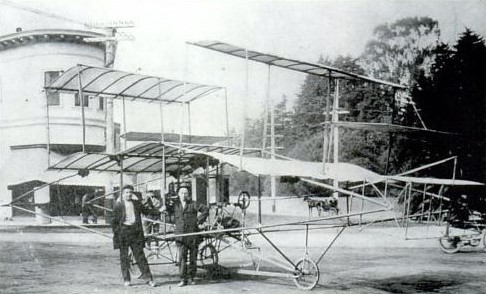
A design of father and son English who built this design – variously named helicopter, helicopter-monoplane or heliocopter in contemporary reports. Construction took place in guarded secrecy in a shed in Fruitville near Oakland from 1910.
The two propellers (today it would be ‘rotors’) were in the front of the machine, diameter 20 feet, and were of an adjustable type. Power was provided by an engine of 8 cylinders producing 75 hp. The curved planes (‘wings’) with a total of 800 sq. ft were intended for soaring the machine.
The idea was to make a straight ascent by use of the propellers and then travel at will by soaring. The whole construction was extremely expensive at least $ 10.000 were outlaid to build it.
In 1906, it was towed through 24th and Harrison streets in Oakland.
Aeronautics Vol. 5 (1909) 1 (July) p.30 The English helicopter met with disaster in a test for lift. It became unfastened from the floor, and the lift testing mechanism in its shed and the helices were wrecked against the rafters. It has never been tried in the open or free flight.

 All Aero