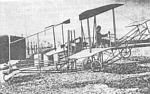
The 1911 Faccioli No. 4 was designed and built by Aristide Faccioli (the first technical director of Fiat).
Span: 26’3″
Length: 26’3″
Weight: 550 lb
The 1911 Faccioli No. 4 was designed and built by Aristide Faccioli (the first technical director of Fiat).
Span: 26’3″
Length: 26’3″
Weight: 550 lb
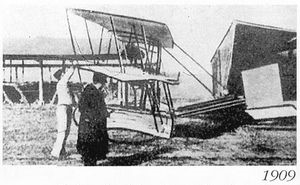
A triplane built by Aristide Faccioli in 1909.
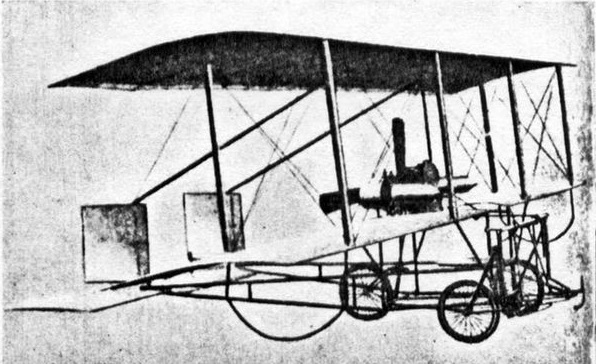
1909 SPA-Faccioli biplane, powered by a 20 hp Faccioli motor. Piloted by its designer Aristide Faccioli, in December 1909 at Turin, Italy, this machine became the world’s 15th aeroplane to make a successful controllable flight.
Designed and built by Aristide Faccioli, he was the first Italian to design and built an aircraft and its engine.
Span: 22′
Length: 11’6″
Weight: 400 lb
Aristide Faccioli produced four aircraft designs during the years 1909-1910, built by his own firm Società Piemontese Automobili.
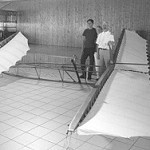
This plane was built in 1909 by the famous Henri Fabre for his cousin Augustin Seguin, who had previously built an unsuccessful glider. The few tests carried out proved that the wing surface of 10 square metres was insufficient for sustaining someone in the air. It was dismantled and stored until it was rediscovered in 1994. It’s now preserved at the Château de Varagnes near Annonay.
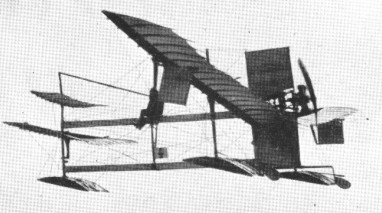
On 28 March 1910, this aircraft built by Henri Fabre made the first successful seaplane flight at Martigues, France. A float equipped aircraft named ‘Le Canard’.

The three-float, Gnôme-powered plane featured a fuselage consisting of two vertically spaced members, and trussed wing spars.
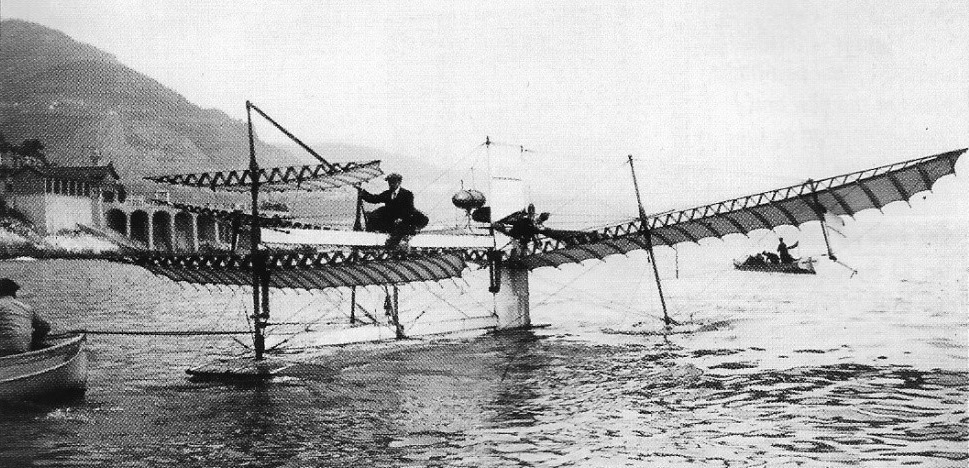
Engine: Gnome 7, 50hp
Span: 45’11” / 14 m
Length: 27’10” / 8.50 m
Height: 12 ft 2 in / 3.70 m
Wing area: 182.99 sq.ft / 17.00 sq.m
Weight gross: 1047 lb / 475 kg
Speed: 55 mph / 89 kph
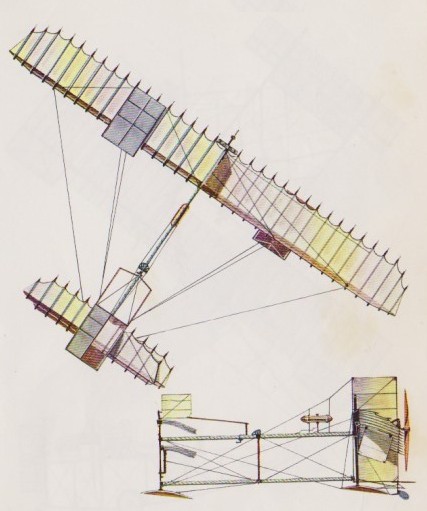

Henri Fabre (born in Marseille (Bouches-du-Rhône) on 29 November 1882 and died on 29 June 1984 in Touvet (Isère), at the age of 101) is a French engineer and aviator. He was the inventor in 1910 of the hydroplane (first named hydro-airplane, until 1913).

The Ezekiel Airship of 1902.
In the early 1900s Excelsior produced 15-30 hp motorcycle engine convesions.

One of the earliest British tractor monoplanes, designed in 1908 by E. I. Everett and constructed by Everett Edgcumbe and Co. Ltd., of Colindale. The machine was powered by a four-cylinder 35 h.p. J. A.P. engine which drove a 6 ft. diameter propeller. The framework was of wood with fabric covering overall; the flying surfaces were double-covered. Warping was used for lateral control, and this was operated by turning the hand-wheel on the control column, the fore-and-aft movement of which actuated the elevators. The engine was water-cooled, its radiator being carried at an angle under the nose of the fuselage.

Tests were carried out in a field at Colindale which was to become part of the London Aerodrome at Hendon. The plane was nicknamed “The Grasshopper”, as it failed to fly properly and succeeded only in making hops from the ground during trials made on 6th and 7th December, 1910, by Bernard Clutterbuck and again during January, 1911, by E. I. Everett. [The machine has been incorrectly identified as the Prosper monoplane (Canada, 1909)]
Span: 25′
Length: 16′
Speed: 30 mph
 All Aero