Voison-Farman 1

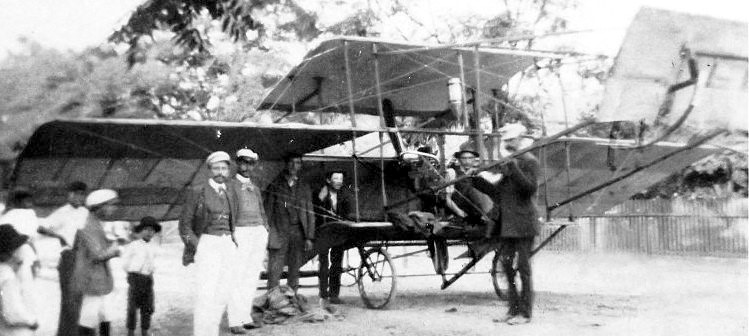
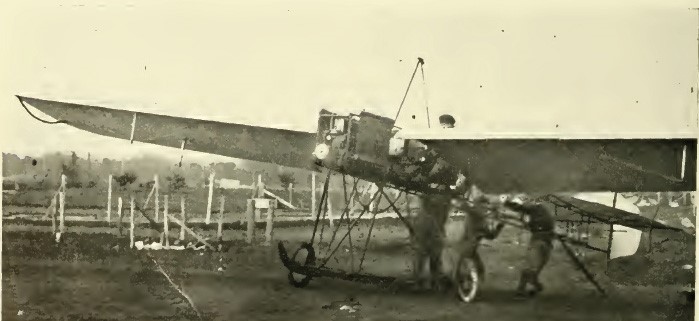
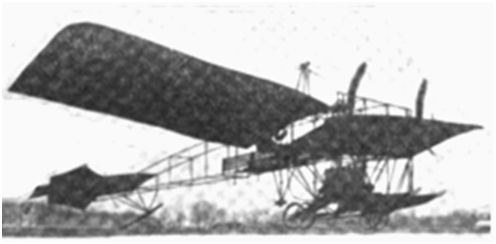
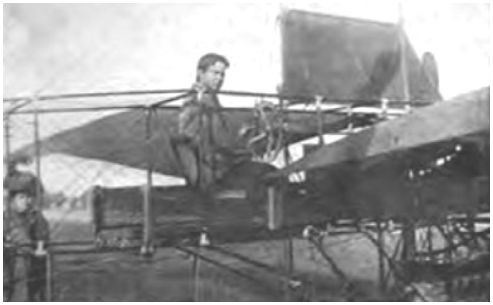
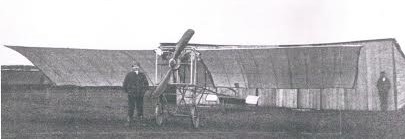
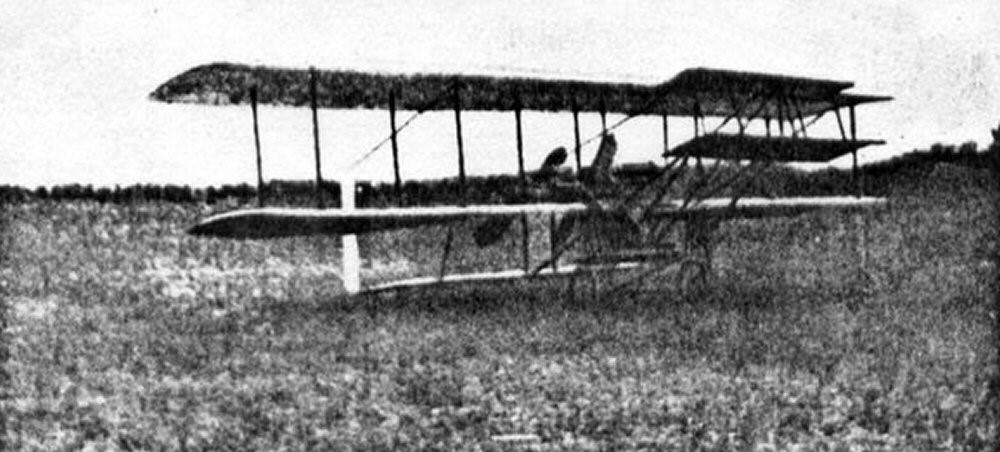
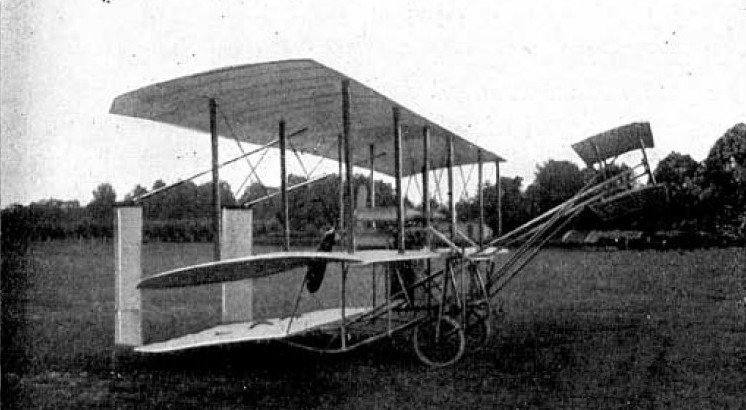
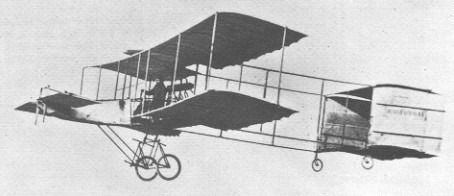
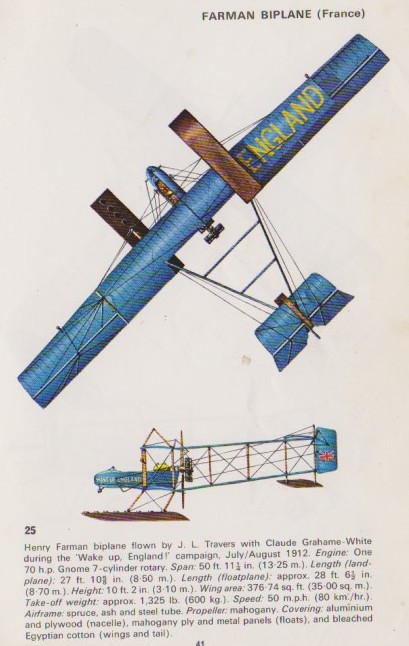
Two identical pusher biplane machines, with Antoinette engines, had been built by the Voisin brothers for two early aviation pioneers, one for Léon Delagrange in March 1907, and the second for his friend and rival the Anglo-French pioneer Henry Farman (1874-1958) in October 1907. The latter biplane became known as the Voisin-Farman I and Farman made a number of modifications of his own during the autumn of that year. Thus, the Voisin-Farman 1 became the Voisin-Farman 1bis; it was flown by Farman on 13 January 1908 to win the Archdeacon’s Grand Prix d’Aviation prize for making the successful first one-kilometer closed-circuit flight.

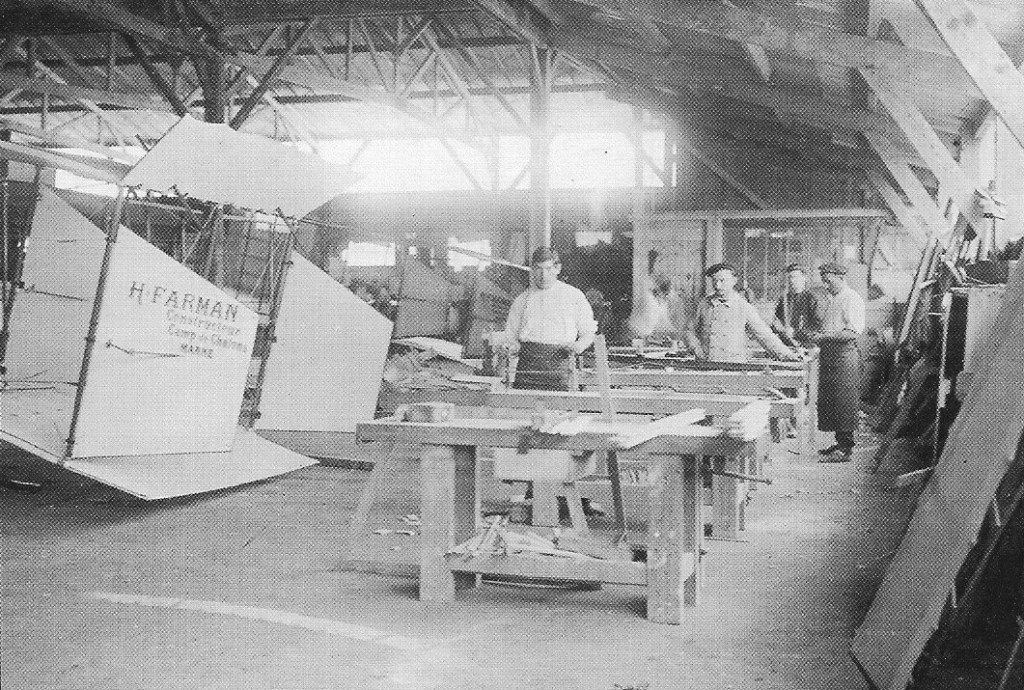
Built for Farman by Voisin Frères, Charles and Gabriel – often referred to as the Voisin-Farman 1 or Voisin HF-1 – yet sometimes called the Farman HF-1, since after delivery from the Voisin Factory, Henry Farman made significant modifications to the machine. This Voisin-built Farman had no ailerons and no wing warping, the only thing to do was to fly a very steady level turn.

In this form it became the first aeroplane, after the Wright Flyer No. 2, 1904, to remain airborne for over a minute and turn a complete circle. The latter flight, made on 13th January, 1908, won Farman the Deutsch Archdeacon prize of 50,000 francs for completing the first official circle of one kilometre in diameter.
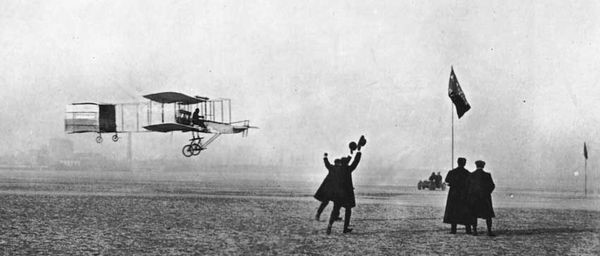
The photograph shows Farman at the moment he crosses the start/finish line at Issy-les-Moulineaux in completing, on January 13, 1908, the first 1 km circuitous flight, thus winning the Grand Prix d’Aviation that had been offered by Henri Deutsch de la Meurthe. Although the two points (start and return) were exactly at 500 m distance, Farman was unable to fly the aeroplane in that way. Observers in the photo from left to right are: René Demanest, André Fournier, Louis Blériot (commissaire au départ et à l’arrivée) and Charles Voisin. In the car are Ernest Archdeacon (one of the prize sponsors) and his wife.
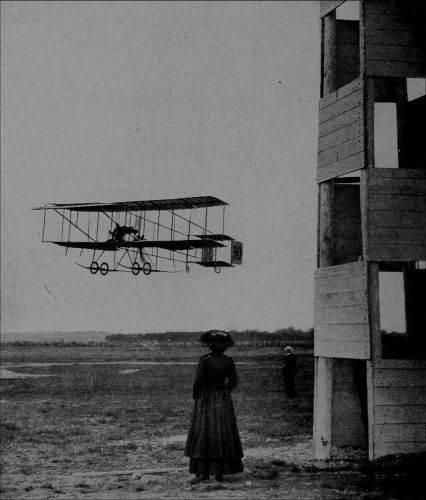
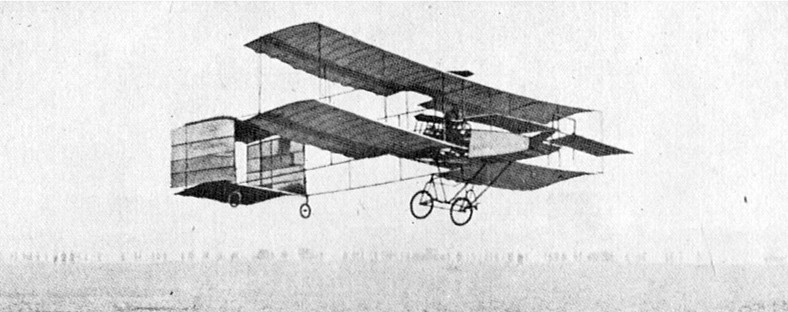
The Champagne Grand Prize Won by Henry Farman – 80 Kilometre’s in 3 hours

Farman had modified hid Voisin machine in January-February 1908 and with it made flights of nearly 45 minutes duration.
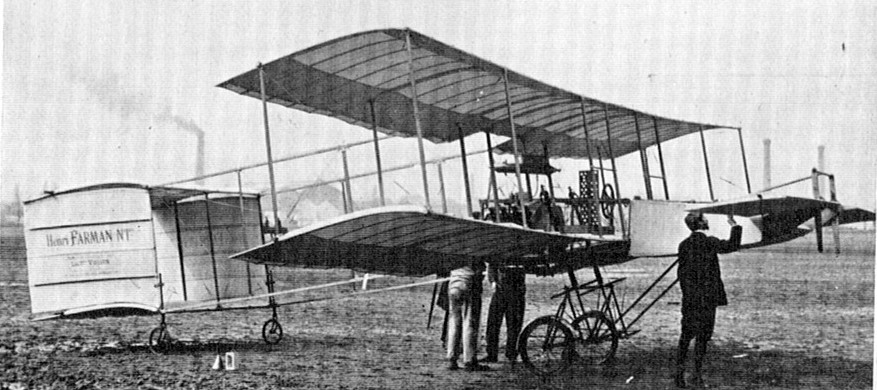
Farman again modified his Voisin in October 1908 as the Voisin-Farman I-bis, making it the first European machine to incorporate successful ailerons.

Gallery

Engine: One 50 h.p. Antoinette.
Wing span: 33 ft. (10.2 m.)
Wing area: 49.8 sq.m / 525 sq.ft
Length: 10.41 m / 34 ft
Weight empty: 1145 lb (520 kg.)
Weight gross: 1280 lb
Speed 40 mph (64 km.p.h.)
Range 1,640 yds. (1,500 m.)
Seats: 1
Farman

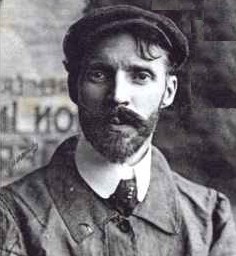
Henri Farman

On November 9,1907 Henri Farman, in aVoisin-50 Antoinette biplane, made the first powered flight in Europe to last over a minute. At a 1909 Reims meeting he flew his own Farman III, the first aircraft with effective ailerons. Brother Maurice was also a designer; the two formed Avions Henri et Maurice

Farman Brothers Article

Maurice Farman designed the MF-7 Longhorn (1913) and MF-11 Shorthorn (1914), both used as trainer and observation aircraft by the Allied forces. Farman F.20 and F.40 developed, the latter with streamlined two-seat nacelle and powered by 135hp Renault engine. Farman F.50 night bomber followed; four-engined F.140 night bomber introduced 1925, replaced by F.221 and F.222 in 1937, the latter used subsequently by Vichy air force after June 1940 as a transport. Civil airliners included the F.60 Goliath. Twin-engined F.180 biplane, F.190 single-engined monoplane introduced 1928, three-engined F.300 in 1930.

The French aircraft manufacturer Socété des Avions H. M. et D. Farman, with factories at Billancourt (Seine), began aircraft engine design and manufacture aimed at civil aviation shortly after WWI.

In France, the Socialist Government of the so called Popular Front brought all the companies building military aircraft, aero engines and armament under its control in 1936. The immediate result was the socialized oblivion of such established companies as Marcel Bloch, Bleriot, Nieuport, Potez, Dewoitine, Hanriot and Farman within half a dozen nationalized groups or Societies Nationales, named according to their geographical location (Nord, Ouest, Centre, Midi and so on). Hanriot joined Farman at Billancourt in 1936, eventually nationalized in 1937, to become SNCA du Centre.

Farman becoming part of SNCAC.
After nationalization, in 1939 the Farman brothers acquired the license to manufacture the Stampe SV.4 trainer biplane. Although SNCAC was assigned manufacturing rights postwar, Farman retained license and with Jean Stampe the Societe Anonyme des Usines Farman developed Monitor I monoplane powered by 140 hp Renault engine. Variants included the II, III and IV, the latter being taken over by Stampe et Renard, Brussels.

Faludi III

Károly Faludi (1872-1974), more known as an actor and singer later in his life, built two airplanes, powered by a 25 hp three-cylinder engine. One was a monoplane and one was a biplane, both with a raised central wing surface. They both crashed at their first test flights in Nagikanizsa in southwest Hungary, the first in the summer and second in October of 1910.

The 1909 Faludy III biplane was designed and built by Karoly Faludy in Hungary.

Span: 25’7″
Length: 22’8″

Fairey

Founded by C R. (later Sir Richard) Fairey, initially to build 12 Short 827 seaplanes. Leased premises at Hayes, Middlesex, replaced by new factory 1917-1918. Became a public company March 5,1929 and the following year opened new airfield at Harmondsworth, later requisitioned and incorporated in site for London’s Heathrow Airport. Reorganized as holding company The Fairey Company Ltd. March 31,1959, aircraft manufacturing subsidiary becoming Fairey Aviation Ltd. and the Stockport plant Fairey Engineering Ltd. Fairey Aviation Ltd. merged with Westland Aircraft Ltd. in 1960. Britten-Norman (Bembridge) Ltd. acquired 1972. Fairey group into liquidation 1977; engineering activities acquired by National Enterprise Board; Britten-Norman operated by liquidator pending sale.

Richard Fairey Article

Company designs included F.2 twin-engined biplane fighter; camber-changing trailing-edge flaps introduced on Hamble Baby. Fairey III series introduced 1917; final model IIIF entered production 1926 and declared obsolete 1940. Fairey Hendon (1930) was the first British cantilever monoplane heavy bomber; Long-range Monoplane captured absolute distance record for Britain 1933. The famous Fairey Swordfish (“Stringbag”) torpedo bomber entered production in 1936; 2,392 were built by Fairey and Blackburn; it was the only biplane to remain in service throughout Second World War. Other famous aircraft included Battle light bomber, Fulmar fleet fighter, and Barracuda dive-bomber. Firefly name revived for Rolls-Royce Griffon-powered monoplane which entered FAA service in 1943, serving in Korea in 1950. First FAA aircraft to combine search and strike roles was the Gannet with Double Mamba coupled turbines; developed Gyrodyne convertible helicopter 1946; Jet Gyrodyne 1953; Rotodyne compound helicopter airliner 1957. Fairey Delta 2 research aircraft set world air speed record of 1,822km/h on March 10, 1956.

Sir Richard Fairey died at the end of 1956

Britten-Norman became Fairey Britten-Norman in 1974.
Faiery Aviation joined Westland in 1961.

Fairchild II

A mid-wing monoplane of mainly conventional configuration, entirely of steel construction and characterized by the vertical radiators on each side of the 100 hp six-cylinder two-stroke Emerson engine. It was the design of Walter L. Fairchild of Mineola and flew for the first time on May 11, 1911 with Auguste Denis as pilot.

Fairchild 1910 monoplane

A monoplane built by Walter L. Fairchild with twin tractor propellers chain-driven by a six-cylinder 100-125 hp, two-cycle Emerson engine set on platform on undercarriage. The fuselage was built of steel tubing, lightness and strength achieved by careful use of different sizes and thicknesses of tubes, the strength of each part and portion calculated in detail. All the tubes of the frame where especial strength was thought advisable were stuffed with elm, giving them great strength. It was flown frequently, but crashed in February 1911.

Faccioli No. 2

On the 13th of January 1909, the first all-Italian aircraft, a triplane designed and built by Aristide Faccioli, took off from a field near the Mirafiori horse racing track. It was powered by a 4-cylinder water-cooled 75 hp engine, designed by Faccioli and built by S.P.A. (Società Piemontese Automobili), driving two offset contra-rotating propellers. It crashed when the tail hit the ground. The machine was rebuilt in May 1909 with the same engine, a biplane wing cellule and a very short tail with a low-mounted horizontal stabilizer. It made a few hops on the parade gound at Venaria Reale, but crashed before the Brescia air show and thus could not be presented there.